Monte-Carlo Masters Brand Guidelines
Clay terraces above the Riviera since 1928.
Aa
Two constants: a clay, cypress and sea palette and a Riviera serif register. Abstract homage — not a Monte-Carlo Masters asset; no logo, trophy or court graphic is reproduced.
From the Hôtel de Paris
A Riviera tournament that moved four times.
The Monte-Carlo Masters grew out of the winter tennis of the Riviera in the 1890s. Sources differ on its founding year. English Wikipedia, citing the Wimbledon librarian Alan Little, says the first Monte Carlo International was played in April 1896 and won in the men’s singles by George Whiteside Hillyard, and that the event became the Monte-Carlo Championships the following year; Hello Monaco, in a history published on 6 April 2026, also dates it to April 1896. French Wikipedia, Monaco Tribune and the Visit Monaco tourism site give 1897, Visit Monaco naming that first event the Monte-Carlo Tennis Championship.
The early tournament moved several times. The Monte-Carlo Country Club’s own history says the Lawn Tennis de Monte-Carlo, opened on 2 April 1893 on top of the cellars of the Hôtel de Paris. In 1905, it says, the Société des Bains de Mer (SBM) voted to move the club to the Condamine so the hotel could build an extension; later, with the town growing, the club moved again to three courts built on a garage roof in Beausoleil, opened on 28 January 1921 as the Festa Country Club.
That rooftop did not last. In 1925, the club’s history says, the American George Pierce Butler, an admirer of Suzanne Lenglen, felt the courts were unworthy of her and persuaded the sports authorities and the SBM to build a grander club. Prince Louis II backed new leisure building, and because space in Monaco was short the SBM bought land at Saint-Roman, in the French commune of Roquebrune-Cap-Martin, just over the border. French Wikipedia says the courts were opened on 27 February 1928 by the Duke of Connaught in the presence of Prince Louis II and renamed the Monte-Carlo Country Club that December.
English Wikipedia’s results tables show that the tournament was not held from 1940 to 1945, during the Second World War, and resumed in 1946; French Wikipedia says the club had been damaged in the war and that George Butler’s daughter, Gloria Butler, revived the event and helped pay for its repair. The club says she worked to promote it and organise the tournament into the 1970s.
Colour
Letrosne’s Art Deco terraces.
The setting is the core of the tournament’s look. The club says the architect Charles Letrosne designed it in an Art Deco style, with courts laid out on terraces cut into the hillside, two or three to each level, separated by borders of flowers and cypress trees, with the paths shaded by beams and arches. French Wikipedia adds that about twenty clay courts sit on several terraces reached by stairs, under pergolas covered with plants. The club says more than 1,500 workers built the terraces, and that the bar was finished in the style of the 1920s.
The show court is not permanent. French Wikipedia says the main court is surrounded by removable stands for the fortnight, in the manner of the Monaco Grand Prix, giving it about 10,200 seats; it has been named Court Rainier III since 2015, while the second court, the Court des Princes, holds about 3,000. A temporary railway halt near the courts is opened only for the tournament, by the same account. The Monte-Carlo Country Club says it welcomes more than 400 journalists and technical staff, 80 line judges and 80 ball kids for the event, and that it draws more than 150,000 spectators over nine days.
The competition itself has changed shape. English Wikipedia says the event was a combined men’s and women’s championship until 1982, when the women’s event ended, and that it became open to professionals in 1969. It then moved between circuits: part of the Grand Prix in 1971–72 and from 1978 to 1989, part of the Rothmans Spring Mediterranean Circuit in 1973 and of World Championship Tennis from 1974 to 1977. In 1990 it joined the ATP’s Championship Series Single Week, the category now called the Masters 1000. English Wikipedia says that since 2009 it has been the only Masters tournament without a mandatory commitment for top players. French Wikipedia gives a singles draw of 56 and a doubles draw of 24 teams.
For many years the club ran far more than two events. French Wikipedia says the men’s singles was once the Coupe de S.A.S. le Prince de Monaco, while doubles for pairs from the same country were played for the Butler Trophy and, for women, the Iliffe Trophy, alongside junior and veterans’ events that mostly ended soon after the open era began.
Typography
Category.
Professional tennis events present themselves through a small set of repeated elements: an event name, a logo, a trophy and a venue. Organisers publish these on their own websites, alongside pages on the event’s history, its past champions and the cities it has called home. Many tournaments have moved more than once, and their published histories often read as a list of venues and dates as much as a list of results.
Names change more often than places. A title sponsor’s name usually leads the event name, and when a partner changes, the name changes with it: the Miami tournament has carried the names of a tea company, a telecoms firm, a stock index and a bank since 1985, and the Indian Wells event has been named for an airline, a magazine, an insurer and a bank. Some events add a presenting partner after the main title rather than before it. Sanctioning bodies, such as the ATP, the WTA and the ITF, and the companies or federations that own each event are part of the record and are named here plainly.
Much of the visual identity sits on the site itself. Court colours are chosen for the event and sometimes explained by the surface supplier; signage around the court, scoreboards, branded balls and towels, and the uniforms of officials and ball kids carry the event and sponsor marks into broadcast pictures. Merchandise extends the same colours and logos to visitors.
This guide looks at those elements as organisers and independent sources describe them: names, owners, venues, sponsors and documented design choices. It leaves out results, scores and money, and treats each sponsor’s own identity as a separate subject.
Aa
A high-contrast Riviera serif, for terraces and pergolas. (Specimen set in Playfair Display, a serif STAND-IN; NOT the Monte-Carlo Masters logo.)
Club, organiser and title
A Monaco event on French soil.
The tournament carries Monaco’s name but is played in France. English Wikipedia places it in Roquebrune-Cap-Martin, which borders Monaco, and French Wikipedia puts the club about 200 metres from the Monegasque border. The Monte-Carlo Country Club says the event is organised by the S.M.E.T.T., the Société Monégasque pour l’Exploitation du Tournoi de Tennis. The club’s history says it has been led since 1972 by Princess Antoinette and then by her daughter and granddaughter, and that its current president also heads the Monegasque Tennis Federation.
The title sponsor is a watchmaker. French Wikipedia says the tournament has carried the name of Rolex since 2006, and it is presented as the Rolex Monte-Carlo Masters on the club’s site and in Monaco’s tourism listings.
Its visual material draws on place: the club’s own pages and the Visit Monaco listing both describe the clay courts, the hillside club and the view over the Mediterranean, and Visit Monaco ties a visit to the tournament to the rest of the Principality.
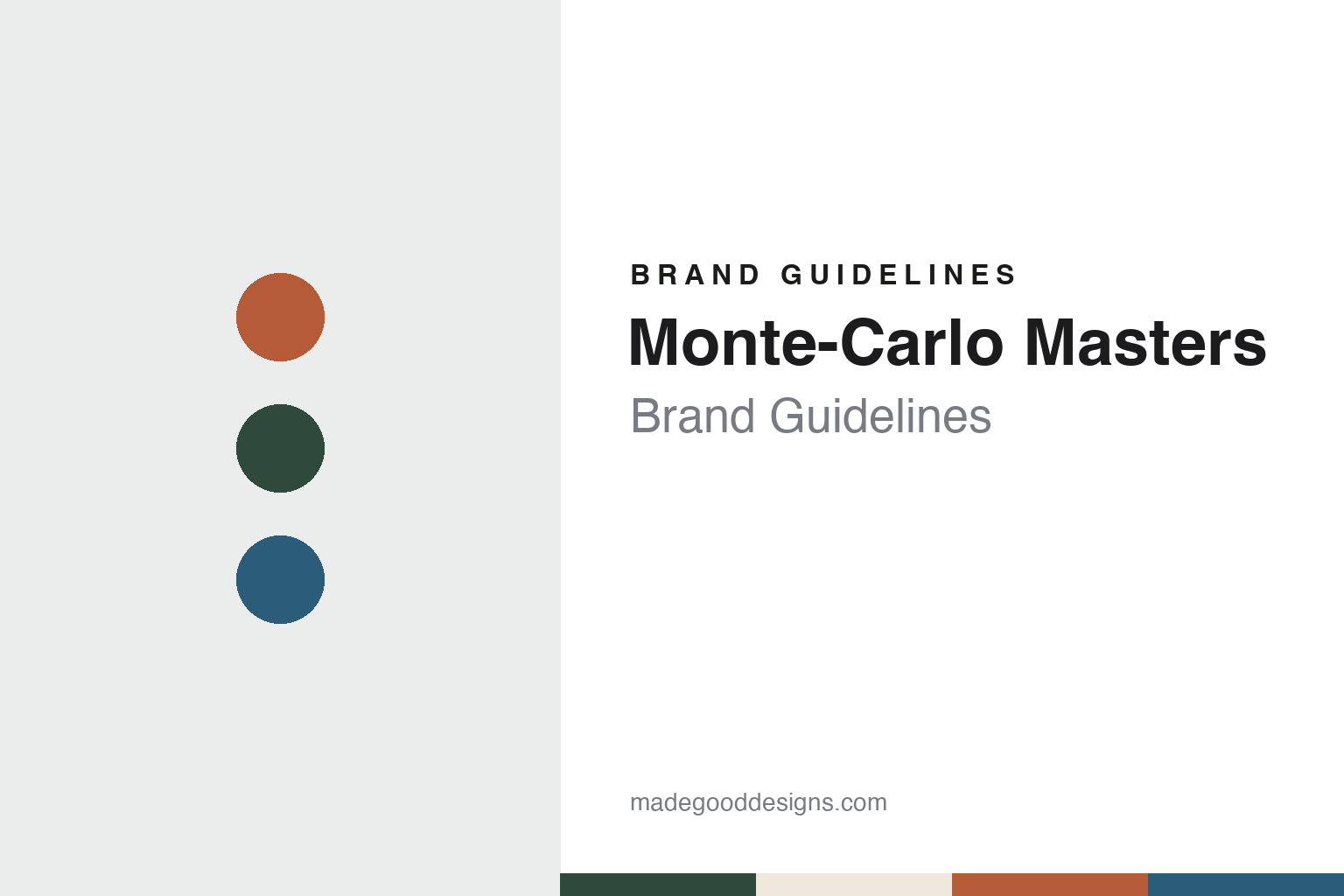
For a design guide, the Monte-Carlo Masters shows how an old club setting can carry a tournament through many names, circuits and sponsors: 1920s terraces, red clay and a temporary stadium raised each spring. Compare Rolex, its title sponsor since 2006, and the Mutua Madrid Open, which English Wikipedia describes as the second Masters event of the European clay swing. For this guide we use a clay red, a cypress green, a sea blue and a warm stone with a serif, an unofficial interpretation; no product or logo is reproduced.
Explore & save
Keep Monte-Carlo Masters’s identity on hand — save it to a board in the Made Good inspiration library.
Monte-Carlo Masters identity set
Pin the Monte-Carlo Masters clay, cypress and sea palette and the Riviera serif register to your own board.
Source & notes
Frequently Asked Questions
What font can I use to match the Monte-Carlo Masters look?
This guide describes Monte-Carlo Masters’ type as “A high-contrast Riviera serif, for terraces and pergolas”. Its type specimen is set in Playfair Display from Google Fonts as a stand-in; Playfair Display is not Monte-Carlo Masters’ own lettering.
What colours are in the Monte-Carlo Masters palette?
This guide’s Monte-Carlo Masters palette is Cypress green #2E4A3A, Ink #1A1C1A, Riviera clay #B65B37, Mediterranean #2B5D7B and Terrace stone #EFE8DB. The tones are the guide’s own unofficial interpretation, not official Monte-Carlo Masters hex codes.