Laver Cup Brand Guidelines
Two teams, one black court and a silver trophy that tells a career.
Aa
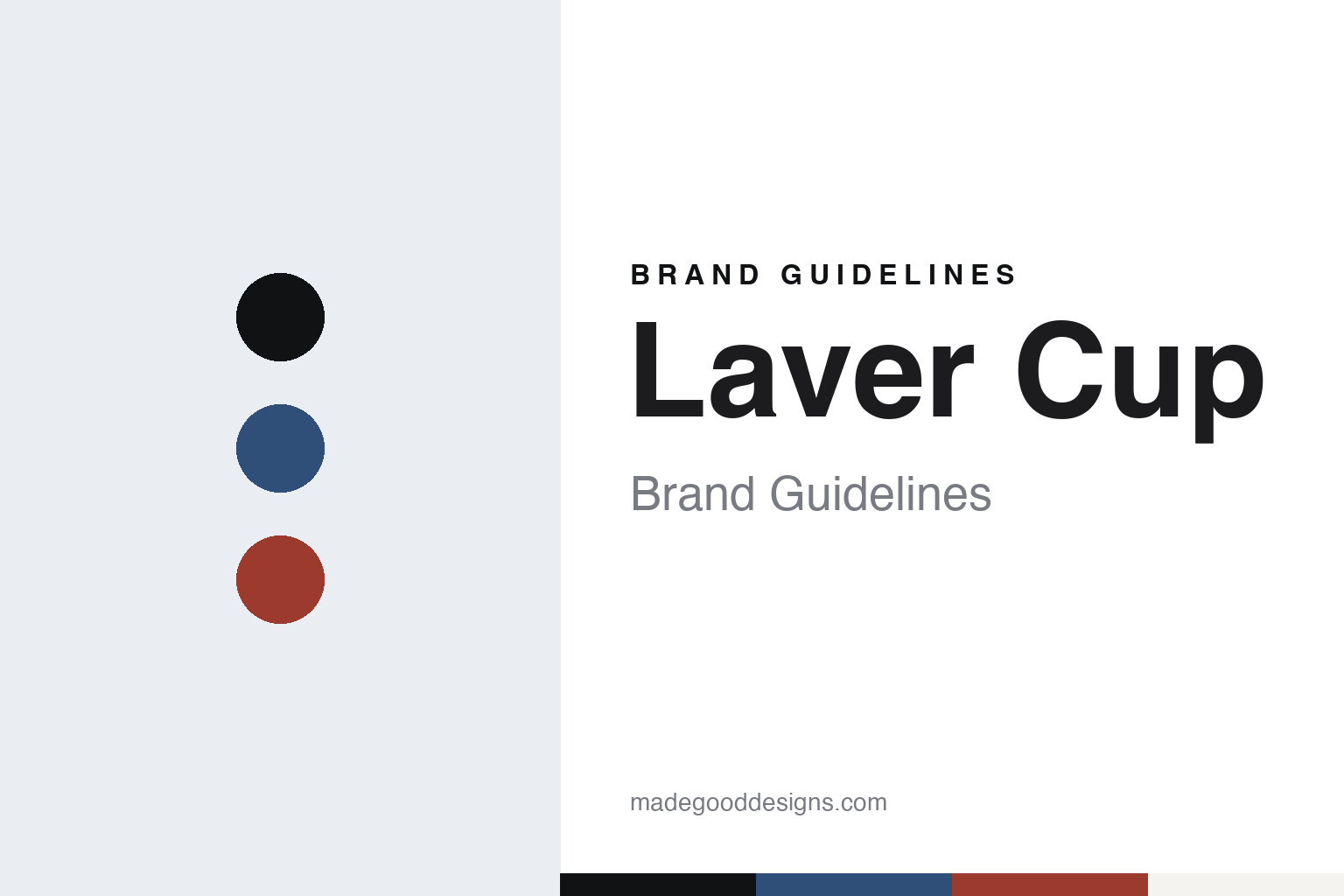
Two constants: an arena black, steel blue and brick palette and an arena sans register. Abstract homage — not a Laver Cup asset; no logo, trophy or team mark is reproduced.
Europe against the world
A team event named after Rod Laver.
The Laver Cup is a men’s team tennis competition in which Team Europe, six players from Europe, meets Team World, six players from the rest of the world, over three days indoors on a hard court. It has been held each September since 2017, usually about two weeks after the US Open, and moves between host cities, alternating between Europe and the rest of the world, according to English Wikipedia and the organisers.
The event is named after the Australian player Rod Laver, who won all four major titles in one calendar year in 1962 and again in 1969. The organisers say it grew out of Roger Federer’s idea for an event to honour Laver and the contemporaries who built the professional game, and that it was inspired by golf’s Ryder Cup.
It was created by TEAM8, the management company in which the 2019 ATP announcement described Federer as a partner, together with Tennis Australia and the Brazilian businessman Jorge Paulo Lemann. The Italian tennis site Ubitennis reported on 9 September 2016 that the organisers had announced, at a press conference at Flushing Meadows, a partnership with the United States Tennis Association (USTA), under which the 2018 edition would be played in the United States.
A USTA release of 2018 described the Laver Cup as a joint initiative of TEAM8, Tennis Australia, the USTA and Lemann, with Rolex as founding partner. The copyright line on the organisers’ website names TRIDENT8, doing business as Laver Cup, and in 2024 the organisers named Tony Godsick, chief executive of TEAM8, as chairman of the Laver Cup.
Colour
Prague, Chicago, Geneva and onward.
The opening edition was played at the O2 Arena in Prague from 22 to 24 September 2017, the dates Ubitennis had reported a year earlier. Chicago’s United Center followed in 2018 and the Palexpo in Geneva in 2019. The organisers had first scheduled three consecutive editions with the Olympic year off, then said in 2018 that the event would be held every year from 2020, according to a USTA release. In April 2020 the Boston edition was moved to 2021, and it took place at TD Garden in September 2021.
Later editions went to the O2 in London in 2022, Rogers Arena in Vancouver in 2023, Uber Arena in Berlin in 2024, Chase Center in San Francisco in 2025 and the O2 in London again from 25 to 27 September 2026, Wikipedia records. The pattern of large indoor arenas in cities that do not usually stage an ATP Tour event is part of the format, the same account says.
On 24 May 2019 the ATP and the Laver Cup announced that the event would become an official part of the ATP Tour calendar, giving it access to ATP marketing and social media and to officials and physios, according to the joint announcement. In September 2024, as the Berlin edition opened, the two announced a five-year extension of the certification agreement that had begun with the 2019 event.
The scoring is its own. Each team has a captain; three of the six players qualify on their ATP singles ranking on the Monday after the French Open in June, and three are captain’s picks named by the start of the US Open, Wikipedia says. Twelve matches are played over three days, nine singles and three doubles. A win is worth one point on the first day, two on the second and three on the third, and the side that reaches 13 points takes the trophy, so the result can only be settled on the final day. Matches are played over two sets, with a 10-point match tiebreak at one set all; if the teams finish level at 12, a deciding one-set match, called “The Decider,” is played on the last day.
Typography
How tennis events present themselves.
Professional tennis events present themselves through a small set of repeated elements: an event name, a logo, a trophy and a venue. Organisers publish these on their own websites, alongside pages on the event’s history, its past champions and the cities it has called home. Many tournaments have moved more than once, and their published histories often read as a list of venues and dates as much as a list of results.
Names change more often than places. A title sponsor’s name usually leads the event name, and when a partner changes, the name changes with it: the Miami tournament has carried the names of a tea company, a telecoms firm, a stock index and a bank since 1985, and the Indian Wells event has been named for an airline, a magazine, an insurer and a bank. Some events add a presenting partner after the main title rather than before it. Sanctioning bodies, such as the ATP, the WTA and the ITF, and the companies or federations that own each event are part of the record and are named here plainly.
Much of the visual identity sits on the site itself. Court colours are chosen for the event and sometimes explained by the surface supplier; signage around the court, scoreboards, branded balls and towels, and the uniforms of officials and ball kids carry the event and sponsor marks into broadcast pictures. Merchandise extends the same colours and logos to visitors.
This guide looks at those elements as organisers and independent sources describe them: names, owners, venues, sponsors and documented design choices. It leaves out results, scores and money, and treats each sponsor’s own identity as a separate subject.
Aa
A heavy arena sans for a team event. (Specimen set in Archivo, a sans STAND-IN; NOT the Laver Cup logo.)
The black court and the silver rocket
A court colour and a trophy built from a career.
Two elements carry the look of the event. The first is the court. The organisers describe a distinctive black court set inside large arenas, and in a 2018 USTA release the Laver Cup managing director Steve Zacks listed “the black court” among the features of the Prague edition, alongside the scoring system and the broadcast.
The second is the trophy. According to a Laver Cup article of 17 July 2019, it was conceived by the organisers with the London design agency Designwerk and made by hand in sterling silver by the silversmiths Thomas Lyte, over more than 400 hours. Its shape suggests a rocket, after Laver’s nickname; curved arms that come together stand for rivals becoming team-mates; 200 notches around the rim represent his 200 career titles; and two sets of four rings on the base mark his Grand Slams of 1962 and 1969. Metal from part of Laver’s New England Merchant Bank Trophy, won at the US Pro Championships, was melted into it. The trophy stands 66 cm tall and weighs 14 kg, and that summer it went on display at the International Tennis Hall of Fame in Newport, Rhode Island, which the article named as its home between editions.
The team split also gives the event a ready-made graphic system: two sides, two captains and a scoreboard that counts points by day rather than sets. The event’s name, its trophy and its organisers’ history pages all point back to Laver and the players of his generation, whom the organisers say the event was created to honour.
For a design guide, the Laver Cup shows how a young event can build an identity from a court colour, a two-team structure and a trophy whose details record one player’s career. Compare the Davis Cup, also a men’s team competition, and the ATP Finals. For this guide we use an arena black, a steel blue and a brick red with a sans, an unofficial interpretation; no product or logo is reproduced.
Explore & save
Keep Laver Cup’s identity on hand — save it to a board in the Made Good inspiration library.
Laver Cup identity set
Pin the arena black, steel blue and brick palette and the arena sans register to your own board.
Source & notes
Frequently Asked Questions
What font can I use to match the Laver Cup look?
This guide describes Laver Cup’s type as “A heavy arena sans for a team event”. Its type specimen is set in Archivo from Google Fonts as a stand-in; Archivo is not Laver Cup’s own lettering.
What colours are in the Laver Cup palette?
This guide’s Laver Cup palette is Arena black #111214, Graphite #2C2E33, Steel blue #2F4E78, Brick #9C3A2E and Paper #F4F3EF. The tones are the guide’s own unofficial interpretation, not official Laver Cup hex codes.
Who founded Laver Cup?
Laver Cup was founded by TEAM8, Tennis Australia and Jorge Paulo Lemann (2016).