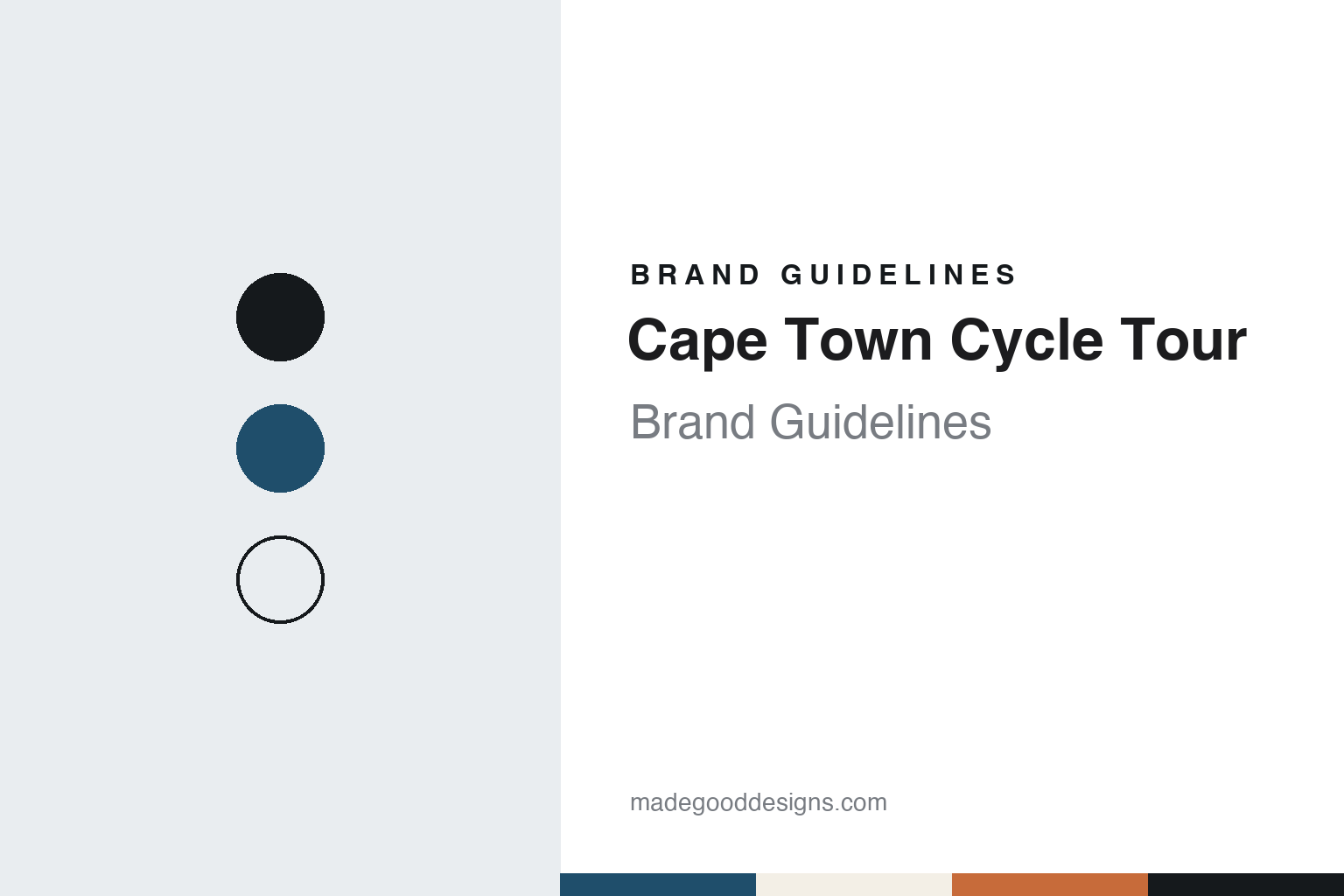
Cape Town Cycle Tour Brand Guidelines
The 1978 peninsula ride once called the Argus.
Aa
Two constants: an Atlantic blue, sandstone and protea coral palette and a display serif register. Abstract homage — not a Cape Town Cycle Tour asset or mark; no logo, medal or number board is reproduced.
The Big Ride-In
A ride for cycle paths that became an annual event.
The Cape Town Cycle Tour began in 1978 as the Big Ride-In. English Wikipedia says it was organised by Bill Mylrea and John Stegmann to draw attention to the need for cycle paths in South Africa, and that it drew hundreds of cyclists, including the mayor of Cape Town of the day; the event’s own website says more than 500 riders started the first edition. English Wikipedia names Lawrence Whittaker as the first winner, in September 1978.
The first route was meant to cover 140 kilometres, with a leg to Cape Point, but it was cut to 104 kilometres when permission to enter what was then the Cape Point Nature Reserve was refused. Figures drawn from Mike Wills’s 2008 history The Cycle Tour and reproduced on English Wikipedia give that first field as 525 entrants and 446 finishers, starting at the Castle on Strand Street and ending in Camps Bay. The organisers persuaded the local evening newspaper, the Cape Argus, which was at first reluctant, to let the event use its name, and for decades it was known as the Argus Cycle Tour.
The route has moved several times since. Wills’s figures, as reproduced on English Wikipedia, show the finish moving to Maiden’s Cove in 1989, and the course running between 104 and 110 kilometres over the years. Between 2000 and 2003, while Chapman’s Peak Drive was closed, the ride used an alternative route back over Ou Kaapse Weg and the Blue Route. By 2013 it was again crossing Chapman’s Peak, with the finish moved to Green Point.
Colour
A newspaper name, then a city name.
The newspaper’s name was later joined by other sponsors. A column on the Marketing Society’s website, written by a rider in the mid-2010s, gives the full title of that period as the “Cape Town Cycle Tour presented by Cape Argus, Pick n Pay and Momentum”, and notes that riders still called the event “the Argus”. English Wikipedia, citing Eyewitness News in September 2014, records the change from the Cape Argus Cycle Tour to the Cape Town Cycle Tour. Pick n Pay remains on the route: Eyewitness News reported in March 2026 that the retailer runs the refreshment station at Jubilee Square.
The event is run by the Cape Town Cycle Tour Trust, which English Wikipedia lists as its organiser and which the event’s website names in its own account of the tour. The ride is traditionally held on the second Sunday of March. English Wikipedia lists a week of related events around it, including a Tricycle Tour for children under six, a Junior Cycle Tour for ages six to twelve and a mountain-bike challenge; the Giro del Capo, a five-day stage race whose last day was the Cycle Tour itself, was last run in 2010. A shorter 42 km route was added in 2023, the organiser says; it starts on the Grand Parade behind the main field and finishes in Riebeek Street in the city centre.
The course is a loop. English Wikipedia describes it as starting at the Grand Parade in central Cape Town, taking Nelson Mandela Boulevard and the M3 to Muizenberg, then following the False Bay coast to Simon’s Town and Smitswinkel Bay before crossing the peninsula past the entrance to the Cape of Good Hope section of Table Mountain National Park. It returns north along the Atlantic coast through Scarborough, Kommetjie and Noordhoek, over Chapman’s Peak to Hout Bay, then over Suikerbossie Hill to Camps Bay, finishing beside the Cape Town Stadium in Green Point. Riders have seven hours from their start to earn a result, the organiser’s rider information says.
Typography
Races, routes and the people who run them.
Professional cycling races and mass-participation rides present themselves through a small set of public materials: the race name and logo, the leaders’ jerseys, the route map and the start and finish. Organisers publish these on their own websites each year, often next to a list of past winners and editions, so a race’s identity is visible as both a current event and a long archive.
Names change more often than the races do. Many events carry a title sponsor or a regional partner in their official name, and those names come and go with contracts, while the core name stays in press coverage and in records of past editions. Some races have been renamed outright, and their organisers usually say so on their history pages. Jersey colours can change too: one Grand Tour moved its leader’s jersey from gold to red in 2010.
Route graphics carry much of the design work. Stage races publish profiles for each day, with climbs and their categories marked; one-day races on rough roads publish numbered sectors, sometimes graded with stars by the organiser. Start towns, finish lines on a city square or a velodrome, and podium settings appear in photographs year after year, alongside trophies, finishers’ medals and official merchandise. Mass-participation rides, which often share roads and branding with a professional race, use similar maps and markers for a much larger field.
Behind each race sits an organiser, and often a parent company. Some of the oldest races were founded by newspapers; many are now run by event companies, sports federations, trusts or regional tourism bodies, and some belong to groups that run several races at once. This guide sets out, for each race, who founded it, who organises and owns it today, and how its name, jerseys and route are presented, from dated sources.
Aa
A display serif for a coastal ride with a newspaper past. (Specimen set in DM Serif Display, a serif STAND-IN; NOT the Cape Town Cycle Tour logo.)
Cape Town Cycle Tour
Around 30,000 riders on closed roads.
The scale of the modern event shows in the city around it. Ahead of the 48th edition on 8 March 2026, Eyewitness News reported that around 30,000 riders, a significant share of them from abroad, were set to ride the 109-kilometre route, with hard road closures across the city centre, Green Point, Sea Point, the southern suburbs and the deep south on the Saturday and Sunday. The broadcaster passed on the organisers’ suggestions for watching: Edinburgh Drive, which riders call Wynberg Hill and which it described as the steepest gradient of the course; the Blue Route bridges; Muizenberg and Kalk Bay; Noordhoek Farm Village before Chapman’s Peak; and Hout Bay’s Main Road before the climb of Suikerbossie.
The event also feeds an international amateur series. Gran Fondo Daily, reporting the 2026 results on 8 March, described the Cape Town Cycle Tour as a qualifying race for the UCI Gran Fondo World Championships, with riders finishing in the top quarter of their age and gender category qualifying for that year’s championships in Niseko, Japan. It put the field at about 30,000 riders, and noted a 78-kilometre medio fondo for elite women alongside the full distance.
The event’s own website now describes a 109-kilometre route around the Cape Peninsula and a field of around 30,000 riders a year, and its rider guides name the start precinct on the Grand Parade, the finish village by the stadium in Green Point and cut-off points along the course at places including Glencairn and Hout Bay.
For a design guide, the Cape Town Cycle Tour shows how a mass ride can carry a sponsor’s name for decades and then take its city’s name while keeping its route, its climbs and its nickname. Compare Tour Down Under, another southern-hemisphere race built around a city, and Unbound Gravel, a mass-participation event that also changed its name. For this guide we use an Atlantic blue, sandstone and a protea coral with a serif, an unofficial interpretation; no product or logo is reproduced.
Explore & save
Keep Cape Town Cycle Tour’s identity on hand — save it to a board in the Made Good inspiration library.
Cape Town Cycle Tour identity set
Pin the Cape Town Cycle Tour Atlantic blue, sandstone and protea coral palette and the display serif register to your own board.
Source & notes
Frequently Asked Questions
What font can I use to match the Cape Town Cycle Tour look?
This guide describes Cape Town Cycle Tour’s type as “A display serif for a coastal ride with a newspaper past”. Its type specimen is set in DM Serif Display from Google Fonts as a stand-in; DM Serif Display is not Cape Town Cycle Tour’s own lettering.
What colours are in the Cape Town Cycle Tour palette?
This guide’s Cape Town Cycle Tour palette is Atlantic blue #1F4E6B, Ink #15191C, Sandstone #F3EFE6, Protea coral #C76B3A and Fynbos green #4F6B4A. The tones are the guide’s own unofficial interpretation, not official Cape Town Cycle Tour hex codes.
Who founded Cape Town Cycle Tour?
Cape Town Cycle Tour was founded by Bill Mylrea and John Stegmann.