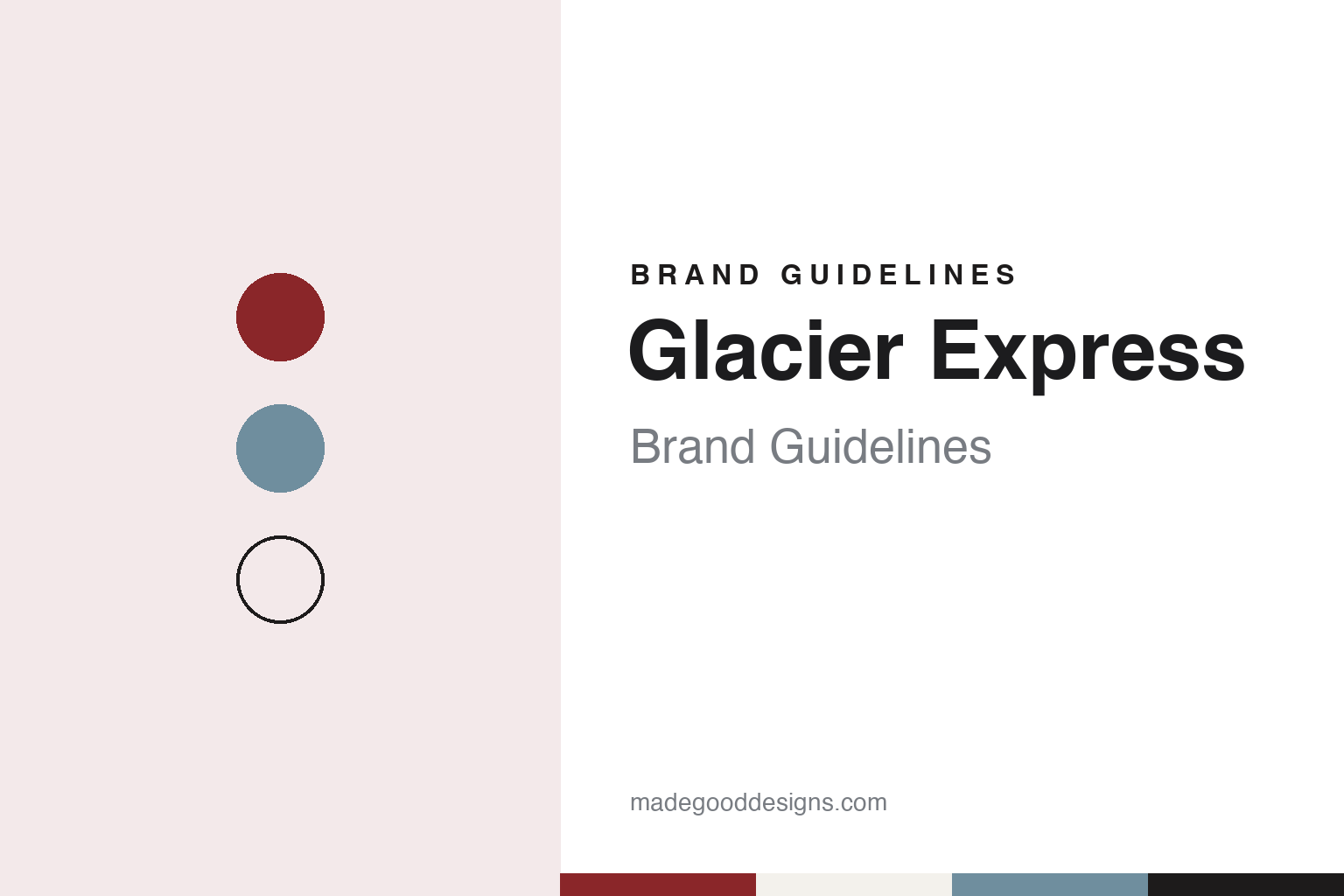
Glacier Express Brand Guidelines
The Zermatt–St. Moritz panoramic train, since 1930.
Aa
Two constants: a Glacier Express red, snow and glacier blue palette and a Swiss sans register. Abstract homage — not a Glacier Express product or mark; no train, logo or livery is reproduced.
Zermatt to St. Moritz
Two resorts, three railways, one through train.
The Glacier Express is a scenic train that links Zermatt, at the foot of the Matterhorn, with St. Moritz in the Engadine, crossing southern and eastern Switzerland on narrow-gauge track. The company that runs it says the first train made the journey on 25 June 1930, and the Rhaetian Railway’s own timeline lists the inaugural run in the same year. Accounts differ on the direction of that first trip: the Glacier Express website describes it as Zermatt to St. Moritz, while the Rhaetian Railway and The Swiss Spectator, in a 2 September 2020 piece marking the ninetieth anniversary, describe it as running from St. Moritz to Zermatt, via Reichenau, Disentis, Andermatt, Gletsch and Brig.
From the start the train was a joint service. The Glacier Express website says that in 1930 the then BVZ Zermatt-Bahn and the Furka Oberalp Bahn began a cooperation with the Rhaetian Railway (RhB) to create a train for tourists. The two western companies merged in 2003 to form the Matterhorn Gotthard Bahn. In 2017 the partners founded Glacier Express AG, based at Andermatt station, in which RhB and the Matterhorn Gotthard Bahn each hold 50 per cent, according to the company.
The early trains were made up of saloon and passenger cars in first, second and third class with a dining car, the company says, and ran only in the summer months: deep snow on the Furka section ruled out winter service. That changed when the Furka Base Tunnel opened on 26 June 1982, giving the route an all-year connection, as both the Glacier Express and the Rhaetian Railway record.
Colour
The slowest express, by its own description.
The route is long and slow by design. The company gives it as 291 kilometres across the cantons of Valais, Uri and Graubünden, with an average speed of 42 km/h, a maximum incline of 12.5 per cent and a journey of about eight hours. Le News, the Swiss English-language paper, wrote on 7 November 2013 that the train “might be billed as the slowest express train in the world,” then taking about seven and a half hours, and counted 291 bridges and 91 tunnels. Its highest point is the Oberalp Pass at 2,033 metres, according to both the paper and the company.
Much of the eastern section runs on the Albula Line between Thusis and St. Moritz, opened in 1903 and extended to St. Moritz in 1904, the company says. Since July 2008 the Albula and Bernina lines have formed the UNESCO World Heritage site “Rhaetian Railway in the Albula/Bernina Landscapes,” a listing reported by swissinfo.ch on 8 July 2008. Le News described the corkscrew tunnels beyond the Albula tunnel, in which the train loses 416 metres of height before Bergün, and the Landwasser Viaduct near Filisur is the structure the company singles out on the line.
The service grew in steps. The company says it introduced individual seat reservations in 1984 and added two more trains in each direction from 1985, including one starting at Davos. In 1993 came the first panoramic cars, with windows glazed up to the roof, run with a dining car. For the 75th anniversary on 25 June 2005 it ordered 24 new panoramic cars, and by 2006, it says, all carriages wore a new livery with a slanted Swiss cross; meals began to be served at passengers’ seats. The Swiss Spectator wrote that the train “did not get the red colour until 1986,” while the Rhaetian Railway dates the repainting of its own fleet in a new red livery to its centenary in 1989.
The newest layer is the Excellence Class, launched in winter 2019. The company describes carriages for 20 passengers, with interiors drawn from mountain hotels and the colours of the landscape, a Glacier Bar under a gilded compass dome, and a five-course menu with wine. All other panoramic cars were refurbished by 2021, with an on-board information system in six languages and windows in the entrance doors that can be opened for photographs, the company says.
Typography
Design and documentation.
Luxury, sleeper and scenic trains sell a journey rather than a seat, and their identities are built to match. A train’s name is often its strongest asset: some revive the names of older services, others are named after a route, a region or a landscape. Operators publish these names with crests, monograms and lettering that echo railway signwriting, and many give a train its own livery, so that the colour of the carriages becomes part of the brand. The Venice Simplon-Orient-Express, for example, runs in a blue-and-gold livery, National Geographic Traveller reported in 2018.
Inside, the identity moves into materials. Carriage interiors carry marquetry, glass, upholstery and fittings, and on trains that use restored rolling stock the pages on history and individual carriages, with their build years and builders, become a large part of what the operator publishes. Newer interiors are often credited to named designers, studios and craft workshops.
The printed and digital pieces around a journey do much of the remaining work. Menus, cabin cards, tickets, luggage labels and welcome letters repeat the same names and lettering; route maps and timetables show where a train runs, how many nights a journey takes and which stations it stops at; and dress codes, music and dining arrangements are described as part of the experience.
Behind the names sit owners and operators that change over time: state railways, regional railway companies, private operators and international hotel groups. This guide states those owners and operators plainly, with dates, and attributes descriptions of carriages, suites and routes to the operator or to a named, dated source. It does not cover fares, and it makes no record claims.
Aa
A Swiss sans — a slanted cross on a red body. (Specimen set in Inter Tight, a sans STAND-IN; NOT the Glacier Express logo.)
Glacier Express
A slanted cross on a red body.
The brand lives in small objects as much as in the train. The one the company tells most about is the tilting glass, a stemmed glass with a slanted base introduced in the 1980s as ordinary tableware, so that drinks stay level on the steep sections and in the helical tunnels. The company tells the story of guards calling out “Tournez les verres!” — French for “turn the glasses” — when the train changed gradient, and it now sells the glass as a souvenir.
The other constants are the windows and the colour. Le News noted in 2013 that in both first and second class the windows extend up around the top of the coach, and that lunch was served in a wood-panelled dining car; the current cars carry the red body and the slanted Swiss cross that the company dates to 2006. Its passengers have changed over time: The Swiss Spectator wrote in 2020 that early travellers came from Europe, that American visitors increased after 1950, and that Asian and Arab travellers followed from the 1980s, with more than eight million passengers carried since 1930.
The train is now a company in its own right rather than a timetable label. Glacier Express AG sells the service under its own name and website, with first and second class, the Excellence Class, menus by month and a souvenir range, while the tracks remain those of its two owners. The Rhaetian Railway, founded as the Landquart–Davos narrow-gauge company in 1888 and renamed in 1895, also runs the Bernina Express over part of the same network.
For a design guide, the Glacier Express shows how a long, slow journey can be branded through a few repeated details: a red body, a slanted cross, glass to the roof and a tilted wine glass. Compare the Rhaetian Railway, one of its two owners, and the Bernina Express, the RhB panoramic train that shares the Albula Line. For this guide we use an Alpine red, snow white and a glacier grey-blue with a sans, an unofficial interpretation; no product or logo is reproduced.
Explore & save
Keep Glacier Express’s identity on hand — save it to a board in the Made Good inspiration library.
Glacier Express identity set
Pin the Glacier Express red, snow and glacier blue palette and the Swiss sans register to your own board.
Source & notes
Frequently Asked Questions
What font can I use to match the Glacier Express look?
This guide describes Glacier Express’s type as “A Swiss sans — a slanted cross on a red body”. Its type specimen is set in Inter Tight from Google Fonts as a stand-in; Inter Tight is not Glacier Express’s own lettering.
What colours are in the Glacier Express palette?
This guide’s Glacier Express palette is Alpine red #8A2629, Ink #1D1B1B, Snowfield #F3F1EC, Glacier grey-blue #6F8E9E and Paper #FAF8F4. The tones are the guide’s own unofficial interpretation, not official Glacier Express hex codes.
Who owns Glacier Express?
Glacier Express is owned by Rhaetian Railway and Matterhorn Gotthard Bahn (50% each).