Pieter Bruegel the Younger built a career on a famous name and a set of proven designs. His father, Pieter Bruegel the Elder, died when he was a small child, yet the son’s Antwerp workshop went on to repeat the father’s crowded village festivals, proverbs and snowbound landscapes for buyers who could never have owned an original. Read as a designer, his work is less about a single masterpiece than about a system: a library of compositions, a production method and a bright palette that made each version saleable.
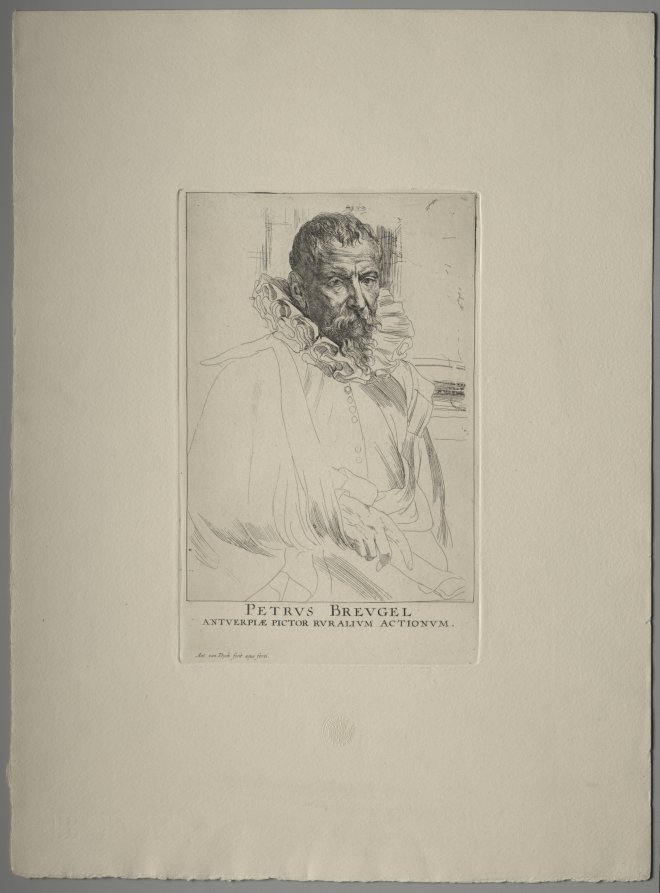
None of his paintings appears as public domain in the open-access collections of the Art Institute of Chicago, Cleveland Museum of Art or the Met, so his paintings are described in text below. The one image here is a portrait of him etched by Anthony van Dyck. For public domain images you can reuse, browse the MGD museum inspiration collection.
Who was Pieter Bruegel the Younger?
He was born in Brussels in 1564, the eldest son of Pieter Bruegel the Elder and Mayken Coecke, daughter of the Antwerp artist Pieter Coecke van Aelst. Britannica records that the elder Bruegel married Mayken in 1563 and moved to Brussels, and that through his sons Jan and Pieter he founded a family of painters. The father died in 1569, so neither boy can have learned much from him directly. His younger brother, Jan Brueghel the Elder, born in 1568 according to the National Gallery in London and the Cleveland Museum of Art, became a painter of flowers and landscapes; our guide to Jan Brueghel the Elder covers that branch of the family.
Pieter made his career in Antwerp, a major centre of the art trade, and ran a sizeable workshop there with apprentices and assistants. Van Dyck’s portrait, discussed below, calls him an Antwerp painter in its lettered title. His death is usually placed in the Antwerp painters’ guild year 1637–38, which is why reference works give 1637/38.
The spelling of his name varies. Museum records use Brueghel, Breughel and Bruegel, and signatures on his panels are generally recorded as “Brueghel” before about 1616 and “Breughel” afterwards. He was long nicknamed “Hell Brueghel” on the belief that he painted scenes of fire and demons, but those pictures are now usually given to his brother Jan.
Key works and the father’s repertoire
Most of the paintings associated with Pieter the Younger are versions of compositions by his father, made in his workshop over several decades. The principal subjects are peasant scenes and proverbs, with religious subjects and landscapes alongside. Among those most often repeated:
- Winter Landscape with Skaters and a Bird Trap. After his father’s small winter scene, this was repeated many times, with some versions signed and dated in the 1600s and 1610s. Skaters on a frozen river, a village and a trap for birds set under a board form a balanced, almost diagrammatic picture.
- The Adoration of the Magi in the Snow. A Nativity set in a Flemish village during a snowfall, where the religious subject is tucked into a crowd of everyday activity.
- St John the Baptist Preaching. A crowd of listeners of every type, gathered under trees; some workshop versions leave out figures that appear in the father’s original.
- Proverbs and peasant weddings. Dense scenes where each small group acts out a saying or a custom.
He also produced compositions of his own in the same idiom. The most often cited is usually called The Village Lawyer or The Tax Collector’s Office: peasants queue with eggs and poultry before an official at a desk piled with papers and sacks. Another, The Whitsun Bride, shows a village spring custom of crowning a young girl. These pictures show close attention to rooms, clothes and gestures, and a brighter, more even colour than his father’s.
For the father’s originals, including the prints that spread his designs, see our guide to Pieter Bruegel the Elder.
The Van Dyck portrait: line, lettering and emphasis
Anthony van Dyck etched this portrait in the early 1630s; the Art Institute of Chicago and the Cleveland Museum of Art both date it 1630–33. The Art Institute also holds Van Dyck’s etched portrait of Jan Brueghel the Elder from the same years, one of several portraits of fellow artists he etched in these years.
The design is a model of selective detail. Van Dyck shades the head, beard and ruff densely with fine crossing lines, then lets the coat and hand dissolve into open contour. Your eye goes straight to the face. Beneath the image, the lettering reads PETRVS BREVGEL / ANTVERPIAE PICTOR RVRALIVM ACTIONVM, roughly “Pieter Breugel, Antwerp painter of rural scenes”, set in spaced Roman capitals with a smaller line below. The title works as a caption and a job description at once, and the classical capitals give a modern painter the authority of an inscription.
In Cleveland’s scan of this impression, the paper reads around #c2baa7 and the darkest lines near #5b574c. These values are measured from the museum’s scan of this impression and describe the photograph, not the original ink and paper.
Technique: a workshop built for versions
Pieter the Younger is generally described as working from full-size patterns. A design on paper could be pricked along its lines and dusted with charcoal, a method called pouncing, leaving a dotted outline on the prepared panel for painters to follow. This allowed one composition to be transferred many times at the same size, which explains why versions of the same scene can match closely in outline but differ in colour and small details.
He did not always have the father’s paintings in front of him, and is thought to have worked from drawings, patterns and prints after his father’s designs. Where the original is lost, his versions can be the main record of what it looked like.
The colour is his own. Compared with the earthy tones of the father’s panels, workshop versions tend to use clearer reds, blue-greens and a light blue sky spread evenly across the surface, which suits pictures meant to be read from edge to edge. For the craft of the etched line in Van Dyck’s portrait, see our introduction to etching.
What to look at in a Bruegel the Younger painting
- The high horizon. Village scenes are seen from above, so the ground fills most of the panel and every figure gets space.
- Clusters, not a centre. Small groups spread across the picture, each telling its own story, so there is no single focal point.
- Repeated colour accents. Red jackets and white headcloths are scattered across the crowd and lead the eye from group to group.
- Silhouettes on light ground. In the winter scenes, dark figures and trees stand out against snow and ice like a printed pattern.
- Differences between versions. Compare two versions of the same scene and note what changes: a figure left out, a colour swapped, a sky lightened.
How designers can borrow his ideas
- Build a template library. Treat your strongest layouts the way his workshop treated a successful composition: keep the master, then produce controlled variations for each use.
- Version deliberately. Change one variable per version, colour, crop or a single figure, so the family stays recognisable. This is how seasonal campaigns and localised packaging work.
- Use a high viewpoint for complex information. Isometric maps, event plans and infographics benefit from the same raised horizon that lets a village scene show everything at once.
- Scatter one accent colour. A single red repeated across a busy layout guides the eye better than one large red block.
- Detail where it matters. Borrow Van Dyck’s approach: finish the face or product in full, and leave secondary areas as outline.
- Sample before you choose. Pull colours from a museum scan with the MGD image colour picker, and compare with the later Dutch tradition in our guide to Dutch Golden Age painting.
Frequently asked questions
Is Pieter Bruegel the Younger the same as Pieter Bruegel the Elder?
No. Pieter Bruegel the Elder, who died in 1569, was his father. Pieter the Younger was born in 1564 and worked in Antwerp until his death in 1637 or 1638, painting many versions of his father’s compositions as well as his own.
Why is the name spelled Bruegel, Brueghel and Breughel?
Spellings varied in the period and between family members. Museum records today use all three, and his own signatures are generally recorded as “Brueghel” earlier in his career and “Breughel” later. Search all three when looking for his work.
Did Pieter Bruegel the Younger only copy his father?
No. Most of his output repeats his father’s designs, but he also produced compositions of his own, such as The Village Lawyer and The Whitsun Bride, in a brighter, more even palette.
Are his paintings in the public domain?
The paintings themselves are centuries old, but museums set their own terms for photographs. The Cleveland Museum of Art releases its scan of Van Dyck’s portrait of him under CC0; check each museum’s licence before reusing other images.