Rovos Rail Brand Guidelines
A founder’s name, restored coaches and steam from Capital Park.
Aa
Two constants: a bottle green, ivory and brass palette and a classic serif register. Abstract homage — not a Rovos Rail asset; no logo, crest or carriage is reproduced.
A family railway in Pretoria
A founder’s name folded into a company name.
Rovos Rail is a private railway company based at Capital Park in Pretoria, South Africa, which runs a hotel train on scheduled journeys across southern Africa, English Wikipedia says. The company was started in 1989 by Rohan Vos, and its name is built from his own: the Heritage Portal, in a 2016 history of South Africa’s long-distance luxury trains, wrote “Rohan Vos (hence Rovos).” Wikipedia says the business is still family owned.
The company tells its origin as a family plan that grew. In a May 2024 article published by the Southern Africa Tourism Services Association (SATSA) for the company’s 35th year, chief operating officer Tiffany Vos-Thane, daughter of the founders Rohan and Anthea Vos, said her father became interested in preserving steam locomotives after joining a heritage society, and at first wanted to tour the country in a rail coach with his family; when the costs proved too high, someone suggested selling tickets. The travel company Voyageurs du Monde, in its own magazine, wrote that he bought his first carriage at an auction.
The Heritage Portal says Vos took over the Capital Park steam locomotive sheds in Pretoria as the company’s base. Steam was at first a large part of the programme: three South African Railways Class 19D locomotives were restored, the Heritage Portal says, and English Wikipedia says they were saved from scrap dealers and returned to service in 1989. Wikipedia lists seven steam locomotives bought between 1987 and 2007, the oldest a Class 6 built by Dübs & Company in Glasgow in 1893, alongside Class 25NC engines built by North British in 1954 and by Henschel in 1953, one of them converted from coal to oil firing.
The Heritage Portal adds that steam mileage dwindled as the supporting infrastructure was removed, and that Transnet diesel and electric locomotives came to do most of the hauling. Tiffany Vos-Thane told SATSA that in December 2023 Transnet approved Rovos Rail running its own locomotives.
Colour
Restored coaches and three kinds of suite.
The train is made up of restored coaches. English Wikipedia says they are former National Railways of Zimbabwe vehicles, formed into trains with two lounges, two restaurant cars and private sleeping compartments, each with its own bathroom. It describes three kinds of accommodation, from the Pullman suite of about 76 square feet to the Royal Suite, which takes up half a carriage at about 172 square feet and has a Victorian-style bath. All cabins have a shower, basin and toilet, Wikipedia says.
The interiors look back to the Edwardian era. Voyageurs du Monde described restored 1920s Pullman cars with mahogany panelling, Edwardian furniture, leather and embroidered fabrics, period china in the dining cars and an observation car with an open rear platform. Tiffany Vos-Thane told the travel site We Are Africa that in the early years her parents ran the company from a heritage building in central Pretoria, with guests walking from the hotel across the road to the station to board. The train runs under the name Pride of Africa, which the Heritage Portal used for it in 2016.
The wine list is South African. Tiffany Vos-Thane told SATSA that the company works with estates in regions including Franschhoek, Stellenbosch and Robertson to pair wines with each meal, and that it refreshed the list in 2021. She also described a rule against electronic devices in the public areas of the train. Staff numbers differ by source: English Wikipedia says over 430, including those restoring carriages at the Capital Park depot, while Tiffany Vos-Thane told We Are Africa there are just under 500.
Typography
Names, liveries and restored carriages.
Luxury, sleeper and scenic trains sell a journey rather than a seat, and their identities are built to match. A train’s name is often its strongest asset: some revive the names of older services, others are named after a route, a region or a landscape. Operators publish these names with crests, monograms and lettering that echo railway signwriting, and many give a train its own livery, so that the colour of the carriages becomes part of the brand. The Venice Simplon-Orient-Express, for example, runs in a blue-and-gold livery, National Geographic Traveller reported in 2018.
Inside, the identity moves into materials. Carriage interiors carry marquetry, glass, upholstery and fittings, and on trains that use restored rolling stock the pages on history and individual carriages, with their build years and builders, become a large part of what the operator publishes. Newer interiors are often credited to named designers, studios and craft workshops.
The printed and digital pieces around a journey do much of the remaining work. Menus, cabin cards, tickets, luggage labels and welcome letters repeat the same names and lettering; route maps and timetables show where a train runs, how many nights a journey takes and which stations it stops at; and dress codes, music and dining arrangements are described as part of the experience.
Behind the names sit owners and operators that change over time: state railways, regional railway companies, private operators and international hotel groups. This guide states those owners and operators plainly, with dates, and attributes descriptions of carriages, suites and routes to the operator or to a named, dated source. It does not cover fares, and it makes no record claims.
Aa
A classic serif for restored Edwardian-style coaches. (Specimen set in Cormorant Garamond, a serif STAND-IN; NOT the Rovos Rail logo.)
Rovos Rail
From Pretoria to Dar es Salaam and Lobito.
The longest journeys cross several countries. Tiffany Vos-Thane told SATSA that her father launched a route from South Africa to Dar es Salaam in Tanzania, via Victoria Falls, in 1993. The Heritage Portal described it in 2016 as a once-a-year trip from Cape Town taking 12 nights; English Wikipedia lists the Dar es Salaam journey at 15 nights and about 5,530 kilometres. In summer 2019, Voyageurs du Monde reported, a train from Dar es Salaam reached Lobito in Angola, on the Atlantic, after a fifteen-day, 4,500-kilometre journey through Zimbabwe, Botswana and Zambia; Wikipedia now lists a Copper Trail journey between Victoria Falls and Lobito.
Closer to home, English Wikipedia lists the Cape Town journey from Pretoria at three nights and about 1,600 kilometres, a two-night Durban journey, a Victoria Falls journey and a Namibia safari to Walvis Bay, among others; SATSA counted 11 journeys in 2024. Voyageurs du Monde describes the Pretoria–Cape Town route crossing the Highveld and the Great Karoo, with a stop at Matjiesfontein, a Victorian village founded in 1890.
Rovos Rail shares its home market with the state-run Blue Train. The Heritage Portal set the two side by side in 2016 as trains offering similar itineraries, one with a long record behind it and the other operating since 1989.
For a design guide, Rovos Rail shows how a private family company can build an identity from restored rolling stock: a founder’s name folded into the company name, steam locomotives restored in its own sheds, and Edwardian-style interiors as the main visual material. Compare Blue Train, South Africa’s state-run luxury train, and Eastern & Oriental Express, another long-distance hotel train. For this guide we use a bottle green, ivory and a brass gold with a classic serif, an unofficial interpretation; no product or logo is reproduced.
Explore & save
Keep Rovos Rail’s identity on hand — save it to a board in the Made Good inspiration library.
Rovos Rail identity set
Pin the Rovos Rail bottle green, ivory and brass palette and the classic serif register to your own board.
Source & notes
Frequently Asked Questions
What font can I use to match the Rovos Rail look?
This guide describes Rovos Rail’s type as “A classic serif for restored Edwardian-style coaches”. Its type specimen is set in Cormorant Garamond from Google Fonts as a stand-in; Cormorant Garamond is not Rovos Rail’s own lettering.
What colours are in the Rovos Rail palette?
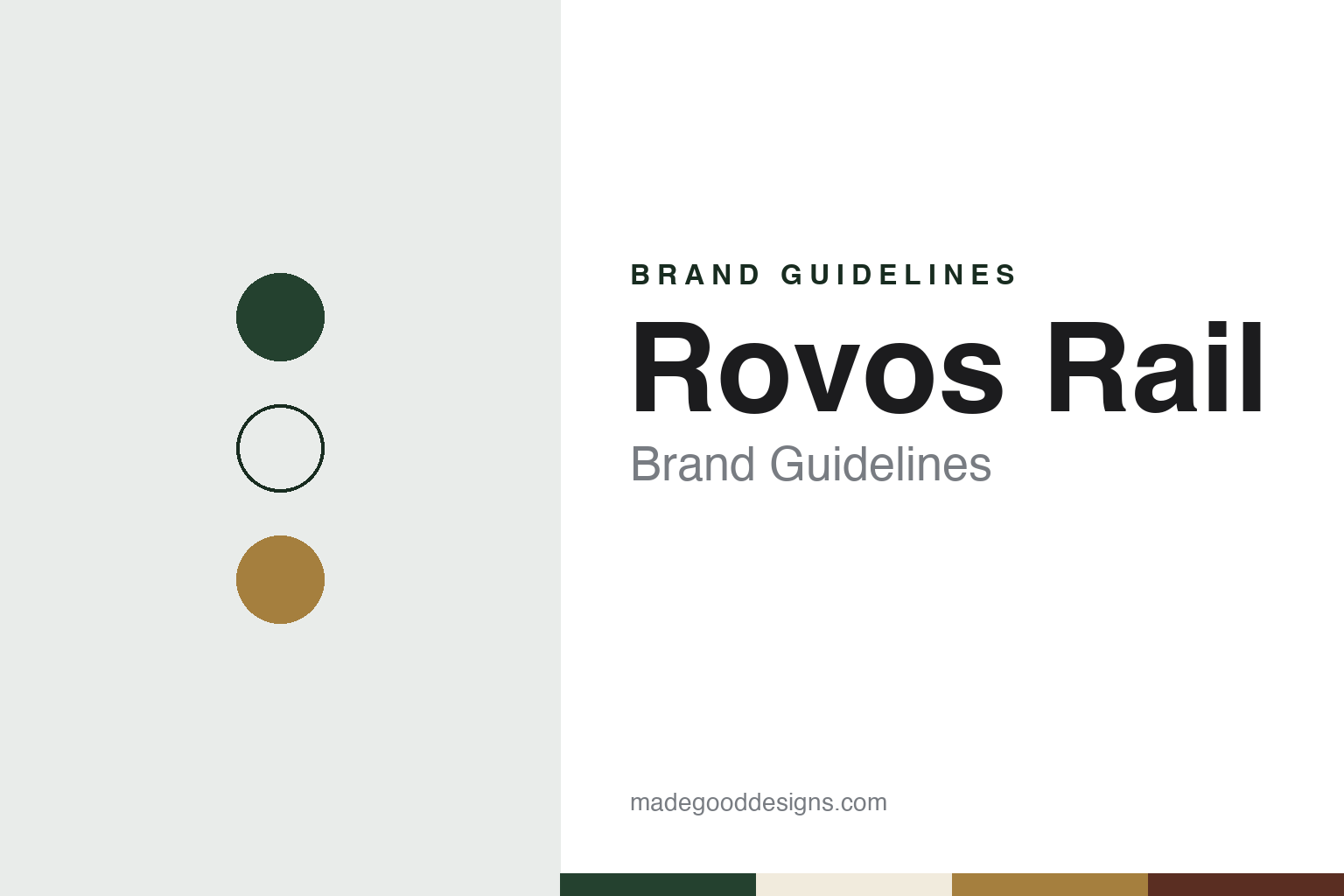
This guide’s Rovos Rail palette is Bottle green #24412F, Shed green #182C20, Ivory #F1EBDD, Brass #A57F3E and Panel mahogany #5A2E22. The tones are the guide’s own unofficial interpretation, not official Rovos Rail hex codes.
When was Rovos Rail founded?
Rovos Rail was founded in 1989, in Pretoria, South Africa.
Who founded Rovos Rail?
Rovos Rail was founded by Rohan Vos in 1989. This guide gives Capital Park, Pretoria (former steam locomotive sheds) as where Rovos Rail is based.
Who owns Rovos Rail?
Rovos Rail is owned by Family owned (English Wikipedia). This guide dates Rovos Rail to 1989, in Pretoria, South Africa.
Where is Rovos Rail based?
Rovos Rail is based in Capital Park, Pretoria (former steam locomotive sheds).