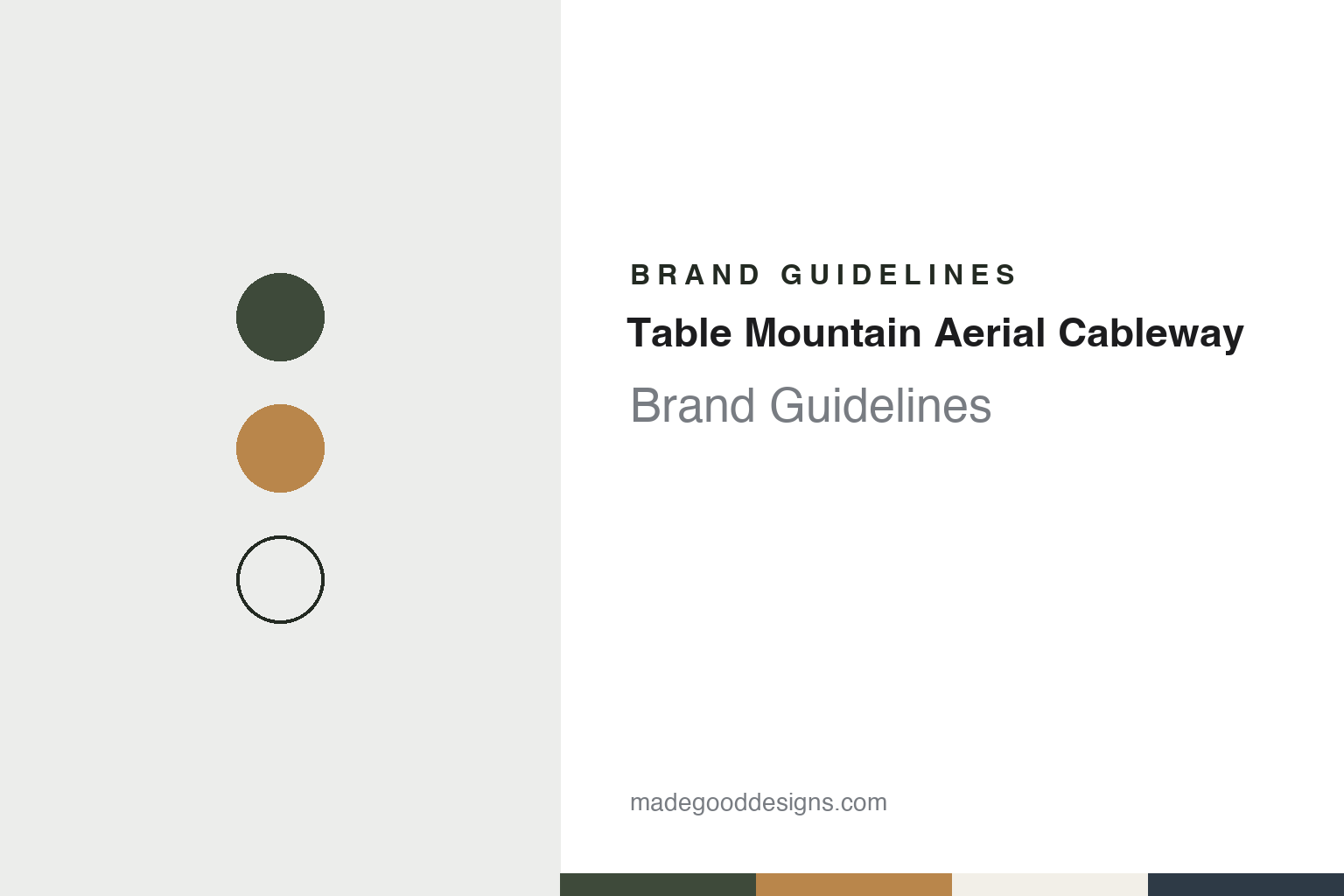
Table Mountain Aerial Cableway Brand Guidelines
Cape Town’s 1929 cableway, now riding on rotating Swiss cars.
Aa
Two constants: a fynbos green, sandstone and tablecloth white palette and a display serif register. Abstract homage — not a Table Mountain Aerial Cableway car or mark; no logo or livery is reproduced.
A cableway from 1929
An engineer’s idea and a 99-year concession.
The Table Mountain Aerial Cableway carries visitors from a lower station on Tafelberg Road to the western end of the Table Mountain plateau above Cape Town, South Africa. English Wikipedia gives the upper station an elevation of 1,067 metres and the vertical rise of the line as 765 metres. Ideas for a way up the mountain are older than the cableway: Wikipedia says Capetonians proposed a railway to the top in the 1870s, and that the City Council looked at the options again in 1912, but neither scheme went ahead.
The cableway came from a Norwegian engineer, Trygve Strømsøe. According to a report by Independent Media’s special investigations unit, published in Business Report on 31 December 2020, he presented the idea of a cable car in 1926 to the businessmen Sir Alfred Hennessy, Sir David Graaff and Sir Ernest Oppenheimer, who formed the Table Mountain Aerial Cableway Company, known as TMACC. Strømsøe was offered a fourth seat on the board, and Hennessy chaired the company from 1929, the paper said. The national government department then responsible for parks told the paper that the company’s 99-year concession began on 26 November 1926.
The contract to build the line went to Adolf Bleichert & Co., the wire-ropeway maker of Leipzig in Germany, English Wikipedia says, and the cableway was opened on 4 October 1929 by the Mayor of Cape Town. The 2020 report gives the same date for the launch of the cable car, and the company’s annual report for 2022–2023 counts its years of service from that start.
Ownership has changed in the published record. English Wikipedia says that in 1993 the son of one of the founders sold TMACC and that the new owners took charge of upgrading the cableway. In the 2020 report the managing director, Wahida Parker, described TMACC as a private company that pays a concession fee to South African National Parks (SANParks) and said no members of the founders’ families sat on its board. The department described it as one of 54 public-private partnerships across 20 national parks, and said the government does not fund its operations. The company chose not to name its current shareholders, the paper said.
Colour
Rotair cars from Switzerland.
The present cars date from 1997, when the cableway reopened after extensive renovation with new cars, English Wikipedia says. The system, which Wikipedia calls the “Rotair”, was installed by the Swiss maker Garaventa, part of the Doppelmayr Garaventa Group, and its design was based on the Rotair cable car on the Titlis above Engelberg. Each car carries 65 passengers, against 25 in the earlier cars, and runs on a double cable, and the ride to the top takes four to five minutes. The floor of each car turns through 360 degrees during the ascent or descent, giving every passenger a turn at the panoramic view. Wikipedia says the cableway has been upgraded three times since 1929.
The line is an aerial tramway with two cars, each shuttling between the lower and upper stations. From the upper station, Wikipedia says, the views run north over the city, Table Bay and Robben Island and west and south over the Atlantic seaboard; the station’s amenities include guided walks, an audio tour and a café. The company’s 2022–2023 annual report lists the work done during its annual maintenance period, including tests on the haul ropes, the shortening of the track ropes and maintenance scheduled by the Swiss federal transport office, the BAV.
Visitor milestones are given by the company and repeated by others. English Wikipedia says the cableway welcomed its 28 millionth visitor in January 2019, and the 2022–2023 annual report says the 30 millionth arrived on 30 December 2022. The same report says the company’s “heritage cable cars” had a facelift and were rebranded during that year.
Typography
Lines, cars and the view.
Mountain railways, funiculars and cable cars present themselves through a small set of public materials: the line’s name, the operator’s logo and the livery of its cabins and railcars, all as the operators publish them. Many lines carry the name of a summit or a station rather than the name of the company, so a single identity often has to cover a railway, a cableway, a restaurant and a viewing platform at once.
Much of that identity is met on the ground. Valley and summit stations, platform signs, timetables, tickets and souvenir graphics repeat the same names and colours, and railcars and cabins often appear in the operator’s own photography against snow, rock and sky. Station names and altitudes are a recurring part of that signage, as the operators print them.
Engineering is a large part of the story these companies tell. Operators and the sources cited in each guide name the rack systems, rope systems, builders and cabin makers behind a line, and the dates on which sections opened, were rebuilt or received new rolling stock. Owners and operators are described plainly here: a listed holding company, a long-established local company or a subsidiary of a larger transport group, with dates taken from dated sources.
Each guide in this series sets out what can be checked about one line: when it opened, who runs it, which renewals and new sections have followed and how its name and graphics appear today. History pages and line-renewal announcements from the operators are cited as company statements, and independent reporting is named where it is used. The palettes and typefaces shown are unofficial interpretations, not the operators’ own.
Aa
A high-contrast display serif for station names and summit signs. (Specimen set in DM Serif Display, a serif STAND-IN; NOT the Table Mountain Aerial Cableway logo.)
Table Mountain Aerial Cableway
A concession at its renewal point.
The concession has reached its original end date. The department told Business Report in 2020 that the agreement ran until 25 November 2025, that it had not gone to tender at any point in its 99 years, and that SANParks would run a public-private partnership tender under National Treasury guidelines. English Wikipedia, citing News24 in September 2025, says SANParks renewed TMACC’s lease for three years to avoid an interruption to the service while a tender is held to select the next operator.
Design notes come mostly from the company’s own material. The 2022–2023 annual report is built around the peregrine falcon, comparing the bird with the cableway in its introduction and using it as the visual theme of the report. The company describes Table Mountain as a World Heritage Site and one of the New 7 Wonders of Nature, and says the land it occupies falls within a national park.
For designers, the cableway’s strongest assets are physical: the car on its two cables, the rotating floor, the upper station at the plateau edge and the mountain behind it. A guide that starts from those elements, rather than from slogans, stays close to what the company and its sources describe.
For a design guide, the Table Mountain Aerial Cableway shows how a long-running concession can be presented through its cars, its stations and its view while owners and contract terms change around it. Compare Titlis, whose Rotair cable car served as the model for the 1997 cars, and Sugarloaf Cable Car, another city cable car, above Rio de Janeiro. For this guide we use a fynbos green, a sandstone ochre, a tablecloth white and a deep slate with a serif, an unofficial interpretation; no product or logo is reproduced.
Explore & save
Keep Table Mountain Aerial Cableway’s identity on hand — save it to a board in the Made Good inspiration library.
Table Mountain Aerial Cableway identity set
Pin the Table Mountain Aerial Cableway fynbos green, sandstone and tablecloth white palette and the display serif register to your own board.
Source & notes
Frequently Asked Questions
What font can I use to match the Table Mountain Aerial Cableway look?
This guide describes Table Mountain Aerial Cableway’s type as “A high-contrast display serif for station names and summit signs”. Its type specimen is set in DM Serif Display from Google Fonts as a stand-in; DM Serif Display is not Table Mountain Aerial Cableway’s own lettering.
What colours are in the Table Mountain Aerial Cableway palette?
This guide’s Table Mountain Aerial Cableway palette is Fynbos green #3E4A3A, Cliff shadow #232A22, Sandstone ochre #B9864B, Tablecloth white #F2EFE8 and Atlantic slate #2E3A46. The tones are the guide’s own unofficial interpretation, not official Table Mountain Aerial Cableway hex codes.
When did Table Mountain Aerial Cableway open?
Table Mountain Aerial Cableway opened on 4 October 1929, in Cape Town, South Africa.