Sugarloaf Cable Car Brand Guidelines
Rio’s bondinho, from an engineer’s 1908 idea to a park name.
Aa
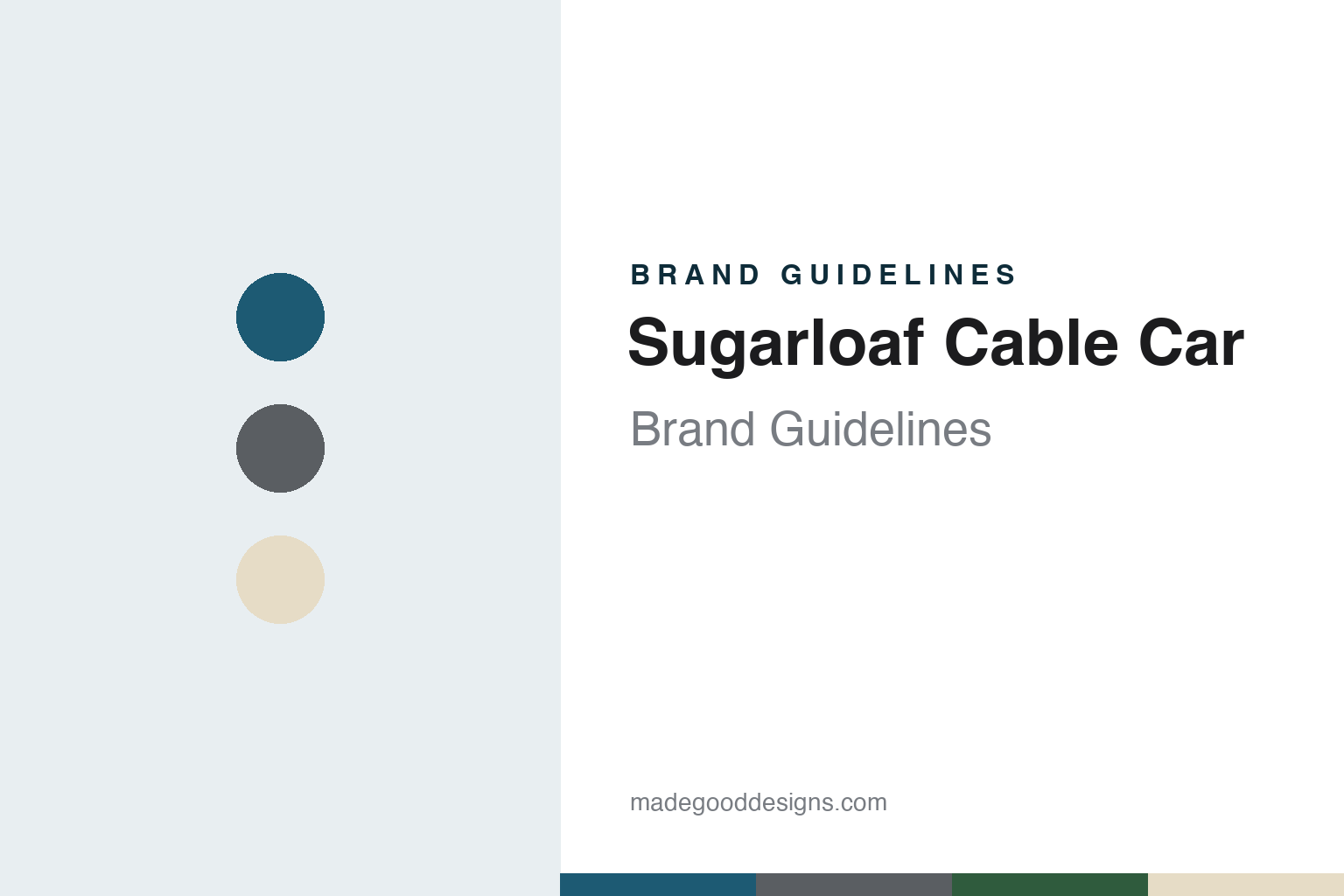
Two constants: a bay blue, granite grey and warm sand palette and a rounded geometric sans register. Abstract homage — not a Parque Bondinho Pão de Açúcar product or mark; no cabin, logo or sign is reproduced.
Caminho Aéreo
An engineer’s 1908 idea for Rio.
The Sugarloaf Cable Car — in Portuguese the Bondinho do Pão de Açúcar — is a two-stage aerial cableway in the Urca district of Rio de Janeiro. Its lower section runs from Praia Vermelha to the Morro da Urca, and its upper section continues to the summit of the Pão de Açúcar, which National Geographic Brasil, citing the operator’s website, put at 396 metres above sea level in 2023. Portuguese Wikipedia says the nickname “bondinho” comes from the likeness of the early cars to the trams, or bondes, that ran in Rio when the line opened.
The idea came from the engineer Augusto Ferreira Ramos. According to Portuguese Wikipedia and a detailed report published in 2008 by the French cableway site remontees-mecaniques.net, he was drawn to the rock around the National Exhibition of 1908 in Urca, which marked a century since Brazil’s ports opened to foreign trade. The French report, written with the operator’s cooperation, says the concession was granted in 1909 and that Ramos then founded the Companhia Caminho Aéreo Pão de Açúcar, whose name translates as the Sugarloaf Aerial Way Company. Portuguese Wikipedia names the Rio businessmen Eduardo Guinle and Raymundo Ottoni de Castro Maya among the backers he approached to promote the scheme.
For the machinery Ramos turned to Germany. The French report names the builder as Julius Pohlig AG, a maker of cableways for carrying materials, and says work began in 1910; Portuguese Wikipedia adds that the cars were imported from Germany and that more than 400 climbing workers carried parts up the rock faces. The lower section opened on 27 October 1912 and the upper section on 18 January 1913, National Geographic Brasil reported in October 2023. A third line, from the Morro da Urca to the Morro da Babilônia, was part of the original scheme but was never built, both Portuguese Wikipedia and the French report say.
The company Ramos founded still runs the line. National Geographic Brasil wrote in 2023 that Cia. Caminho Aéreo Pão de Açúcar is the same company that manages the bondinho today, and Portuguese Wikipedia describes it as a private concession held by that company since construction.
Colour
Agudio lines, Swiss cabins.
The original cars ran for six decades. In 1969, the French report says, a commission for new projects opened an international tender for two replacement cableways on the operator’s behalf, and in 1970 it chose Agudio of Milan, which worked with the Carioca engineer Christóvão Leite de Castro. The mechanical parts were made in Italy and shipped to Brazil by sea and by air in 1971 and 1972. The new lines were built beside the old ones so that service could continue during the works; the 1912 cabin made its last commercial trip on 29 October 1972, and the new installations opened that year. English Wikipedia says cabin capacity rose from 22 to 75 passengers and was later reduced to 65.
The four stations of 1972 were designed by the Brazilian architect Harry James Cole, according to the French report, which describes them as an expressive 1970s mix of late modernism and rounded forms meant to sit close to nature. Each has a plain, concrete-coloured block at the back for the entrances and machinery and, at the front, a row of four concrete portals over the platforms, each capped with a semi-transparent vault. The lower station also holds the ticket desks and a souvenir shop that visitors pass through on the way to the platforms.
The cabins changed again in 2008. The operator fitted new cables by the Swiss maker Fatzer in 2002 and chose CWA, another Swiss firm, in January 2008 to build four new cabins, the French report says. They came from CWA’s Replica range, which reproduces existing vehicles: the new cars keep the egg-like shape and wraparound glazing of the 1972 cabins, now with smoked dark glass and a glossy lacquered body. Each carries 65 passengers and a driver, and the earlier cabins are kept on display at the Morro da Urca.
The line has also had a screen career. English and Portuguese Wikipedia both note that it was the setting for an action scene in the 1979 James Bond film Moonraker, and National Geographic Brasil recorded that Roger Moore visited that year to film it.
Typography
Lines, summits and the names on them.
Mountain railways, funiculars and cable cars present themselves through a small set of public materials: the line’s name, the operator’s logo and the livery of its cabins and railcars, all as the operators publish them. Many lines carry the name of a summit or a station rather than the name of the company, so a single identity often has to cover a railway, a cableway, a restaurant and a viewing platform at once.
Much of that identity is met on the ground. Valley and summit stations, platform signs, timetables, tickets and souvenir graphics repeat the same names and colours, and railcars and cabins often appear in the operator’s own photography against snow, rock and sky. Station names and altitudes are a recurring part of that signage, as the operators print them.
Engineering is a large part of the story these companies tell. Operators and the sources cited in each guide name the rack systems, rope systems, builders and cabin makers behind a line, and the dates on which sections opened, were rebuilt or received new rolling stock. Owners and operators are described plainly here: a listed holding company, a long-established local company or a subsidiary of a larger transport group, with dates taken from dated sources.
Each guide in this series sets out what can be checked about one line: when it opened, who runs it, which renewals and new sections have followed and how its name and graphics appear today. History pages and line-renewal announcements from the operators are cited as company statements, and independent reporting is named where it is used. The palettes and typefaces shown are unofficial interpretations, not the operators’ own.
Aa
A rounded geometric sans for a hillside park. (Specimen set in Outfit, a sans STAND-IN; NOT the Parque Bondinho Pão de Açúcar logo.)
Parque Bondinho
A park name and a heart of stone.
In March 2022, in its 110th year, the attraction took a new name and identity. Diário do Rio reported on 17 March 2022 that it would be called Parque Bondinho Pão de Açúcar across all its visual communication, adding the word “parque” to stress that a visit goes beyond the cable car rides. The new logo was created by the branding agency Superunion. The park’s chief executive described it as showing the profile of the rock, its reflection in Guanabara Bay and a “heart of stone set in the earth,” and said the symbol also refers to the steel cables and the contour lines of the hills. The launch campaign, “Felicidade lá em cima” (“Happiness up there”), was made by Agência3, and the agency Crama was named for the park’s signage, which the company said would carry history and interactivity as well as directions.
The summit areas are part of that offer. National Geographic Brasil described the Morro da Urca in 2023 as having viewpoints such as the Mirante Maria Ercília, shops, cafés, restaurants and an amphitheatre used for shows and summer music festivals, along with a nature area where marmosets and birds can be seen. Citing Agência Brasil, it reported that more than 50 million people had ridden the cable car. Portuguese Wikipedia gives the present carrying rate as about 1,200 passengers an hour, with each section taking roughly three minutes.
Published line lengths differ by source. English Wikipedia gives 600 and 850 metres for the two sections; National Geographic Brasil, citing Agência Brasil, gives 528 and 750 metres; and the French report lists 484 and 750 metres.
For a design guide, the Sugarloaf Cable Car shows how a transport line can keep a recognisable cabin shape through three generations of vehicles while its name and logo move on. Compare Table Mountain Aerial Cableway, another city cableway on a landmark rock, and Peak Tram, a city funicular from the 1880s. For this guide we use a bay blue, a granite grey, a forest green and a warm sand with a sans, an unofficial interpretation; no product or logo is reproduced.
Explore & save
Keep Sugarloaf Cable Car’s identity on hand — save it to a board in the Made Good inspiration library.
Sugarloaf Cable Car identity set
Pin the Sugarloaf Cable Car bay blue, granite grey and warm sand palette and the rounded geometric sans register to your own board.
Source & notes
Frequently Asked Questions
What font can I use to match the Sugarloaf Cable Car look?
This guide describes Sugarloaf Cable Car’s type as “A rounded geometric sans for a hillside park”. Its type specimen is set in Outfit from Google Fonts as a stand-in; Outfit is not Sugarloaf Cable Car’s own lettering.
What colours are in the Sugarloaf Cable Car palette?
This guide’s Sugarloaf Cable Car palette is Bay blue #1D5A73, Granite grey #5A5E62, Mata green #2F5B3D, Warm sand #E6DCC6 and Paper #F7F4EE. The tones are the guide’s own unofficial interpretation, not official Sugarloaf Cable Car hex codes.
When did Sugarloaf Cable Car open?
Sugarloaf Cable Car opened on 27 October 1912, in Rio de Janeiro, Brazil.
Who founded Sugarloaf Cable Car?
Sugarloaf Cable Car was founded by Augusto Ferreira Ramos on 27 October 1912.