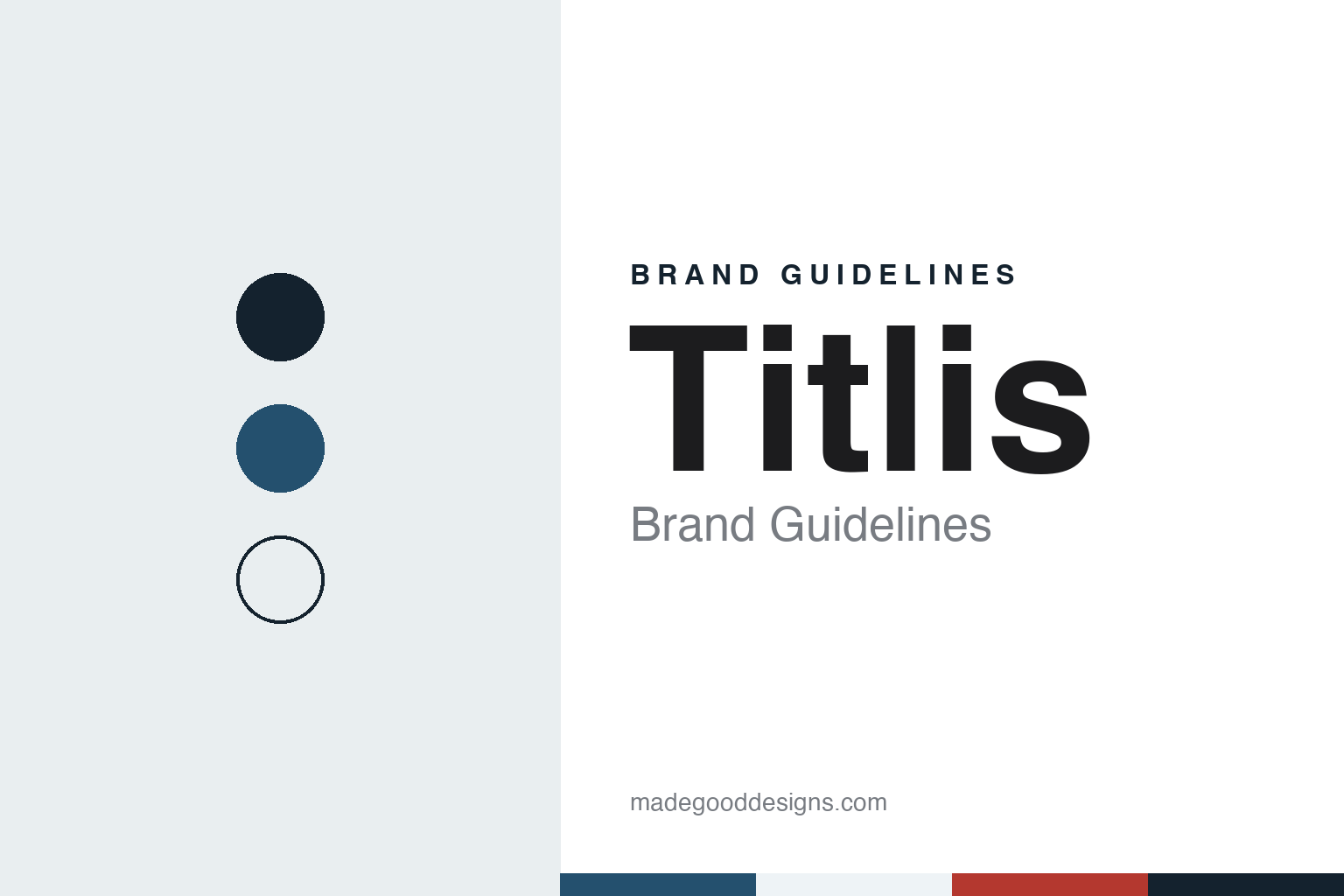
Titlis Brand Guidelines
Engelberg’s cableways, the Rotair and a summit rebuilt.
Aa
Two constants: a glacier blue, slate, white and red palette and an Alpine grotesque register. Abstract homage — not a Titlis cabin, sign or mark; no logo or livery is reproduced.
Engelberg to Klein Titlis
A funicular, a ropeway and a string of mergers.
Titlis is, to begin with, a mountain: a 3,238-metre summit of the Uri Alps on the border between the cantons of Obwalden and Bern, reached mainly from the monastery village of Engelberg on its north side, English Wikipedia says. A document of 1435 calls it Tuttelsberg, after a man named Tutilo, and the name later became Titlisberg and then Titlis. The brand, though, is the lift company that carries people up it.
That company is Bergbahnen Engelberg-Trübsee-Titlis AG, known as BET and trading as Titlis Bergbahnen. German Wikipedia gives its legal seat as Wolfenschiessen and its headquarters as Engelberg, says it employs more than 250 people on average through the year, and notes that its shares are listed on the SIX Swiss Exchange.
The business grew out of separate lift companies, each set up to build one line. The Drahtseilbahn Engelberg-Gerschnialp AG, founded in 1911, opened the funicular from Engelberg to Gerschnialp in January 1913. The Luftseilbahn Gerschnialp-Trübsee AG, founded in 1926, opened an aerial cableway from Gerschnialp to Trübsee in December 1927; German Wikipedia says it was built by the Leipzig firm Bleichert. A ski lift from Trübsee to the Jochpass followed in December 1943, and the Luftseilbahnen Trübsee-Kleintitlis AG opened its cableway to Klein Titlis in two stages, in the summer of 1965 and the spring of 1967. English Wikipedia dates the inauguration of the cable car to Klein Titlis to March 1967.
The companies came together over sixteen years. German Wikipedia says the Engelberg funicular company and the Gerschnialp–Trübsee cableway company merged in 1982 to form BET; the Trübsee–Kleintitlis company joined in 1992, and in 1998 the Trübsee-Jochpass-Engstlensee lift company joined together with the Jochpass-Jochstock ski lift and chairlift company.
Colour
The Rotair, the Cliff Walk and the restaurants.
The lift system climbs in stages. English Wikipedia lists the stations as Engelberg at 996 metres, Gerschnialp at 1,262 metres, Trübsee at 1,796 metres, Stand at 2,428 metres and Klein Titlis at 3,028 metres, and says a direct route from Engelberg to Trübsee, bypassing Gerschnialp, was created in 2016. German Wikipedia lists the company’s lines as the Engelberg–Gerschnialp funicular, gondola lifts from Engelberg to Gerschnialp and from Gerschnialp to Trübsee, aerial cableways from Gerschnialp to Trübsee and from Trübsee to Stand, and the Titlis Rotair from Stand to the summit, plus seven chairlifts and the Ice Flyer glacier lift. The last two cableways together are also called the Titlis-Seilbahn.
The Rotair is the line that gives the brand its picture. It opened in December 1992, German Wikipedia says, with cabins whose floors turned on their own axis during the ride between Stand and the summit station. In November 2014 the cabins were replaced, and since then the whole cabin has turned. The 2014–2015 period also brought the Titlis-Express, a detachable gondola built by Garaventa.
The summit itself has grown into a visitor complex. English Wikipedia describes an illuminated glacier cave entered from inside the cable-car station, which also holds shops and restaurants, and says the Titlis Cliff Walk, a suspension bridge, opened in December 2012. Catering began early: German Wikipedia says a self-service restaurant opened at Stand in the winter of 1966–1967 and a panorama restaurant on the Titlis in 1972. The restaurants now trade as Titlis Gastroland, and the company also runs the Hotel Terrace in Engelberg and the Berghotel Trübseehof near the Trübsee station.
For a designer, the system reads as a chain of names: Engelberg, Gerschnialp, Trübsee, Stand, Klein Titlis. Each stage has its own station, and the signage, timetables and tickets have to carry visitors from one cabin type to the next, from funicular cars to gondolas to the large revolving cabins of the Rotair.
Typography
Railways and ropeways.
Mountain railways, funiculars and cable cars present themselves through a small set of public materials: the line’s name, the operator’s logo and the livery of its cabins and railcars, all as the operators publish them. Many lines carry the name of a summit or a station rather than the name of the company, so a single identity often has to cover a railway, a cableway, a restaurant and a viewing platform at once.
Much of that identity is met on the ground. Valley and summit stations, platform signs, timetables, tickets and souvenir graphics repeat the same names and colours, and railcars and cabins often appear in the operator’s own photography against snow, rock and sky. Station names and altitudes are a recurring part of that signage, as the operators print them.
Engineering is a large part of the story these companies tell. Operators and the sources cited in each guide name the rack systems, rope systems, builders and cabin makers behind a line, and the dates on which sections opened, were rebuilt or received new rolling stock. Owners and operators are described plainly here: a listed holding company, a long-established local company or a subsidiary of a larger transport group, with dates taken from dated sources.
Each guide in this series sets out what can be checked about one line: when it opened, who runs it, which renewals and new sections have followed and how its name and graphics appear today. History pages and line-renewal announcements from the operators are cited as company statements, and independent reporting is named where it is used. The palettes and typefaces shown are unofficial interpretations, not the operators’ own.
Aa
An Alpine grotesque — compact, legible from a cabin window. (Specimen set in Archivo, a sans STAND-IN; NOT the Titlis logo.)
Titlis 3020
An antenna tower turned into a viewing platform.
The most visible change of recent years is architectural. In November 2018 the design magazine designboom reported that Herzog & de Meuron, the Basel architects, had drawn up a plan for the whole summit for Titlis Bergbahnen, under the name Titlis 3020. It covered three elements: the summit station of the cableway, first built in 1967 and expanded and renovated several times since; the roughly 50-metre beam antenna tower built in the 1980s by the Swiss Post; and the tunnel linking the two, which runs past the ice grotto. The plan kept the Rotair and proposed a new summit station in place of a further renovation of the old one, and reinforced the antenna tower with two glazed horizontal volumes, giving it a cross shape.
The tower came before the rest. Design Diffusion reported in July 2026 that the Titlis Tower opened its doors in June as the opening phase of the renovation; English Wikipedia dates the opening to May 2026. Design Diffusion described the work: the tower’s concrete base was extended to hold the visitor entrance, technical rooms and a garage, and the load-bearing steel structure was joined to two suspended horizontal volumes, four vertical circulation towers and a viewing platform, the Horizon Deck. The tower also holds a restaurant, Joseph’s. In the same article the company is named as Bergbahnen Engelberg-Trübsee-Titlis AG, with Titlis Cableways as its English name.
A second cableway has also been added. German Wikipedia says the Titlis Connect aerial cableway, from Stand to a point just below Klein Titlis, opened in 2025, first as a goods ropeway, and from 2026 also carries passengers, particularly while work on the Rotair is under way.
For a design guide, Titlis shows how a lift company’s identity can rest on one machine, the revolving cabin, and on a summit that keeps being rebuilt around it. Compare Pilatus-Bahnen, another central Swiss mountain operator near Lucerne, and Jungfraubahn. For this guide we use glacier blue, slate, white and a red with a sans, an unofficial interpretation; no product or logo is reproduced.
Explore & save
Keep Titlis’s identity on hand — save it to a board in the Made Good inspiration library.
Titlis identity set
Pin the Titlis glacier blue, slate, white and red palette and the Alpine grotesque register to your own board.
Source & notes
Frequently Asked Questions
What font can I use to match the Titlis look?
This guide describes Titlis’ type as “An Alpine grotesque — compact, legible from a cabin window”. Its type specimen is set in Archivo from Google Fonts as a stand-in; Archivo is not Titlis’ own lettering.
What colours are in the Titlis palette?
This guide’s Titlis palette is Glacier blue #24506E, Summit slate #14222E, Firn white #EEF3F6, Cabin red #B4382F and Paper #F7F8F8. The tones are the guide’s own unofficial interpretation, not official Titlis hex codes.
When was Titlis founded?
Titlis was founded in 1913 (funicular opened), in Engelberg, Switzerland.