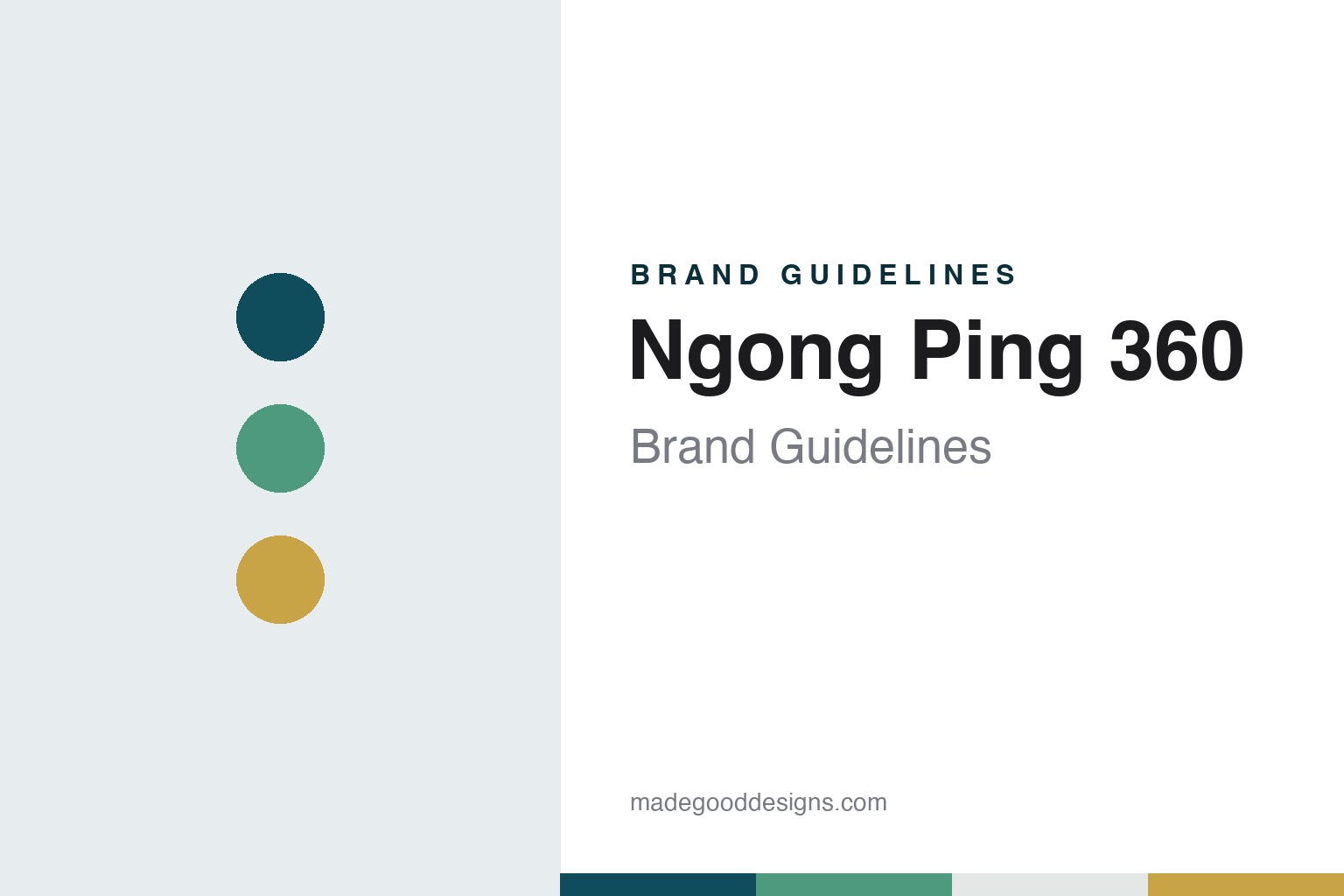
Ngong Ping 360 Brand Guidelines
Lantau’s MTR cable car, sold on the view from the cabin.
Aa
Two constants: a bay teal, jade and temple gold palette and a geometric sans register. Abstract homage — not a Ngong Ping 360 cabin or mark; no logo or livery is reproduced.
A cable car for Lantau
A government franchise, financed and built by MTR.
Ngong Ping 360 is the cable car and village attraction on Lantau Island in Hong Kong. It links the new town of Tung Chung, beside the MTR station of the same name, with the Ngong Ping plateau, home of the Po Lin Monastery and the Tian Tan Buddha. A background brief prepared for the Legislative Council’s Panel on Economic Services in October 2006 sets out how it came about. In 1998 the Financial Secretary announced that the government would go ahead with a cable car between Tung Chung and Ngong Ping as a tourist attraction, to be built under a 30-year franchise on a build-operate-transfer basis, with the government providing the land.
In July 2002 the government signed a provisional agreement with the MTR Corporation, the operator of Hong Kong’s railway, so that preparatory work could begin. The Tung Chung Cable Car Bill was introduced into the Legislative Council on 12 February 2003 and passed on 28 May 2003. In November 2003 the government signed a project agreement with MTR for the 30-year franchise to finance, design, build, run and maintain the line, and granted it a 30-year land lease for a themed village running from the upper terminal to the core of Ngong Ping, the Legislative Council paper says. English Wikipedia dates the start of construction to the beginning of 2004; the Hong Kong Institution of Engineers project record gives October 2002 to May 2006 for the project as a whole.
The name came before the opening. According to the LegCo brief, a marketing campaign in April 2005 announced “Ngong Ping 360” for the whole project, a reference to the panoramic views over North Lantau Country Park, Tung Chung Bay, the airport and the Buddha. The cable car itself was named Ngong Ping Skyrail and the themed village Ngong Ping Village; the operator’s website now calls the line the Ngong Ping Cable Car.
The cable car opened on 18 September 2006, the date the LegCo brief gives for its official opening and the date Travel News Asia gave in November 2006 for its opening to the public; English Wikipedia describes that day as a soft opening and dates a grand opening ceremony to 9 November 2006. At the start, Travel News Asia reported, the attraction was developed and financed by MTR and managed by Skyrail-ITM (Hong Kong), whose Australian parent ran the Skyrail Rainforest Cableway in Cairns. In September 2007, the Hong Kong government’s news service reported, an MTR subsidiary took over the management and operation of the cable car system. English Wikipedia says the line is owned by the MTR Corporation and run by a directly owned MTR subsidiary.
Colour
Leitner cabins, two angle stations and glass floors.
The line is a bicable gondola lift: one cable acts as a track in the air and a second hauls the cabins along it. The HKIE project record names Leitner as the cable car contractor, Aedas as architect, Arup as civil and electrical-mechanical consultant and Maeda as civil and building contractor. Leitner’s own reference page lists the line as a 2006 installation for MTR with a length of 5,784 metres, a height difference of 418 metres, a line speed of seven metres per second and a capacity of 3,500 people per hour. The operator rounds the length to 5.7 km and gives the ride as about 25 minutes.
The route is not straight. English Wikipedia describes two angle stations, one on the south shore of the airport island at Chek Lap Kok and one west of Nei Lak Shan inside Lantau North Country Park, where cabins detach from the cables to change direction without passengers getting on or off. The operator says the line turns 60 degrees at the airport island station towards North Lantau. The cableway is carried on eight towers, five of them inside the country park, Wikipedia says, and the HKIE record says the alignment and type of system were chosen to keep the number of towers down.
The cabins are the most visible part of the brand. Wikipedia describes the standard cabin as seating ten with room for seven more standing, and dates the Crystal Cabin, with a glass floor, to April 2009. The operator now sells three classes: the Standard Cabin, the Crystal Cabin and Crystal+, which it says uses tempered glass giving more than 80 per cent visibility. Its pages sell the ride on what passengers see on the way: Tung Chung Bay, the airport, the Hong Kong–Zhuhai–Macao Bridge, the green slopes of North Lantau and, at the end, the Buddha.
At the top, Travel News Asia described Ngong Ping Village in 2006 as a 1.5-hectare village in a traditional Chinese style, with landscaped gardens, beside the upper terminal. The HKIE record lists its early attractions as Walking with Buddha, the Monkey’s Tale Theatre and the Ngong Ping Tea House, alongside shops and restaurants.
Typography
Lines, cars and the view.
Mountain railways, funiculars and cable cars present themselves through a small set of public materials: the line’s name, the operator’s logo and the livery of its cabins and railcars, all as the operators publish them. Many lines carry the name of a summit or a station rather than the name of the company, so a single identity often has to cover a railway, a cableway, a restaurant and a viewing platform at once.
Much of that identity is met on the ground. Valley and summit stations, platform signs, timetables, tickets and souvenir graphics repeat the same names and colours, and railcars and cabins often appear in the operator’s own photography against snow, rock and sky. Station names and altitudes are a recurring part of that signage, as the operators print them.
Engineering is a large part of the story these companies tell. Operators and the sources cited in each guide name the rack systems, rope systems, builders and cabin makers behind a line, and the dates on which sections opened, were rebuilt or received new rolling stock. Owners and operators are described plainly here: a listed holding company, a long-established local company or a subsidiary of a larger transport group, with dates taken from dated sources.
Each guide in this series sets out what can be checked about one line: when it opened, who runs it, which renewals and new sections have followed and how its name and graphics appear today. History pages and line-renewal announcements from the operators are cited as company statements, and independent reporting is named where it is used. The palettes and typefaces shown are unofficial interpretations, not the operators’ own.
Aa
A clean geometric sans for cabin numbers and route maps. (Specimen set in Manrope, a sans STAND-IN; NOT the Ngong Ping 360 logo.)
Ngong Ping 360
Twenty years of wrapped cabins.
The attraction marked its 20th anniversary in 2026. The Standard reported on 23 June 2026 that all 108 cabins had been wrapped in anniversary designs: 24 carried collaborations with local and international brands, and the other 84 were fitted with patterns that glow in the dark. That summer the cable car added evening services, running until 10 pm on eight days in July and August, and passengers with night tickets were given small ultraviolet torches to find luminous patterns inside the cabins.
The village changed with it. According to The Standard, three photo spots recreated a mahjong table, a classic MTR station and an old “bing sutt” café; a retired standard cabin became a neon installation at Stupa Square; and after dark the village was lit to look like a 1980s Hong Kong neon streetscape, with live music from local singers. The managing director, James Tung Pui-chuen, told the paper that the night route passes the lit airport, the Hong Kong–Zhuhai–Macao Bridge and the illuminated Buddha.
For designers, the cabin is the surface to study. Its shape stays fixed, while the wraps change from campaign to campaign, and the name itself, with its number, points to the view rather than to the machinery, as the 2005 campaign set out.
For a design guide, Ngong Ping 360 shows how a transport franchise can be branded as a view: a number in the name, cabin classes defined by how much glass they offer, and a themed village at the top. Compare the Peak Tram, the funicular to Victoria Peak, and MTR, the railway company that holds the cable car franchise. For this guide we use a bay teal, a jade green, a soft mist grey and a temple gold with a sans, an unofficial interpretation; no product or logo is reproduced.
Explore & save
Keep Ngong Ping 360’s identity on hand — save it to a board in the Made Good inspiration library.
Ngong Ping 360 identity set
Pin the Ngong Ping 360 bay teal, jade and temple gold palette and the geometric sans register to your own board.
Source & notes
Frequently Asked Questions
What font can I use to match the Ngong Ping 360 look?
This guide describes Ngong Ping 360’s type as “A clean geometric sans for cabin numbers and route maps”. Its type specimen is set in Manrope from Google Fonts as a stand-in; Manrope is not Ngong Ping 360’s own lettering.
What colours are in the Ngong Ping 360 palette?
This guide’s Ngong Ping 360 palette is Bay teal #0F4C5C, Deep channel #0B2F38, Lantau jade #4E9A7E, Morning mist #E3E7E6 and Temple gold #C9A447. The tones are the guide’s own unofficial interpretation, not official Ngong Ping 360 hex codes.
When did Ngong Ping 360 open?
Ngong Ping 360 opened on 18 September 2006 (Tung Chung to Ngong Ping, Lantau).