Accor Arena Brand Guidelines
The 1984 Bercy pyramid with lawn-covered walls.
Aa
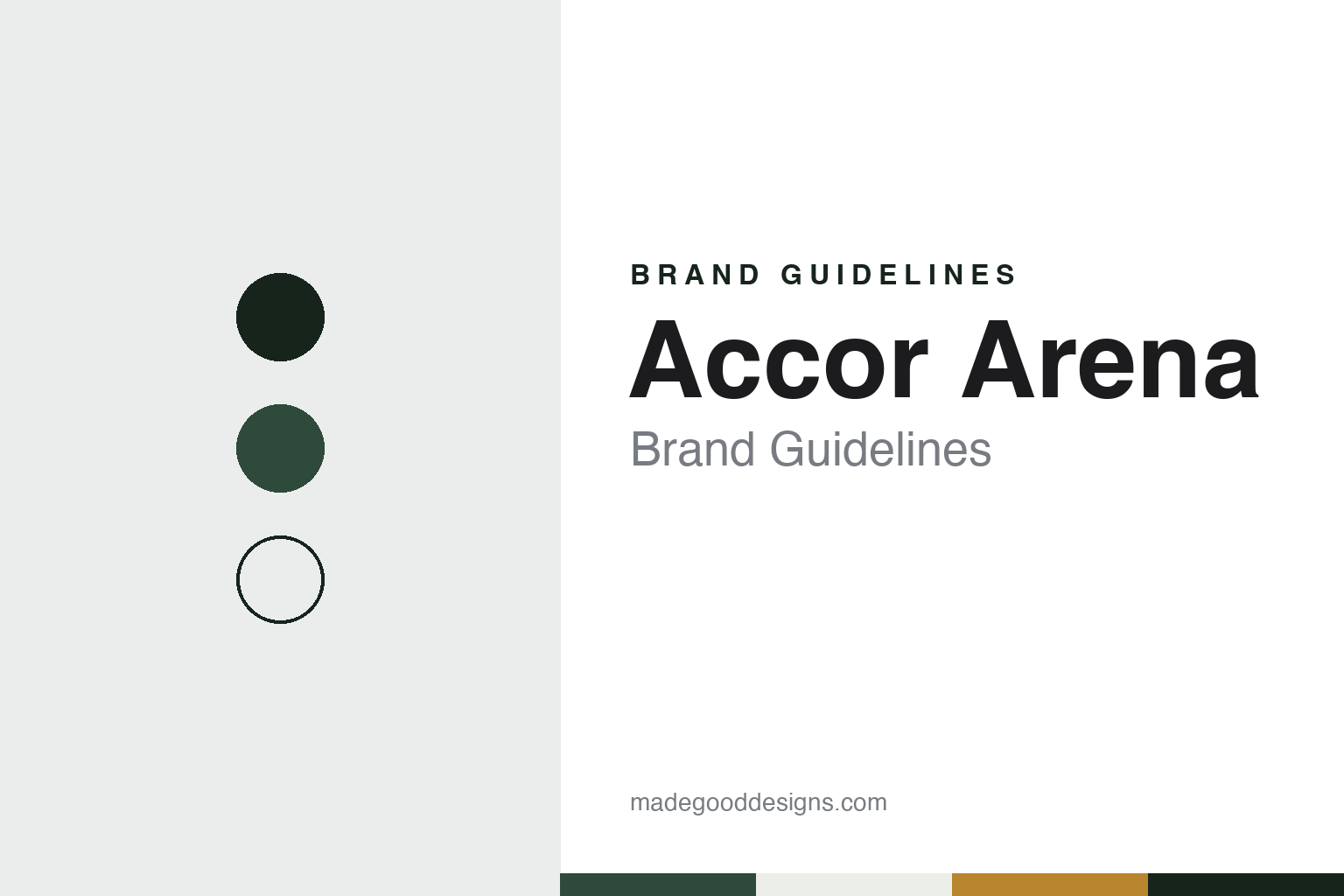
Two constants: a lawn green, night ink and brass palette and a wide grotesque sans register. Abstract homage — not an Accor Arena asset or mark; no logo, sign or building image is reproduced.
Paris-Bercy
A competition, a pyramid and a Prouvé roof.
The building now called Accor Arena began as the Palais omnisports de Paris-Bercy, a name usually shortened to POPB, “Paris-Bercy” or simply “Bercy.” It stands on the Boulevard de Bercy in the 12th arrondissement of Paris, on the right bank of the Seine, between the Ministry of the Economy and Finance and the Parc de Bercy. French Wikipedia describes the site’s earlier life as part of the old Bercy wine warehouses, active until the 1960s and then left to decline, before the City of Paris drew up a new district there in the 1970s.
The hall came out of a design competition. In May 1979 the City of Paris invited sixteen architectural teams to propose a sports palace for the future Parc de Bercy, and on 23 October 1979 it chose the team of Michel Andrault and Pierre Parat with Jean Prouvé and Aydin Guvan, according to French Wikipedia. Foundation work began in February 1981, construction proper on 30 March 1981, and the work ended in December 1983. The hall opened on 3 February 1984 with the Six Jours de Paris track-cycling race, and English Wikipedia dates its opening concert to 17 February 1984, when the Orchestre de Paris performed Berlioz’s Grande Messe des Morts.
French Wikipedia describes a pyramid whose sloping outer walls are covered with lawn, and a main hall with no load-bearing posts in the stands: four pylons set back from the seating carry an irregular steel roof frame conceived by Prouvé, about 24 metres above the floor, with a rail network for moving lighting, sound and staging. Covering some 55,000 square metres, the building also houses an ice rink, the Patinoire Sonja-Henie, the same source says.
Colour
Sport, concerts and long residencies.
From the start Bercy was built to switch between sport and shows. French Wikipedia lists the Six Jours de Paris from 1984 to 1989, an indoor BMX event from December 1984 to 1990, and indoor athletics championships in 1994, 1997 and 2011. English Wikipedia says the hall was the main home of the Paris Masters tennis tournament until 2024, and that it hosts the Grand Slam Paris judo event and the LNB All-Star Game in basketball. It has hosted the Festival des Arts Martiaux every year since 1985; the 38th edition took place in March 2025. In 2024 it was a venue of the Paris Olympic Games, for artistic and trampoline gymnastics and the basketball medal games, and of the Paralympic Games, for wheelchair basketball, English Wikipedia says. Regular-season NBA games have been played there in 2020, 2023, 2024 and 2025.
English Wikipedia records that Queen played Bercy in 1984 and A-ha in 1988, and it counts Johnny Hallyday as the artist who appeared there most often, with 93 solo concerts between 1987 and 2016 and eight more with Les Vieilles Canailles. On 14 September 2021 the square in front of the hall was officially renamed the esplanade Johnny-Hallyday, French Wikipedia says. When Pollstar reported on the reopened hall in November 2015, the coming months’ line-up included Madonna alongside sports shows and wrestling.
The concert set-up is flexible. French Wikipedia describes a stage at one end or a central “American” stage, with capacity changing as the floor is opened; the main hall can be arranged for anything from about 3,500 seated to 20,300 seated and standing in the 360-degree configuration, the same source says.
Typography
Design and documentation.
An arena presents itself through a small set of public pieces: its name, the wordmark its operator publishes, the building itself, the signs and screens that guide visitors inside, and the ticket that gets them through the door. Some names are older than the buildings that carry them. Madison Square Garden in New York is the fourth venue of that name, English Wikipedia says, and the current building, opened in February 1968, stands at 31st to 33rd streets, away from Madison Square itself, where the first two stood.
Other arenas take their names from a sponsor. The former Millennium Dome in London became The O2 under a naming-rights deal with the mobile network O2 that The Register reported in May 2005, and Music Week reported in 2017 that the agreement had been extended for a further ten years. A sponsor’s name can also be set aside: during the London 2012 Games the arena inside The O2 was called the North Greenwich Arena, because of the Games’ rules on corporate sponsorship.
The buildings carry much of the identity. Trade press and architects’ accounts describe them in material terms: Building with Steel in 1968 described Madison Square Garden as a circular drum faced in brown precast concrete under a cable-suspended roof, credited to Charles Luckman Associates, and Pollstar in 2022 described how Populous built The O2’s arena inside an existing tent with twelve yellow masts. The signage, wayfinding, digital screens, tickets and colour schemes that operators publish are part of the same picture.
Behind each venue sits a chain of owners, operators and sponsors, and those relationships change. This guide describes them plainly and with dates, as the sources give them, along with the renamings, the architects and the companies’ own pages on their history.
Aa
A wide grotesque sans for a building that reads as a shape on the skyline. (Specimen set in Archivo, a sans STAND-IN; NOT the Accor Arena logo.)
Accor Arena
Four names on one pyramid.
The current name dates from the hall’s renovation. Work began in 2014 and ended in October 2015, interrupted for the tennis tournament and a run of concerts, according to French Wikipedia; the construction weekly Batiweb reported on 15 October 2015 that the works ran from April 2014 to October 2015 for the operating company, the Société anonyme d’exploitation du Palais omnisports de Paris-Bercy (SAE POPB), with the Paris architects DVVD among the project’s designers. The hall grew from 17,000 to 20,300 places in its biggest configuration, Batiweb reported, with a new 2,000-square-metre hall for food and events, 4,000 square metres of business-club space over four levels and a reworked pedestrian promenade outside.
The name changed in stages. English Wikipedia says the hall became Bercy Arena on 1 January 2015. On 8 October 2015 the International Association of Venue Managers’ news blog reported that it would reopen on 17 October as the AccorHotels Arena, under a ten-year naming agreement for a venue “managed by AEG and the city of Paris,” with 30 seating configurations ranging from 8,000 to 20,300 seats. Pollstar reported in November 2015 that the City of Paris owns the building and that it is operated by a management company in which AEG and the city are partners; French Wikipedia gives that company’s shares as 52 per cent for the City of Paris and 48 per cent for Anschutz Entertainment Group. After the hotel group itself returned to the single name Accor, the Conseil de Paris voted on 5 April 2019 to change the hall’s name, and it became Accor Arena in 2020 — officially “Accor Arena POPB,” French Wikipedia says; English Wikipedia dates the change to June 2020. French Wikipedia adds that Accor pays only to put its name on the building.
The architecture still does the identity work. In the 2015 Batiweb report, DVVD’s Daniel Vaniche described the building as strong in the Paris cityscape for its pyramid form, its lawn-covered slopes and the metal lattice of its roof — a description that holds through every change of sign.
For a design guide, Accor Arena shows how a sponsor’s name can sit on a building whose form is the real signature. Compare Accor, the hotel group behind the name, and The O2, another arena tied to AEG. For this guide we use a lawn green, a night ink and a brass with a sans, an unofficial interpretation; no product or logo is reproduced.
Explore & save
Keep Accor Arena’s identity on hand — save it to a board in the Made Good inspiration library.
Accor Arena identity set
Pin the Accor Arena lawn green, night ink and brass palette and the wide grotesque sans register to your own board.
Source & notes
Frequently Asked Questions
What font can I use to match the Accor Arena look?
This guide describes Accor Arena’s type as “A wide grotesque sans for a building that reads as a shape on the skyline”. Its type specimen is set in Archivo from Google Fonts as a stand-in; Archivo is not Accor Arena’s own lettering.
What colours are in the Accor Arena palette?
This guide’s Accor Arena palette is Bercy lawn green #2E4A3A, Night ink #17241C, Concrete pale #ECEFE8, Stage brass #B8862F and Paper #F7F7F4. The tones are the guide’s own unofficial interpretation, not official Accor Arena hex codes.
When did Accor Arena open?
Accor Arena opened on 3 February 1984 (Bercy, Paris 12e).
Who owns Accor Arena?
Accor Arena is owned by City of Paris. This guide dates Accor Arena to 3 February 1984 (Bercy, Paris 12e).