Rod Laver Arena Brand Guidelines
A tennis centre court that doubles as Melbourne’s concert hall.
Aa
Two constants: a night-session, court-blue and roof-silver palette and a condensed sports sans register. Abstract homage — not a Rod Laver Arena or Melbourne Park asset; no logo, sign or wordmark is reproduced.
Flinders Park
A new home for the Australian Open.
Rod Laver Arena was built to give the Australian Open a new home. From 1972 to 1987 the tournament had been played on the grass of Kooyong, in Melbourne’s inner east, and the club had become too small for it, the reference site Grand Slam History says. English Wikipedia says the new precinct was developed beside the Jolimont rail yard, near the Yarra River, and the tournament moved there in 1988.
Construction began in 1985, with the builder Civil & Civic, and was completed in 1987, English Wikipedia says. Australasian Leisure Management reported in September 2016 that the arena was first designed by Cox Architecture in association with Peddle Thorp. Melbourne & Olympic Parks, which runs the venue, dates the completion of the first stage to 1987: a centre court of 14,280 seats under a 700-tonne retractable roof, with match and practice courts, concourses, transport links and car parking.
The arena opened on 11 January 1988, in time for that year’s championships, English Wikipedia says. Its first name was the National Tennis Centre at Flinders Park, and the court itself was known as Centre Court. Melbourne & Olympic Parks says AC/DC was the first live band to play there, in the same year. In 1996 the whole precinct was renamed Melbourne Park, Grand Slam History says, and the arena carried the Centre Court name until the end of the decade.
Colour
A tennis court, a concert hall and a roof.
From the start the building was meant to do two jobs. It is the centre court of the Australian Open each January, and for the rest of the year it is one of Melbourne’s main halls for concerts and other sport. English Wikipedia says that for events other than tennis, part of the southern lower seating bowl is pulled back to make room for a stage or floor seating, and lists basketball, motorbike supercross, ballet, conferences and wrestling among its past uses. English Wikipedia gives the seating capacity as 14,820 for tennis, up to 15,400 for basketball with seats added around the court, and up to 14,200 for concerts with floor seating. Between 1992 and 2000 it was a home court for Melbourne’s National Basketball League teams.
Melbourne & Olympic Parks gives some of the dated events in its own history: the 2005 World Artistic Gymnastics Championships, the gymnastics events of the 2006 Commonwealth Games, and a record crowd of 16,183 for a Justin Timberlake concert on 18 November 2007. English Wikipedia adds the 2007 world swimming championships, for which a temporary pool was built inside the arena, and the 2003 Davis Cup semi-final and final.
The colour most people link with the court has changed. Grand Slam History says the Australian Open was played on green Rebound Ace from 1988 to 2007 and switched in 2008 to Plexicushion in a bright blue; English Wikipedia says the surface was changed again in 2019, to Greenset, keeping the blue.
The roof has been rebuilt too. In the second stage of the Melbourne Park redevelopment the roof was modernised, the Victorian Government said in September 2019, and English Wikipedia says it can now close in five minutes, against about 30 minutes before.
Typography
Venues, names and buildings.
An arena presents itself through a small set of public pieces: its name, the wordmark its operator publishes, the building itself, the signs and screens that guide visitors inside, and the ticket that gets them through the door. Some names are older than the buildings that carry them. Madison Square Garden in New York is the fourth venue of that name, English Wikipedia says, and the current building, opened in February 1968, stands at 31st to 33rd streets, away from Madison Square itself, where the first two stood.
Other arenas take their names from a sponsor. The former Millennium Dome in London became The O2 under a naming-rights deal with the mobile network O2 that The Register reported in May 2005, and Music Week reported in 2017 that the agreement had been extended for a further ten years. A sponsor’s name can also be set aside: during the London 2012 Games the arena inside The O2 was called the North Greenwich Arena, because of the Games’ rules on corporate sponsorship.
The buildings carry much of the identity. Trade press and architects’ accounts describe them in material terms: Building with Steel in 1968 described Madison Square Garden as a circular drum faced in brown precast concrete under a cable-suspended roof, credited to Charles Luckman Associates, and Pollstar in 2022 described how Populous built The O2’s arena inside an existing tent with twelve yellow masts. The signage, wayfinding, digital screens, tickets and colour schemes that operators publish are part of the same picture.
Behind each venue sits a chain of owners, operators and sponsors, and those relationships change. This guide describes them plainly and with dates, as the sources give them, along with the renamings, the architects and the companies’ own pages on their history.
RL
A condensed sans with the upright, numbered feel of a scoreboard. (Specimen set in Barlow Condensed, a sans STAND-IN; NOT the Rod Laver Arena logo.)
Rod Laver Arena
A name honouring a player, and a new face.
The arena took its present name on 16 January 2000, Melbourne & Olympic Parks says, when it was renamed in recognition of the Australian tennis player Rod Laver. Grand Slam History describes him as a two-time winner of the calendar Grand Slam. The neighbouring Show Court One followed the same pattern on 12 January 2003, when it was renamed Margaret Court Arena, the venue company says.
The arena is owned by the State of Victoria and managed by the Melbourne & Olympic Parks Trust, the body that also runs the precinct’s other arenas and the rectangular stadium next door. English Wikipedia says the trust was set up in October 1995 under an amended Melbourne and Olympic Parks Act of 1985. It trades as Melbourne & Olympic Parks, and its website presents Rod Laver Arena alongside Margaret Court Arena, John Cain Arena, Kia Arena and AAMI Park. Its site notes that Melbourne Park is moving its ticketing to AXS as official ticketing partner, with some events still sold through Ticketek.
The building’s present face dates from a major refit. In September 2016 Australasian Leisure Management reported the redevelopment design by Cox Architecture, the firm that had worked on the original: four new annexes, or “pods,” one of them becoming the main public entrance, a re-skinned facade, new food and drink spaces, better disability access, a reworked loading bay and rigging, and automated retractable seating, built by Lendlease. The magazine called it the first major work at the arena since 1988. English Wikipedia says construction began in April 2016 and the refurbishment was finished in late December 2018. In September 2019 the Victorian Government announced that the second stage of the Melbourne Park redevelopment was complete, with a new Northern Annex, ramp access to the seating bowl and a Changing Places accessible facility.
For a design guide, Rod Laver Arena shows how one building can carry a sports identity and an entertainment identity at once, under a name that honours a person rather than a sponsor. Compare 3Arena, whose predecessor, the Point, also opened in 1988, and AXS. For this guide we use a night-session navy, a court blue and a roof silver with a condensed sans, an unofficial interpretation; no product or logo is reproduced.
Explore & save
Keep Rod Laver Arena’s identity on hand — save it to a board in the Made Good inspiration library.
Rod Laver Arena identity set
Pin the night-session, court-blue and roof-silver palette and the condensed sports sans register to your own board.
Source & notes
Frequently Asked Questions
What font can I use to match the Rod Laver Arena look?
This guide describes Rod Laver Arena’s type as “A condensed sans with the upright, numbered feel of a scoreboard”. Its type specimen is set in Barlow Condensed from Google Fonts as a stand-in; Barlow Condensed is not Rod Laver Arena’s own lettering.
What colours are in the Rod Laver Arena palette?
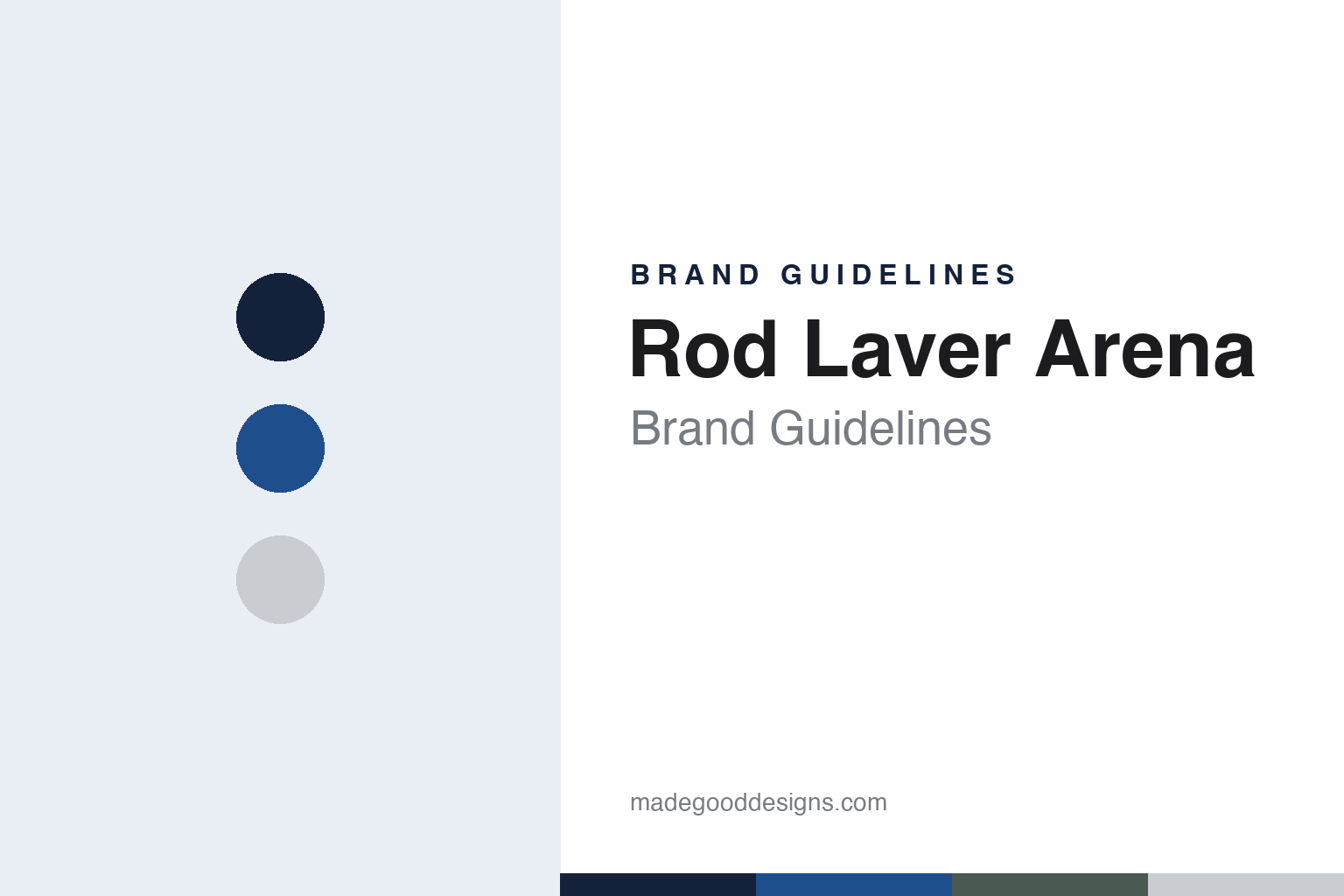
This guide’s Rod Laver Arena palette is Night session #14213A, Court blue #1F4E8C, Bluestone #4A5A52, Roof silver #C9CDD2 and Paper #F5F6F4. The tones are the guide’s own unofficial interpretation, not official Rod Laver Arena hex codes.
When did Rod Laver Arena open?
Rod Laver Arena opened in January 1988, in Flinders Park, Melbourne.