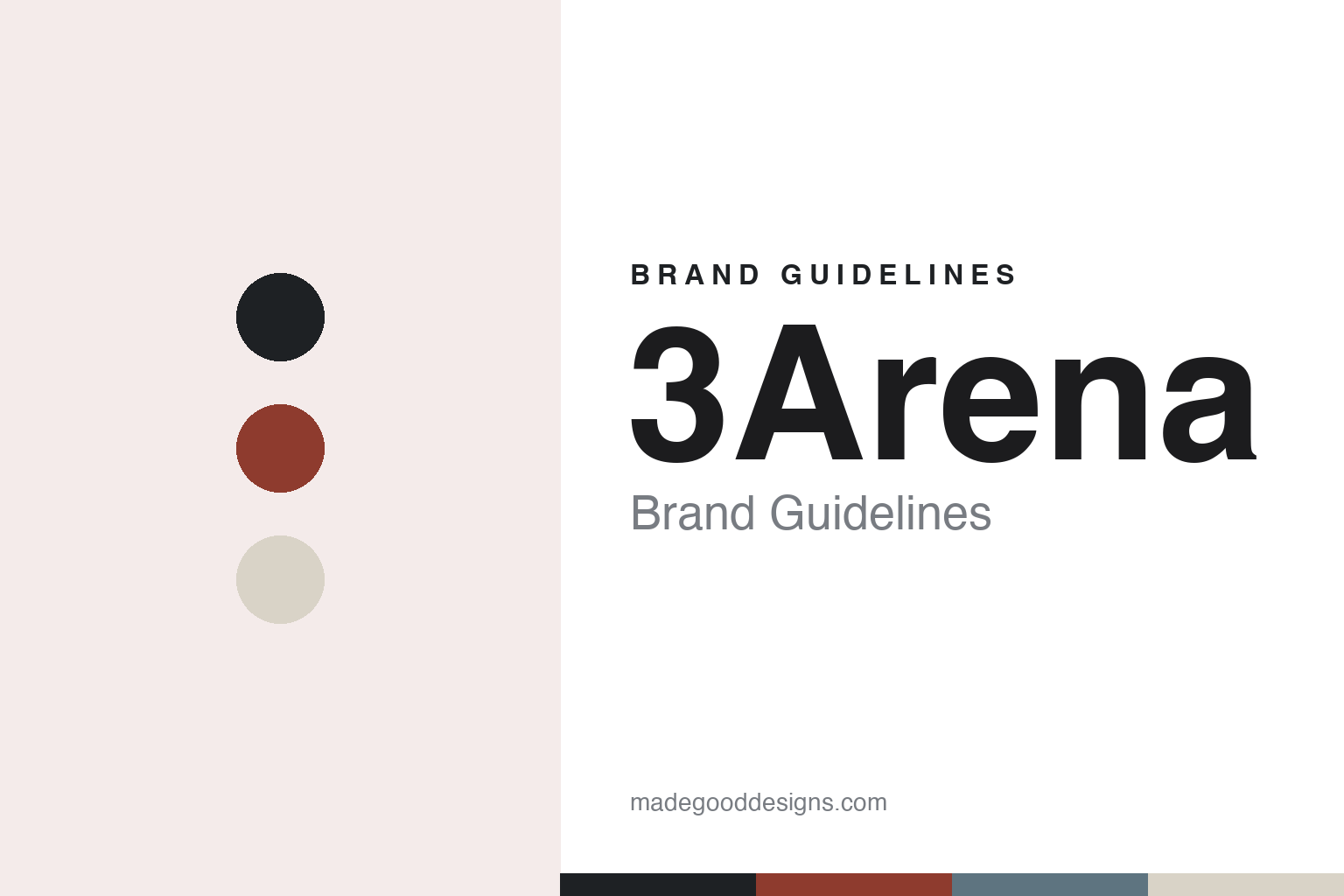
3Arena Brand Guidelines
A Victorian railway store on the Liffey, rebuilt as an arena and renamed twice.
Aa
Two constants: a dock-night, depot-brick and Liffey-slate palette and an industrial grotesque register. Abstract homage — not a 3Arena or Three Ireland asset; no logo, sign or wordmark is reproduced.
The Point
A railway store on the quay, then a music hall.
3Arena stands on North Wall Quay in the Dublin Docklands, on the north bank of the River Liffey, a mile or so downriver from the city centre. The building began as something else entirely. It was put up in 1878 as a train depot serving the busy port, New Steel Construction reported in September 2008, and English Wikipedia adds that railwaymen knew it as “the Point Store.”
By the late 1980s the depot had stood unused for years. English Wikipedia says the Dublin developer Harry Crosbie bought it and, with Apollo Leisure, now part of Live Nation, fitted it out with balconies, offices and backstage space. It opened as a concert and events hall in 1988, known as the Point Theatre or the Point Depot. Before the refit, U2 recorded “Van Diemen’s Land” in the empty building for their 1988 album Rattle and Hum, Wikipedia says.
English Wikipedia describes a hall that was turned into an ice rink, a boxing ring, an exhibition centre, an opera house and a circus as well as a concert venue, with about 6,300 seats or room for 8,500 standing. It hosted the Eurovision Song Contest in 1994, 1995 and 1997, and Riverdance was first performed there as the interval act of the 1994 contest. The Point closed in 2007 for a full rebuild.
Colour
Three old walls and a new steel bowl.
The rebuild kept the old depot’s skin and replaced almost everything inside it. New Steel Construction, the British steel-industry magazine, set out the team in its fact file of 1 September 2008: client Live Nation, architect HOK Sport, main contractor Walls Construction, structural engineer Buro Happold and steelwork contractor Walter Watson, with about 2,900 tonnes of steel.
Three of the depot’s original brick walls were kept and the fourth was taken down, so that a new steel-framed interior and a new, higher roof could be built inside, a Buro Happold project leader told the magazine. To fit the new auditorium within the old walls, the stage and seating were turned through 90 degrees. Nine of the original cast-iron columns and 17 wrought-iron beams were tested, reused and built into the new frame, set in new positions.
The first steel to go up was four 27-metre “super columns,” one in each corner, linked by 54-metre roof trusses; the steel contractor compared the result to a giant table, with the columns as legs and the trusses as its top. The roof was designed to carry touring equipment in different layouts. The magazine reported that the work would nearly double the concert capacity to about 14,000, and that the venue would open in December 2008.
The seats wrap the stage in a wide fan. English Wikipedia says the furthest seat is about 60 metres from the stage, some 20 metres closer than in the old Point, that the architects likened the plan to the Colosseum in Rome, and that there are no corporate boxes. The venue’s own site now calls it an amphitheatre-style auditorium for more than 13,000 people. A Luas light-rail stop at the back of the building, called The Point, opened on 8 December 2009, Wikipedia says.
Typography
Venues, names and buildings.
An arena presents itself through a small set of public pieces: its name, the wordmark its operator publishes, the building itself, the signs and screens that guide visitors inside, and the ticket that gets them through the door. Some names are older than the buildings that carry them. Madison Square Garden in New York is the fourth venue of that name, English Wikipedia says, and the current building, opened in February 1968, stands at 31st to 33rd streets, away from Madison Square itself, where the first two stood.
Other arenas take their names from a sponsor. The former Millennium Dome in London became The O2 under a naming-rights deal with the mobile network O2 that The Register reported in May 2005, and Music Week reported in 2017 that the agreement had been extended for a further ten years. A sponsor’s name can also be set aside: during the London 2012 Games the arena inside The O2 was called the North Greenwich Arena, because of the Games’ rules on corporate sponsorship.
The buildings carry much of the identity. Trade press and architects’ accounts describe them in material terms: Building with Steel in 1968 described Madison Square Garden as a circular drum faced in brown precast concrete under a cable-suspended roof, credited to Charles Luckman Associates, and Pollstar in 2022 described how Populous built The O2’s arena inside an existing tent with twelve yellow masts. The signage, wayfinding, digital screens, tickets and colour schemes that operators publish are part of the same picture.
Behind each venue sits a chain of owners, operators and sponsors, and those relationships change. This guide describes them plainly and with dates, as the sources give them, along with the renamings, the architects and the companies’ own pages on their history.
3A
A compact industrial grotesque, matched to brick, steel and a numeral name. (Specimen set in Archivo, a sans STAND-IN; NOT the 3Arena logo.)
3Arena
From The O2 to a numeral.
The rebuilt hall opened as The O2 on 16 December 2008, taking the name of the mobile network O2 under a naming agreement, similar to The O2 in London, Wikipedia notes. English Wikipedia gives a charity concert on that date as the first event. The change from the Point to The O2 drew an outcry at the time, Hospitality Ireland recalled in 2014.
That name lasted under six years. English Wikipedia dates the sale of O2 Ireland to the rival operator Three Ireland to June 2014, and on 4 September 2014 Three announced the venue’s new name: 3Arena, written as one word with a numeral in place of the network’s spelled-out name. Hospitality Ireland reported that a crane had lifted the O2 sign off the building the day before. To mark the change, Three ran “3Arena Illuminated” from 10 to 13 September, projecting animation and words onto the outside of the building, Hot Press reported on the day of the announcement. Both titles gave the capacity then as 13,500 and said the venue hosted more than 100 shows a year.
Ownership has stayed constant through both names. Hot Press described the venue as Live Nation-owned and quoted the chief executive of Live Nation Ireland as speaking for its owners; English Wikipedia names the owning company as Apollo Leisure Group, a Live Nation subsidiary. The arena’s own site says the Three Ireland sponsorship began in 2014. As under O2, the sponsor runs its own rooms inside: the site lists four club and bar spaces, of which Three+ Lounge and Club 3 are operated by Three Ireland, while two private members’ clubs are run by the venue, one called the Studio and one called the 1878, the year the depot was built.
The visual identity therefore sits in layers: the brick shell of a railway store, a modern steel bowl and a sponsor’s name that has already changed once. The arena’s website and tickets use the 3Arena name, while the retained Victorian brick walls remain the building’s outer face, as New Steel Construction described in 2008.
For a design guide, 3Arena shows how a venue can keep a historic building as its face while its name follows a sponsor. Compare The O2, the London arena whose naming model the Dublin venue first borrowed, and Ticketmaster. For this guide we use a dock-night charcoal, a depot-brick red and a Liffey slate blue with a sans, an unofficial interpretation; no product or logo is reproduced.
Explore & save
Keep 3Arena’s identity on hand — save it to a board in the Made Good inspiration library.
3Arena identity set
Pin the dock-night, depot-brick and Liffey-slate palette and the industrial grotesque register to your own board.
Source & notes
Frequently Asked Questions
What font can I use to match the 3Arena look?
This guide describes 3Arena’s type as “A compact industrial grotesque, matched to brick, steel and a numeral name”. Its type specimen is set in Archivo from Google Fonts as a stand-in; Archivo is not 3Arena’s own lettering.
What colours are in the 3Arena palette?
This guide’s 3Arena palette is Dock night #1E2124, Depot brick #8E3B2E, Liffey slate #5E7480, Quay stone #D9D3C7 and Paper #F6F4EF. The tones are the guide’s own unofficial interpretation, not official 3Arena hex codes.
Who owns 3Arena?
3Arena is owned by Live Nation.