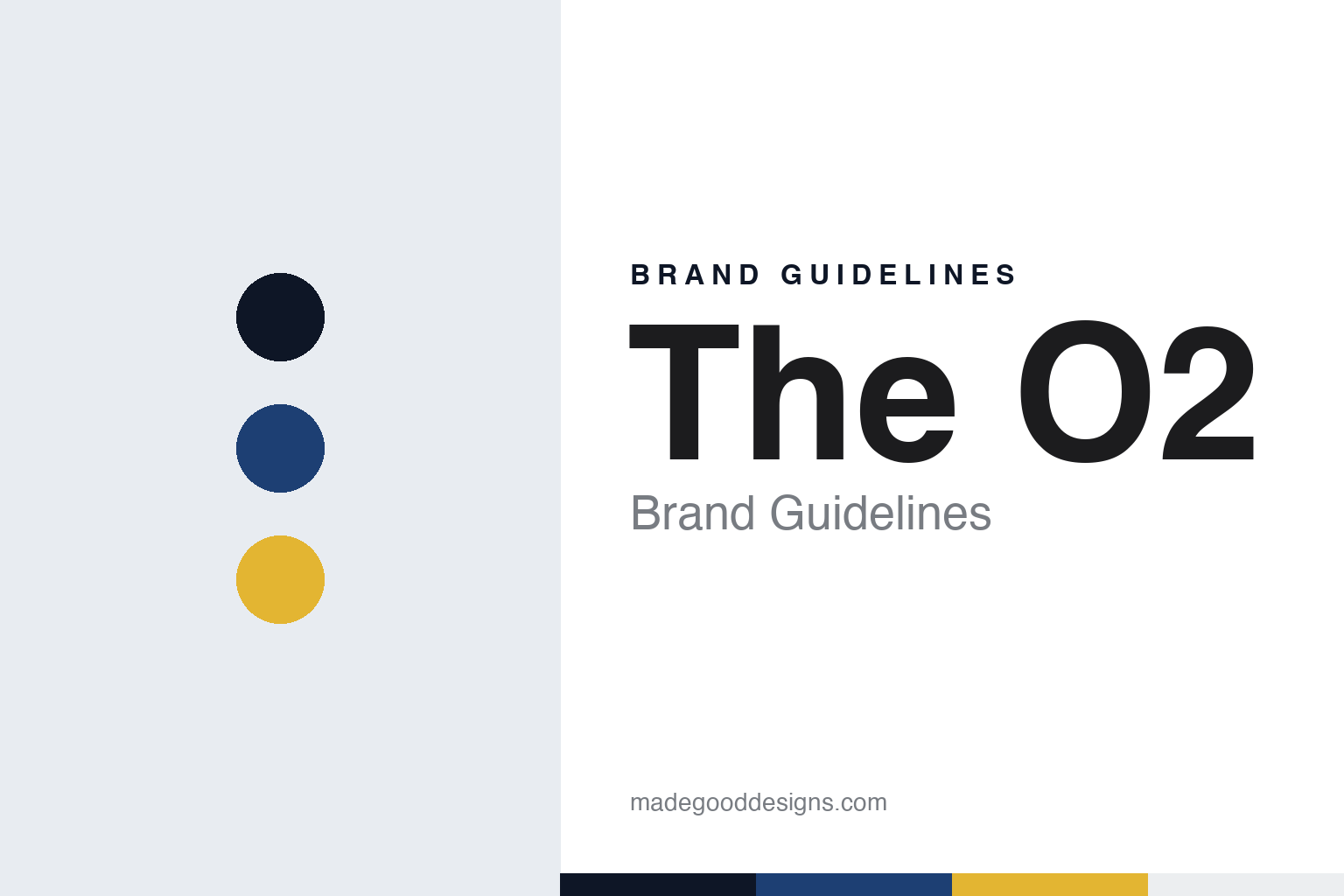
The O2 Brand Guidelines
A white tent with twelve yellow masts, renamed and refilled as an arena district.
Aa
Two constants: a blue, mast yellow and canopy white palette and a rounded geometric sans register. Abstract homage — not an asset of The O2; no logo, sign or ticket is reproduced.
After the Dome
A millennium tent looking for a use.
The O2 is an entertainment district on the Greenwich Peninsula in south-east London, built inside the shell of the Millennium Dome. English Wikipedia describes the Dome as a large white marquee with twelve 100-metre yellow support towers, one for each month of the year or each hour on a clock face, a nod to Greenwich Mean Time; in plan it is a circle 365 metres across, and its canopy is 52 metres high at the centre. The architect was Richard Rogers, and the structure was engineered by Buro Happold. The building housed the Millennium Experience exhibition, which was open to the public from 1 January to 31 December 2000.
After the exhibition closed, the shell needed a new use. In December 2001 the developer Meridian Delta, then a subsidiary of Quintain and Lendlease, was chosen to turn the Dome into a sports and entertainment centre, and the building was sub-leased to Anschutz Entertainment Group, or AEG, for 58 years, Wikipedia says; AEG would develop and operate it for the length of the lease. In 2009 Quintain and Lendlease sold their interest in Meridian Delta to Trinity College, Cambridge.
Pollstar, in a 2022 article marking the venue’s fifteenth year, described how Tim Leiweke, then running AEG, looked at the site in 2001 while searching London for a place to build an arena, and was drawn by the tent and its twelve yellow columns. The district holds several venues under one roof: an arena at the centre, a smaller music club called Indigo at The O2, a cinema run by Cineworld since 2010, a bowling alley, an exhibition space, bars and restaurants along an indoor street called the Entertainment Avenue, and, since October 2018, an outlet shopping centre, first called Icon Outlet and renamed Outlet Shopping at The O2 in August 2023.
Colour
Naming the building after a phone network.
The name came before the venue opened. On 25 May 2005 The Register reported that the mobile network O2 had confirmed it would sponsor the Dome and rename it “The O2,” in a tie-up with AEG, ahead of a reopening planned for 2007 as a venue for music, shows and sport. The same report said the venue was expected to carry a large O2 logo on its roof. English Wikipedia says that O2 did open talks with AEG in 2005 about putting its logo and branding on the roof of the Dome, but that this did not take place.
AEG worked to retire the old name. Pollstar reported in April 2006, citing The Daily Telegraph, that the company had issued a press release asking journalists to write “The O2” and not “the O2 Dome,” and quoted David Campbell, then president of AEG Europe, saying AEG wanted “a clean break between the two buildings.” An O2 spokesman told the same paper that the network itself had once been called Cellnet, a name few people still remembered.
The deal has been extended. Music Week reported on 23 February 2017 that O2 would remain the naming-rights partner for a further ten years under a new agreement with AEG, the venue’s operator, and that O2 customers would get access to tickets 48 hours before general sale. The telecoms company behind the name is now part of Virgin Media O2, Wikipedia says, and the network is a separate business from the venue, which AEG runs; AEG’s concert-promoting arm is AEG Presents.
The venue has also had to drop the name. During the London 2012 Olympic and Paralympic Games the arena was called the North Greenwich Arena, Wikipedia says, because of the Games’ rules on corporate sponsorship of venues.
Typography
Venues, names and owners.
An arena presents itself through a small set of public pieces: its name, the wordmark its operator publishes, the building itself, the signs and screens that guide visitors inside, and the ticket that gets them through the door. Some names are older than the buildings that carry them. Madison Square Garden in New York is the fourth venue of that name, English Wikipedia says, and the current building, opened in February 1968, stands at 31st to 33rd streets, away from Madison Square itself, where the first two stood.
Other arenas take their names from a sponsor. The former Millennium Dome in London became The O2 under a naming-rights deal with the mobile network O2 that The Register reported in May 2005, and Music Week reported in 2017 that the agreement had been extended for a further ten years. A sponsor’s name can also be set aside: during the London 2012 Games the arena inside The O2 was called the North Greenwich Arena, because of the Games’ rules on corporate sponsorship.
The buildings carry much of the identity. Trade press and architects’ accounts describe them in material terms: Building with Steel in 1968 described Madison Square Garden as a circular drum faced in brown precast concrete under a cable-suspended roof, credited to Charles Luckman Associates, and Pollstar in 2022 described how Populous built The O2’s arena inside an existing tent with twelve yellow masts. The signage, wayfinding, digital screens, tickets and colour schemes that operators publish are part of the same picture.
Behind each venue sits a chain of owners, operators and sponsors, and those relationships change. This guide describes them plainly and with dates, as the sources give them, along with the renamings, the architects and the companies’ own pages on their history.
Aa
A rounded geometric sans that echoes a circle and a short name. (Specimen set in Outfit, a sans STAND-IN; NOT The O2 logo.)
The O2
An arena built under a tent.
The redevelopment left the Dome’s outer shell in place and built new buildings inside it. Wikipedia credits the design to Populous and Buro Happold; the Millennium Dome article gives the architects as HOK SVE, the practice that later became Populous, with Buro Happold. Because cranes could not be used under the canopy, the arena roof was built on the ground and then raised. Nicholas Reynolds of Populous, the design principal, told Pollstar in 2022 that the whole roof was assembled on the floor and lifted with strand jacks to about four metres below the tent, and that the canopy let his team design an open concourse with an outdoor feel. The only changes to the shell itself, Wikipedia says, were blue lights on the support poles and screens on some of the large sculptures inside.
The venue opened in stages. A private event for staff, “The O2 Premiere,” took place on 23 June 2007 with Tom Jones and Kaiser Chiefs among the performers, and the venue opened to the public on 24 June 2007 with a concert by Bon Jovi, Wikipedia and Pollstar both record; the network’s press release at the time described the show as the band’s only UK appearance of 2007, with O2 customers offered tickets 48 hours before everyone else. Elton John played his Red Piano show there that September. Pollstar described the arena in 2022 as built for 20,000 spectators. Since 21 June 2012 visitors have also been able to climb over the roof on Up at The O2, a 190-metre fabric walkway with a viewing platform at the top.
For a design guide, The O2 shows how a sponsor’s short name can replace a building’s original one, and how an existing landmark, a white tent with yellow masts, can carry a new identity without being altered. Compare 3Arena in Dublin, and Madison Square Garden, a New York arena built above a working railway station. For this guide we use a deep blue, a mast yellow and a canopy white with a rounded sans, an unofficial interpretation; no product or logo is reproduced.
Explore & save
Keep The O2’s identity on hand — save it to a board in the Made Good inspiration library.
The O2 identity set
Pin the blue, mast yellow and canopy white palette and the rounded geometric sans register to your own board.
Source & notes
Frequently Asked Questions
What font can I use to match the The O2 look?
This guide describes The O2’s type as “A rounded geometric sans that echoes a circle and a short name”. Its type specimen is set in Outfit from Google Fonts as a stand-in; Outfit is not The O2’s own lettering.
What colours are in the The O2 palette?
This guide’s The O2 palette is Peninsula blue #1D3F73, Thames night #0E1626, Mast yellow #E3B532, Canopy white #ECEEF0 and Paper #F7F7F5. The tones are the guide’s own unofficial interpretation, not official The O2 hex codes.
When did The O2 open?
The O2 opened on 24 June 2007, in Greenwich Peninsula, London.