Madison Square Garden Brand Guidelines
The fourth Garden: a drum of brown concrete over a working railway station.
Aa
Two constants: a navy, aggregate brown and buff palette and a condensed arena sans register. Abstract homage — not a Madison Square Garden asset; no logo, sign or ticket is reproduced.
Four Gardens
A name that moved uptown, then west.
Madison Square Garden is a name older than the building that now carries it. English Wikipedia counts the present arena, on the block between Seventh and Eighth avenues and 31st and 33rd streets in Midtown Manhattan, as the fourth venue of the name. The first two, opened in 1879 and 1890, stood beside Madison Square itself, at East 26th Street and Madison Avenue; the second was designed by the architect Stanford White. A third Garden, designed by the theatre architect Thomas W. Lamb and built by the boxing promoter Tex Rickard, opened in 1925 on Eighth Avenue at 50th Street and stayed in use until 1968.
The current building opened on February 11, 1968, under the name Madison Square Garden Center, Wikipedia says. It was built on the site of the old Pennsylvania Station, whose above-ground halls were taken down to make room for it, and it sits on top of the station’s working platforms. The arena forms part of the Pennsylvania Plaza office and retail complex, named after the railway station below.
The project had a corporate backer. In February 1959 the former car maker Graham-Paige bought a 40 percent interest in Madison Square Garden and later took control, and in November 1960 its president, Irving Mitchell Felt, bought the rights to build above Penn Station from the Pennsylvania Railroad, according to Wikipedia. In 1977 the arena was sold to Gulf and Western Industries. Locally the building is still called simply “the Garden,” or MSG, and its tenants are named in the same way: the New York Knicks of the NBA and the New York Rangers of the NHL play there, and the New York Liberty of the WNBA did so from 1997 to 2017.
Colour
Luckman, Severud and a cable roof.
The 1968 building is a drum. The British trade journal Building with Steel described it in 1968, in an article that New Steel Construction reprinted in January 2008, as a huge circular structure about 153 feet high, credited to the architects Charles Luckman Associates and the structural engineers Severud-Perone-Fischer-Sturm-Conlin-Bandel. Its roof is a 404-foot steel cable suspension roof: 48 zinc-coated cables run from an outer compression ring to a central tension ring, a system the journal likened to a bicycle wheel laid on its side on top of 48 steel columns. With no internal columns, the journal said, spectators had a clear view of the arena floor from any of the 20,234 seats it counted at the time.
The engineering firm, now Severud Associates, still lists the project on its website, naming Charles Luckman Associates as architect, giving a completion date of 1968 and describing a 404-foot diameter roof. It adds that the plant room on top of the roof acts as a mass damper, and that the Garden stands on existing columns that were reinforced and on new columns placed between the tracks below.
The outside was finished in a restrained palette. Building with Steel described the whole structure as faced with precast concrete panels in varying shades of brown aggregate, separated by buff-coloured recessed concrete coves that were lit at night. Below the main arena, the same report listed a 5,000-seat amphitheatre then called the Forum, a cinema, a Hall of Fame, an art gallery and a bowling centre, alongside a 29-storey office tower on the plaza. The smaller hall survives today as The Theater at Madison Square Garden, which Wikipedia says seats between 2,000 and 5,600 for concerts.
The interior has been rebuilt twice. A renovation in 1991, designed by Ellerbe Becket, replaced the seats with cushioned teal and violet ones, Wikipedia says. A second renovation, carried out in phases over three off-seasons from 2011 to 2013, added wider concourses with large windows to the street, new LED video systems, two walkways hung from the ceiling over the arena floor, a new lobby called Chase Square and a new scoreboard.
Typography
Venues, names and owners.
An arena presents itself through a small set of public pieces: its name, the wordmark its operator publishes, the building itself, the signs and screens that guide visitors inside, and the ticket that gets them through the door. Some names are older than the buildings that carry them. Madison Square Garden in New York is the fourth venue of that name, English Wikipedia says, and the current building, opened in February 1968, stands at 31st to 33rd streets, away from Madison Square itself, where the first two stood.
Other arenas take their names from a sponsor. The former Millennium Dome in London became The O2 under a naming-rights deal with the mobile network O2 that The Register reported in May 2005, and Music Week reported in 2017 that the agreement had been extended for a further ten years. A sponsor’s name can also be set aside: during the London 2012 Games the arena inside The O2 was called the North Greenwich Arena, because of the Games’ rules on corporate sponsorship.
The buildings carry much of the identity. Trade press and architects’ accounts describe them in material terms: Building with Steel in 1968 described Madison Square Garden as a circular drum faced in brown precast concrete under a cable-suspended roof, credited to Charles Luckman Associates, and Pollstar in 2022 described how Populous built The O2’s arena inside an existing tent with twelve yellow masts. The signage, wayfinding, digital screens, tickets and colour schemes that operators publish are part of the same picture.
Behind each venue sits a chain of owners, operators and sponsors, and those relationships change. This guide describes them plainly and with dates, as the sources give them, along with the renamings, the architects and the companies’ own pages on their history.
Aa
A condensed sans for scoreboards, banners and marquee lettering. (Specimen set in Barlow Condensed, a sans STAND-IN; NOT the Madison Square Garden logo.)
Madison Square Garden
One arena, several corporate owners.
The Garden’s owners have been reorganised several times in recent years. Before 2020 the arena, the Knicks and the Rangers all belonged to the Madison Square Garden Company. In April 2020 that company spun off its non-sports assets, including the arena, as Madison Square Garden Entertainment, and was itself renamed Madison Square Garden Sports, keeping the two teams, English Wikipedia says; both companies remain under the voting control of the Dolan family.
A second split followed in 2023. Pollstar reported on March 30, 2023 that Madison Square Garden Entertainment would spin off its traditional live business, including its performance venues and the Christmas Spectacular starring the Radio City Rockettes, under the Madison Square Garden Entertainment name, and rename the parent company Sphere Entertainment Co. The parent company announced on April 21, 2023 that the spin-off had been completed late on April 20, and that Sphere Entertainment kept about a third of the shares of the new MSG Entertainment. Since then the arena has belonged to MSG Entertainment, which Wikipedia says also runs The Theater at Madison Square Garden, Radio City Music Hall, the Beacon Theatre and the Chicago Theatre, while the Las Vegas venue Sphere stayed with Sphere Entertainment.
Its music history is long. Wikipedia records that Billy Joel had played the Garden 150 times as of July 2024, including a monthly residency he began in 2014, and that Elton John once held the record with 64 appearances; in 2017 Phish played a 13-night run there called “The Bakers’ Dozen,” marked afterwards by a banner in the rafters.
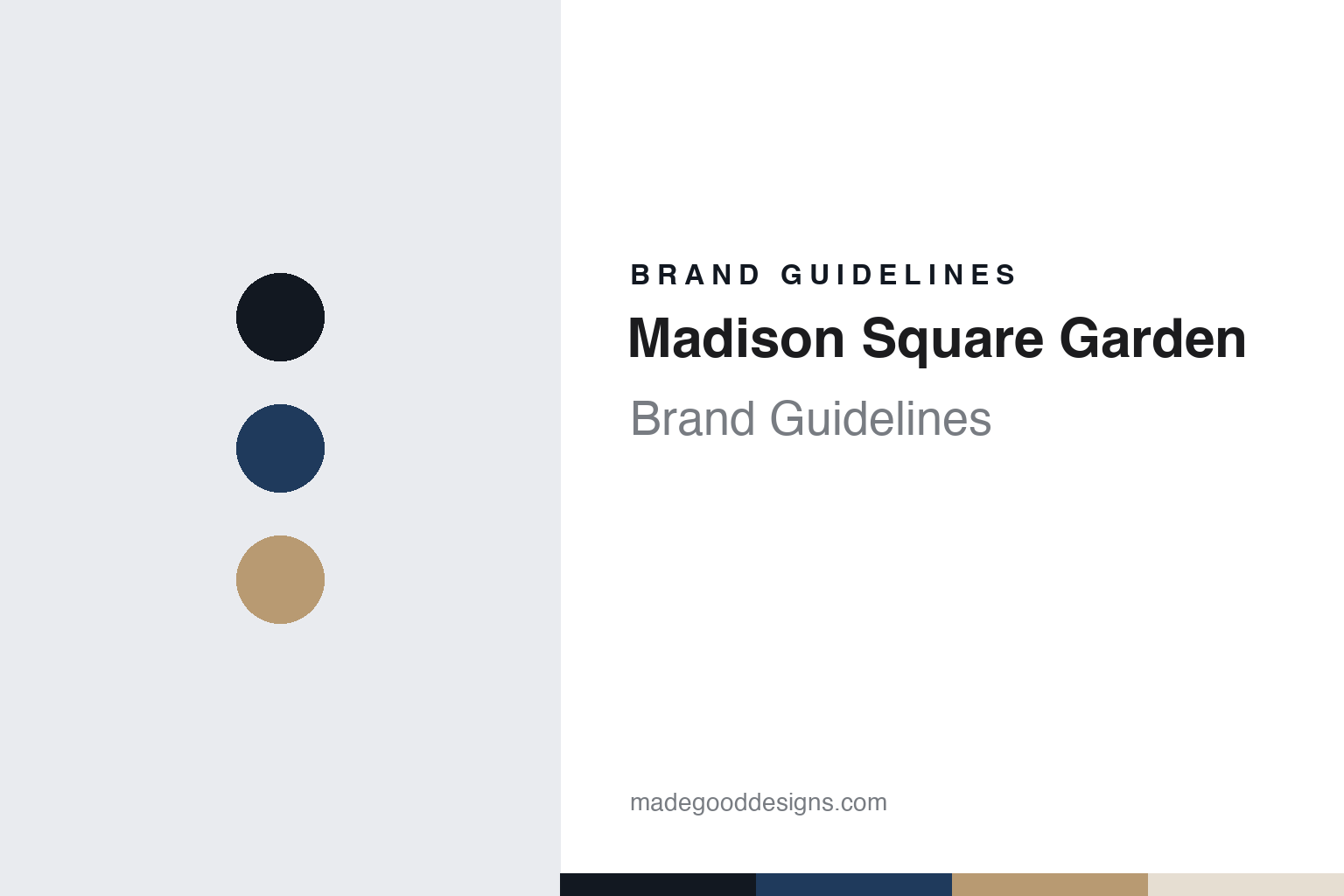
For a design guide, Madison Square Garden shows how a name can outlast three buildings and several owners, and how a plain geometric form, a brown concrete drum with a cable roof, can become the image of a venue. Compare The O2, a London arena built inside an existing tent structure, and Sphere, its former sister venue in Las Vegas. For this guide we use a navy, an aggregate brown and a buff with a condensed sans, an unofficial interpretation; no product or logo is reproduced.
Explore & save
Keep Madison Square Garden’s identity on hand — save it to a board in the Made Good inspiration library.
Madison Square Garden identity set
Pin the navy, aggregate brown and buff palette and the condensed arena sans register to your own board.
Source & notes
Frequently Asked Questions
What font can I use to match the Madison Square Garden look?
This guide describes Madison Square Garden’s type as “A condensed sans for scoreboards, banners and marquee lettering”. Its type specimen is set in Barlow Condensed from Google Fonts as a stand-in; Barlow Condensed is not Madison Square Garden’s own lettering.
What colours are in the Madison Square Garden palette?
This guide’s Madison Square Garden palette is Arena navy #1F3A5C, Night ink #121821, Aggregate brown #8A6B4E, Buff cove #B89A72 and Paper #F6F3EE. The tones are the guide’s own unofficial interpretation, not official Madison Square Garden hex codes.
When did Madison Square Garden open?
Madison Square Garden opened in February 11, 1968, in Midtown Manhattan, New York.
Who owns Madison Square Garden?
Madison Square Garden is owned by Madison Square Garden Entertainment (since April 2023).