Whitby Folk Week Brand Guidelines
A 1965 folk weekend that grew into a week of song and dance across a Yorkshire harbour town.
Aa
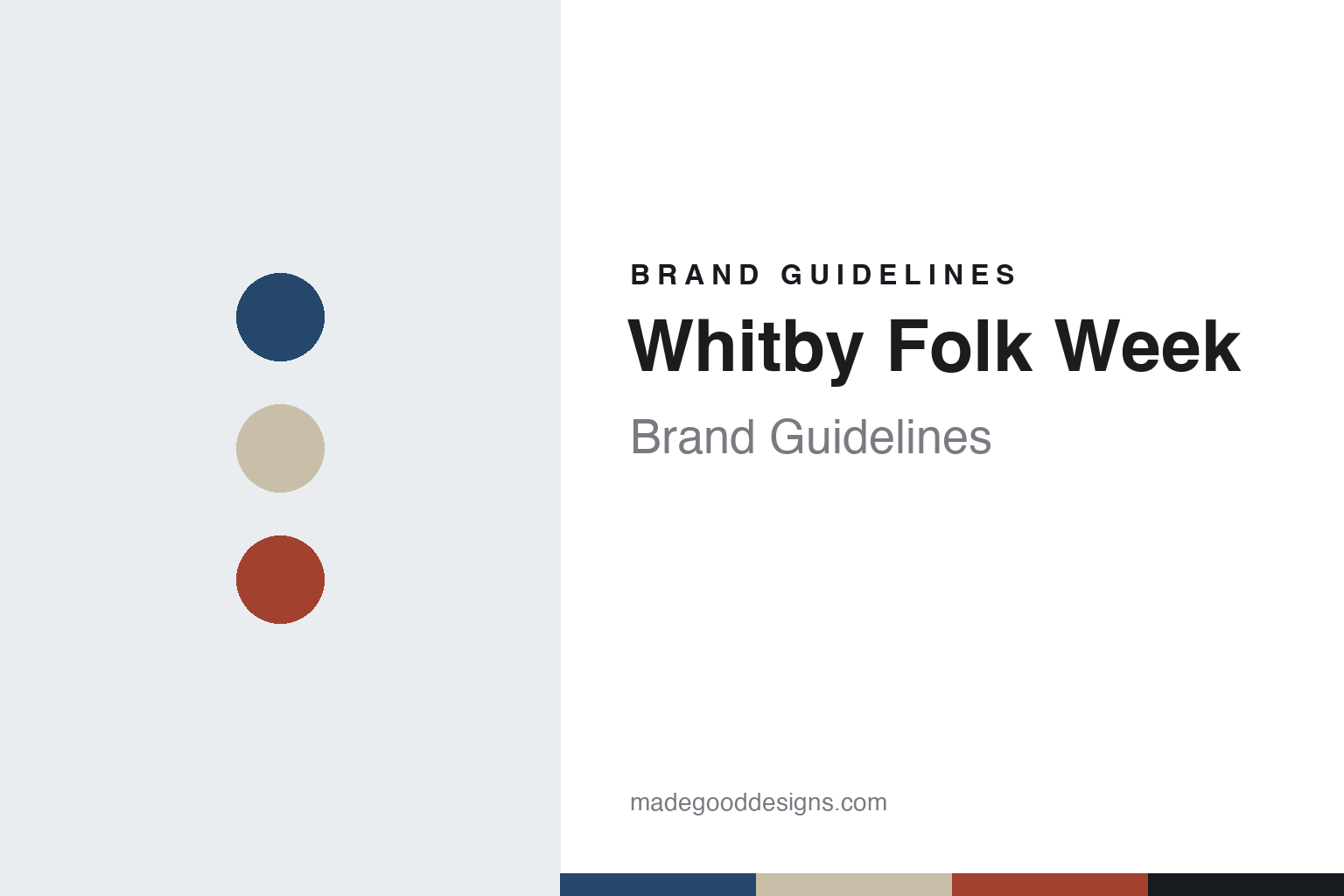
Two constants: a North Sea blue, abbey stone and pantile red palette and a plain humanist sans register. Abstract homage — not a Whitby Folk Week poster or mark; no logo, artwork or wristband is reproduced.
From weekend to week
A folk weekend of 1965 that became a festival week in 1981.
Whitby Folk Week began as a weekend. English Dance and Song, the magazine of the English Folk Dance and Song Society, looked back over the festival’s history in August 2025, the year of its 60th annual edition, and says that from 1965 and for some years after, the Whitby folk festivals were weekend events organised by Tony Foxworthy, the society’s representative in the north-east of England. People who remember those early weekends, the magazine says, recall a Saturday afternoon concert followed by a large ceilidh in the evening, with the band the Ranters playing for the first ceilidh in 1965.
The early festival had its own map of the town. The magazine names the Mission to Seamen as the main venue of those first years, where a plaque recalling Foxworthy now hangs in the entrance, and describes festival-goers walking up to the Abbey campsite at the top of Whitby’s 199 steps. From the late 1960s, it says, Grahame Binless ran the festival on behalf of the society, and during the 1970s it grew into a much larger event: the festival office moved to Flowergate Hall, and concerts were held in the old Spa Theatre.
The decisive change came in 1981. That year, English Dance and Song says, Whitby Folk Week was born, as the festival grew from its weekend form into a week running from Saturday to Friday, with music, song and dance spread across a wide range of venues in the town. The 1980s also produced the festival’s logistics team, nicknamed the “Goon Squad,” which moved chairs, sound equipment and even a mobile stage on castors around the town.
The organisation then changed hands. By the mid-1980s, the magazine says, the society was withdrawing from running its own festivals, and Malcolm Storey became the sole organiser of Whitby Folk Week. He retired in 2006, and since then the festival has been run by a Board of Directors, the same article says. The 60th annual festival was held from 16 to 22 August 2025.
Colour
Song, dance, music and storytelling across a harbour town.
The festival describes itself as a celebration of British traditional song, dance, music and storytelling, held every August in the fishing town of Whitby on the North Yorkshire coast. English Dance and Song put the scale at over 600 music, song, dance and storytelling events across the town each year, and noted that the festival does not list headline acts: artists and audiences meet throughout the week, at the festival’s venues and around the town.
Dance runs through the week. The festival website describes daily dance displays around the town and parades on the first Saturday and the final Friday. Its 2026 programme listed a Sunday afternoon Dance Extravaganza at the Spa Pavilion and a range of visiting teams that included morris sides, rapper sword teams, a clog and step dance group and the Goathland Plough Stots. Social dancing runs through the evenings, with ceilidhs, contra and Playford dances held in the Whitby Pavilion.
Learning is the second thread. The website describes progressive workshops that build through the week, such as Singing in Harmony, Playford for All and a Festival Orchestra, alongside one-off sessions in music, song and dance for beginners and experienced players. A family programme sits beside them: Playtime and Playworks for children, workshops for juniors, a Yoof Club for teenagers and daily family ceilidhs, according to the 2026 listing.
Talks and storytelling make up a third strand. The festival’s programme includes daily storytelling, presentations and interviews, and sessions for songs, shanties and ballads. The Roy Palmer Lecture is one of its fixtures: the Traditional Song Forum, which organises the series, says its 2026 lecture, the eleventh, was given as part of Whitby Folk Week. The Cliff Bairstow Jig Competition reached its tenth edition in 2025, English Dance and Song noted, and a Music and Craft Fair, selling instruments, crafts and festival merchandise, is open daily through the week.
Typography
Folk festivals and their settings.
A folk festival is often remembered by where and when it happens before anything else. Some take over a park on the edge of a city in high summer, with marquees pitched on the lawns; others fill a seaside town in late August, spreading concerts, dances and workshops through its halls and streets. Some gather in a concert hall in the depths of winter, some on a hillside in a provincial park, and some on a showground or in a festival village built for the purpose. The setting and the week in the calendar do much of the work a logo does elsewhere.
Where a festival issues an annual poster or programme cover, its look is renewed each year, and the artist behind it, whether an illustrator, a printmaker or a designer, shapes how that edition is remembered. When a festival credits those artists, the run of posters becomes a visual record of the event, edition by edition, and a festival without a fixed mark can still read as one thing across many years.
Behind most of these names stands an organiser that keeps them going: a city council, a folk society, a non-profit association, a trust or a small company, supported in many cases by large teams of volunteers. Organisers can change, and formats with them, while the name stays: the Cambridge Folk Festival, for one, has kept the name it was given in 1965 through several changes of format.
The practical layer is what audiences handle on the day. Programme booklets, stage timetables, wristbands, campsite and site maps, and signs pointing between venues all carry the festival’s type and colour into daily use. This guide looks at each festival through that lens: its setting, its calendar, its organiser and the material its audience reads, set out in plain terms and with our own unofficial palettes.
Aa
A plain humanist sans — read as a day sheet, a venue sign and a wristband. (Specimen set in Work Sans, a sans STAND-IN; NOT the Whitby Folk Week logo.)
Whitby Folk Week
A calendar rule, a town and a programme book.
Whitby Folk Week’s identity is tied to a calendar rule as much as a place. The festival says it always takes place during the week leading up to the weekend that contains the end-of-August bank holiday Monday; in 2026 that meant Saturday 22 to Friday 28 August. The name itself records the change of 1981, when a weekend became a week, and it has stayed the same since.
The town supplies the setting. Instead of a single fenced site, the festival spreads its events across venues around Whitby, among them the Pavilion on the West Cliff, where the festival office sits during the week, and the Spa Pavilion. That makes the practical layer of the identity unusually important: a programme of hundreds of events, a ticket that gives access to hundreds of events, a festival office, and daily dance displays and parades in the streets. Volunteers carry much of it; the festival says it depends on a large team who give four to five hours a day in return for a ticket, with camping if they need it.
For a design guide, Whitby Folk Week shows how a festival without headline acts can be held together by a town, a fixed week and a dense programme. Compare Cambridge Folk Festival, the English folk festival that also began in 1965, and Celtic Connections, which also spreads traditional music across venues in its home city. For this guide we use North Sea blue, abbey stone and pantile red with a sans, an unofficial interpretation; no product or logo is reproduced.
Explore & save
Keep Whitby Folk Week’s identity on hand — save it to a board in the Made Good inspiration library.
Whitby Folk Week identity set
Pin the Whitby Folk Week North Sea blue, abbey stone and pantile red palette and the plain humanist sans register to your own board.
Source & notes
Frequently Asked Questions
What font can I use to match the Whitby Folk Week look?
This guide describes Whitby Folk Week’s type as “A plain humanist sans — read as a day sheet, a venue sign and a wristband”. Its type specimen is set in Work Sans from Google Fonts as a stand-in; Work Sans is not Whitby Folk Week’s own lettering.
What colours are in the Whitby Folk Week palette?
This guide’s Whitby Folk Week palette is North Sea blue #24476B, Harbour ink #171B20, Abbey stone #C9BFA8, Pantile red #A3412F and Sea mist #F3F2EE. The tones are the guide’s own unofficial interpretation, not official Whitby Folk Week hex codes.
When was Whitby Folk Week founded?
Whitby Folk Week was founded in 1965, in Whitby, North Yorkshire.