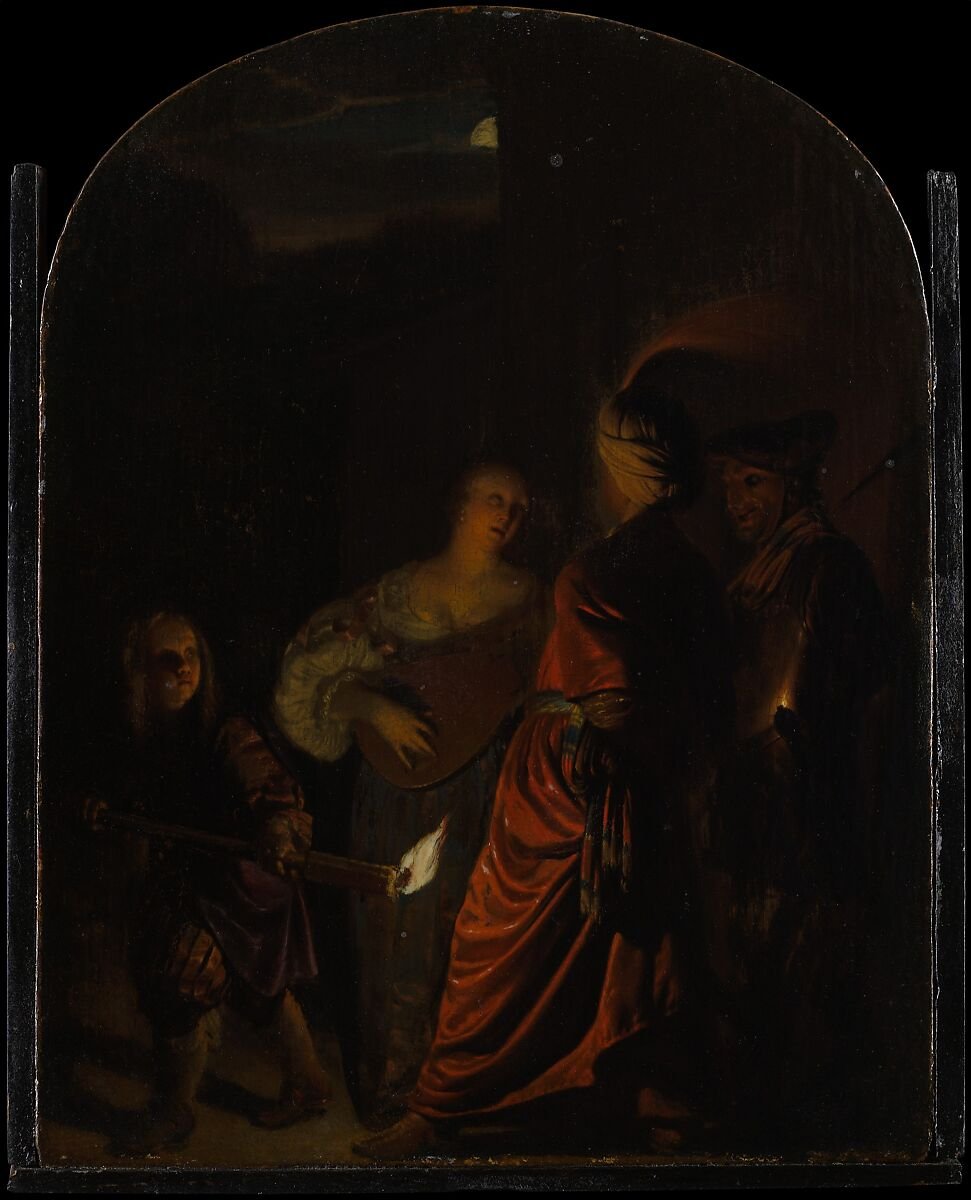
Frans van Mieris the Elder worked at the scale of a phone screen. His Serenade in the Metropolitan Museum of Art is 14.6 cm tall; his self-portrait with a cittern in the National Gallery, London, is 17.5 cm. Into these spaces he fitted lace, fur, glass, satin and faces lit by a single source, painted so finely that, as the National Gallery puts it, brushmarks in his pictures are almost universally invisible. For designers who work small, he shows what a tiny frame can hold.
More public-domain works from the period are gathered in the MGD museum inspiration collection.

Who was Frans van Mieris the Elder?
He was born in Leiden on 16 April 1635 and died there on 12 March 1681, the dates given by the Leiden Collection and by Britannica; the Metropolitan Museum of Art, the National Gallery and the Kunsthistorisches Museum in Vienna all give Leiden 1635–1681. The National Gallery records that he was taught by Abraham van den Tempel and Gerrit Dou.
Piet Bakker’s biography for the Leiden Collection fills in the route. His father was a goldsmith and diamond cutter, and in 1645 the boy was apprenticed to a goldsmith cousin. He proved a gifted draughtsman and was sent to the drawing master and glass engraver Abraham Toorenvliet, then to Dou. The early biographer Arnold Houbraken reports that Dou called him “the prince among his pupils”. After a spell with Van den Tempel he returned to Dou, preferring small formats and fine detail.
The Leiden Collection dates his entry into the Leiden Guild of Saint Luke to 14 May 1658. In 1657 he married Cunera van der Cock, a marriage recorded by both the Leiden Collection and the National Gallery; two sons, Jan and Willem, also became painters. The Leiden Collection relates that Archduke Leopold Wilhelm invited him to Vienna as court painter, an offer he declined, and that Cosimo III de’ Medici commissioned five pictures from him, including a self-portrait.
Key works by Frans van Mieris
The Doctor’s Visit (1657), Kunsthistorisches Museum, Vienna. Oil on gilded copper, 33.8 by 26.8 cm, inscribed “F. van Mieris Anno 1657”. The museum notes that the artist’s wife was the model. The Leiden Collection calls it his earliest dated work.
The Cloth Shop (1660), Kunsthistorisches Museum, Vienna. Catalogued by the museum as Cavalier in the Shop, on oak, 54.5 by 42.7 cm. Both the Leiden Collection and the art historian Eddy de Jongh, drawing on Houbraken, describe it as painted for Archduke Leopold Wilhelm.
A Woman in a Red Jacket Feeding a Parrot (about 1663), National Gallery, London. Oil on copper, 22.5 by 17.3 cm. The gallery says he made three versions himself and that it was copied many times by others.
Self Portrait of the Artist, with a Cittern (1674), National Gallery, London. Oil on canvas, 17.5 by 14 cm. The gallery identifies the costume as that of Ottavio, a lover from the commedia dell’arte.
The Serenade (about 1678–80), Metropolitan Museum of Art. Oil on wood with an arched top, 14.6 by 11.1 cm.
What to look at: one light in a dark box
The Serenade is a night scene. A woman plays a lute; beside her a man in a long red cloak and plumed hat turns away; a boy at left carries a burning torch, and a second small flame glows by the hand of a figure at the far right. A crescent moon sits high in the arched top. Almost everything else is black.
- Small sources, big effect. Two tiny flames light the boy’s face, the woman’s white sleeve and throat, and the folds of the red cloak; nothing else is allowed to compete.
- The arch as a frame. The rounded top turns the panel into a window or niche and gives the moon a place to sit.
- A diagonal of faces. Boy, woman and the two men rise in a line from lower left to upper right, so the eye travels across the group rather than stopping on one figure.
The drawings work the other way, dark marks on a pale ground. In The Cardplayer a seated man in a broad hat turns towards us, cards fanned in one hand, a tall glass and loose cards on the table. Tablecloth, hatched wall and hat-brim shadow are separated by chalk density alone.
Palette: near-black with one warm red
Measured from the museum’s scan of The Serenade, the panel is dominated by near-blacks at #0b0a08 and #16110d, warmed by a deep brown at #3a1e0e. The red cloak reaches about #57270c, and even the brightest lit areas average only around #5e4431 in the scan. In so compressed a range, a small step up in value reads as light.
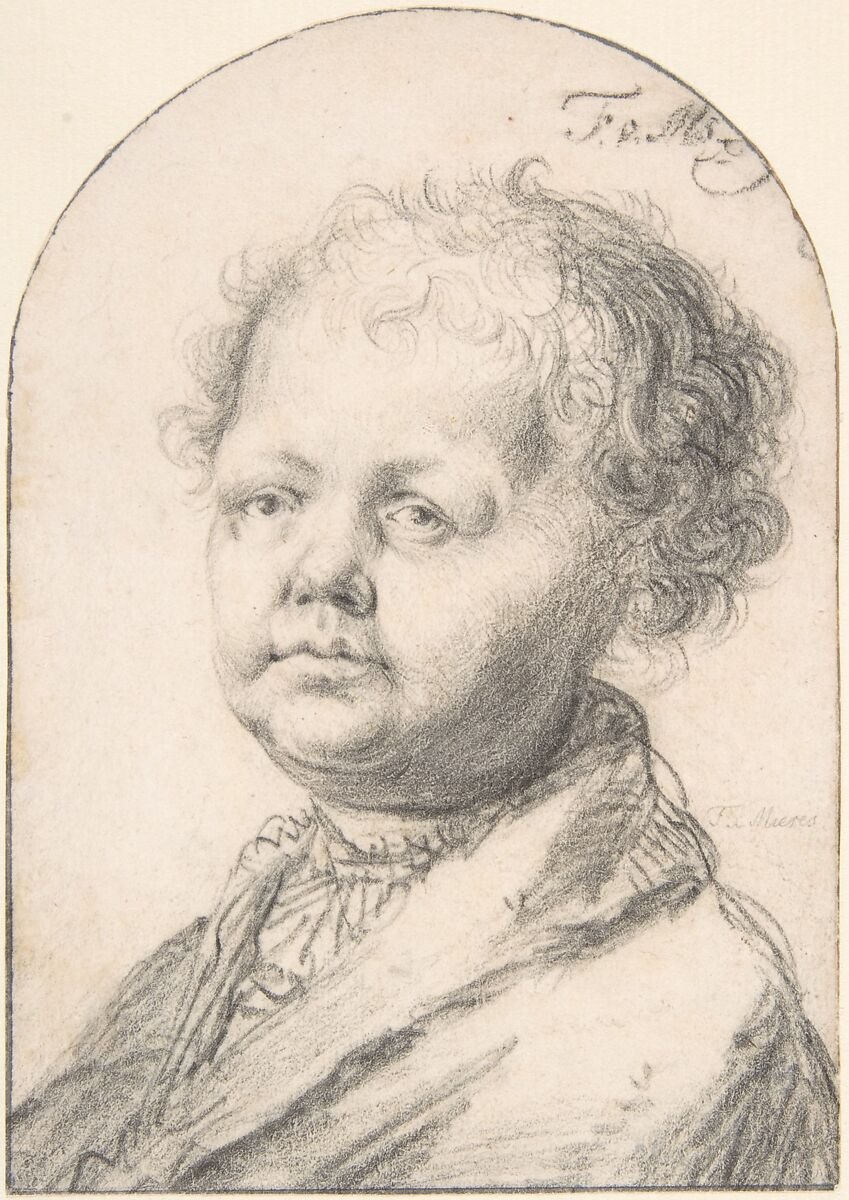
The drawings offer the reverse palette. Measured from the museum’s scans, The Cardplayer sits on vellum tones of #dfd0b8 and #cabaa4 with chalk greys at #9d8f7d and #72675a, while the Portrait of a Young Boy runs from a warm paper white at #f2e3d3 down through #b4a99b to #867d72. To build either scheme, load a scan into the MGD colour palette generator.
Technique: copper, panel, chalk and vellum
Van Mieris chose smooth supports. The Vienna Doctor’s Visit is on gilded copper, the London parrot picture on copper, the Serenade and the Vienna Cloth Shop on wood. The National Gallery explains that copper makes his brushstrokes virtually invisible and lets him render textures, from a bird’s stiff feathers to the braid on a chair. The gallery describes him as a fijnschilder, one of Leiden’s school of fine painting, with a technique learned from Dou.
His drawings are just as small and just as finished. The Met’s Portrait of a Young Boy is black chalk heightened with white, with touches of graphite, on a sheet 14 by 9.8 cm. The curls are looping strokes, the face soft tone, and the arched outline echoes the Serenade. The Cardplayer, 11.7 by 15 cm, is black chalk and grey wash on vellum; the Met suggests the chalk was probably moistened in places, which would account for the deeper blacks in the hat and coat.
The Leiden Collection’s essay on his patrons notes that his friend Jan Steen, back in Leiden from 1657, and Van Mieris influenced each other: Steen based variations of the doctor’s visit on Van Mieris’s Vienna picture. For the wider school, see our guide to Dutch Golden Age painting.
Lettering, signatures and inscriptions
Van Mieris often lettered inside the scene. The Kunsthistorisches Museum records the signature of the Cloth Shop on the back of a chair, “F. van Mieris f. 1660”, and a Latin inscription on a strip of bunting that the museum translates as “he who will may buy” or “he who will may compare”. On the Met boy, initials sit at the upper right inside the arch and a fuller name runs down the right edge; on The Cardplayer what looks like an interlaced monogram is drawn on the front of the table.
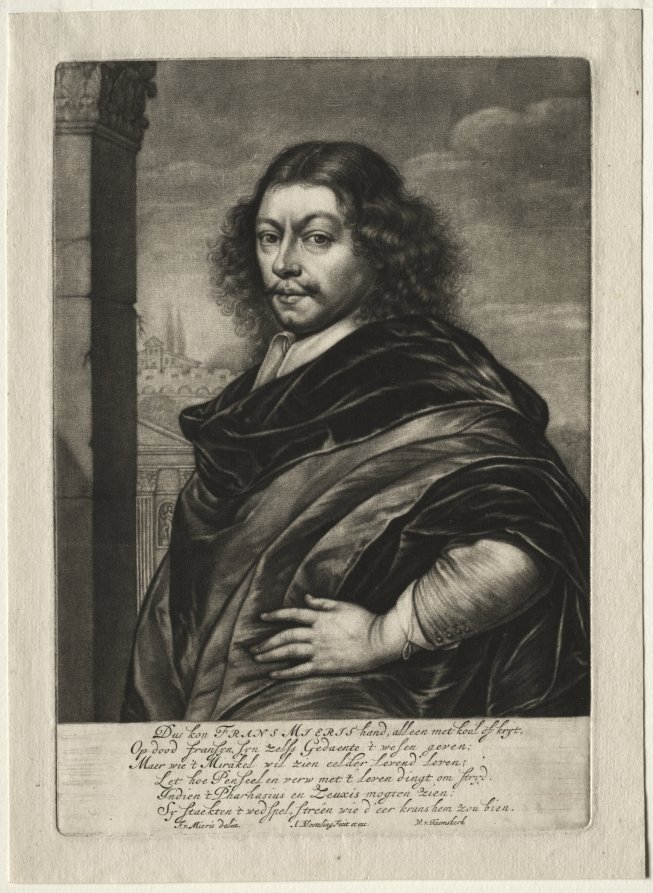
Printmakers spread his image with text attached. The Cleveland Museum of Art’s mezzotint by Abraham Blooteling reproduces a self-portrait drawing, marked “F.v.Mieris delin.” beneath the image, and adds six lines of Dutch verse praising the hand that could give life with chalk alone, invoking the ancient painters Zeuxis and Parrhasius. The verse is signed W. v. Heemskerk. The Leiden Collection identifies a Willem van Heemskerck, cloth merchant, poet and calligraphic glass engraver, as the man who persuaded Van Mieris’s father to let the boy train as an artist.
How designers can borrow Frans van Mieris’s ideas
- Design at final size. Van Mieris resolved texture at 15 cm. Proof icons, labels and thumbnails at the size they will be seen, not zoomed in.
- Compress the value range. In a dark interface or a night-time campaign, keep most of the area within a few steps of black and let one warm tone carry the light.
- Use a frame shape. An arched or rounded top, as on the Serenade and the boy drawing, turns a rectangle into a window and gives a focal point a home.
- Put the type in the world. A signature on a chair back or a motto on bunting suggests packaging and editorial layouts where text sits on objects in the image rather than floating over it.
Frequently asked questions
Who was Frans van Mieris the Elder?
A Dutch genre and portrait painter, born in Leiden in 1635, who trained with Gerrit Dou and Abraham van den Tempel, joined the Leiden painters’ guild in 1658 and worked in Leiden until his death in 1681.
What is a fijnschilder?
A “fine painter”: the name for Leiden artists such as Dou and Van Mieris who painted small pictures with meticulous, nearly invisible brushwork. The National Gallery describes Van Mieris as one of them.
Why is he called “the Elder”?
To distinguish him from his grandson, Frans van Mieris the Younger (1689–1763), the son of Willem van Mieris, as recorded by the Städel Museum and the Leiden Collection. His son Jan was also a painter.
Where can I see paintings by Frans van Mieris?
The Kunsthistorisches Museum in Vienna holds The Doctor’s Visit and The Cloth Shop; the National Gallery in London holds the parrot picture and the self-portrait with a cittern; the Metropolitan Museum of Art holds The Serenade and drawings.