Melbourne International Jazz Festival Brand Guidelines
Ten October days of jazz across a city’s halls, clubs and squares.
Aa
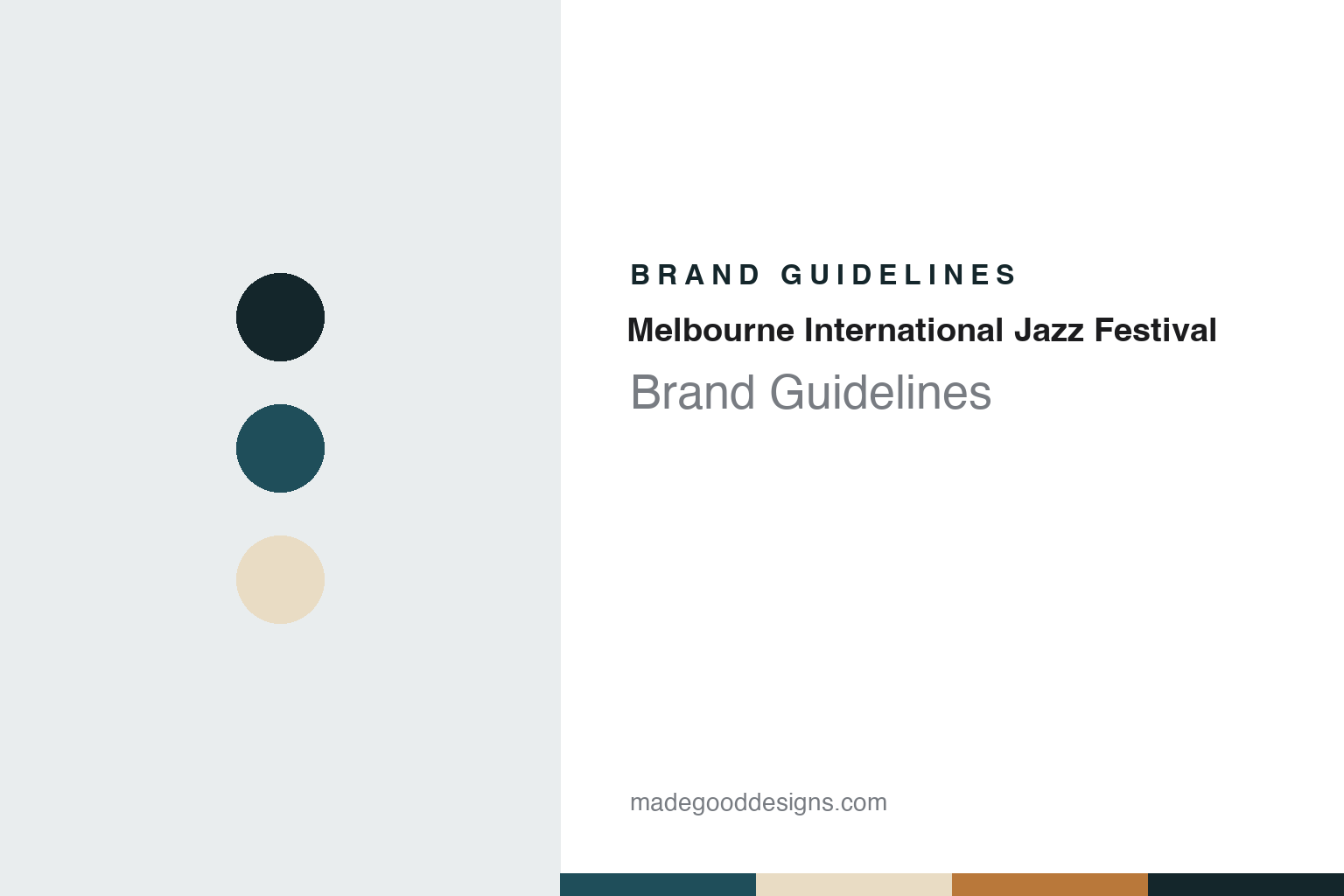
Two constants: a teal, cream and brass palette and a night-club serif register. Abstract homage — not a Melbourne International Jazz Festival asset; no logo, poster or artwork is reproduced.
A festival for the city
From a January debut to an October fixture.
The Melbourne International Jazz Festival is an annual jazz festival held across Melbourne, in Victoria, Australia. English Wikipedia dates the first festival under that name to 10–26 January 1998, and describes a festival that takes place in concert halls, arts venues, jazz clubs and the streets of the city. The festival writes its own name in full and shortens it to MIJF, the abbreviation also used in press coverage.
Its first artistic director was Adrian Jackson. Billboard reported in July 2004 that Jackson had held the role since the festival’s start in 1998, and that he was stepping away to concentrate on another Victorian event, the Wangaratta Festival of Jazz, held each October.
The calendar has moved more than once. The first festival ran in January; the same Billboard report announced the next edition for May 2005, with Carlo Pagnotta, director of Umbria Jazz in Perugia, as international artistic director. The Age reported in August 2006 that the 2005 festival was billed as “Umbria Jazz-Melbourne ’05,” a sister event to the Italian festival, launched with an event in New York. The festival’s next edition was held in 2007.
By 2009 the festival had settled into autumn. The Age reported in February 2009 that Michael Tortoni was its new artistic director, and that the seven-day programme, of about 55 events, would open on 26 April. English Wikipedia says that in 2020 the festival presented These Digital Times, a free series streamed online on the last Saturdays of May, June and July. It is now held in the Australian spring: Music Feeds listed the 2022 edition for 14–23 October and the 2023 edition for 20–29 October.
Colour
Halls, clubs, a music bowl and a square.
The 2009 programme gives an early picture of how the festival uses the city. According to The Age, the opening-night headliner and artist-in-residence was the American bassist Charlie Haden, leading an orchestra with a line-up drawn from American and Australian players; the newly built Melbourne Recital Centre hosted concerts; ACMI, the screen museum, ran a jazz film programme; and the National Gallery of Victoria hosted talks. The paper reported that the organisers took Bert Stern’s film of the 1958 Newport Jazz Festival, Jazz on a Summer’s Day, as a model for a festival that would run as one thread through the city rather than as a list of separate concerts.
The festival now describes its season as ten days every October. Its own website, in its 29th year, cites more than 130 performances and 550 artists, and names a Modern Masters series that pairs international guests with Australian musicians at the Sidney Myer Music Bowl, Hamer Hall and Melbourne Recital Centre. Music Feeds used the Modern Masters name in its 2022 report, when the festival listed more than 400 artists.
The 2024 edition shows the format at work. Limelight called it the 27th edition, from 18 October, with more than 400 artists from 12 countries in 109 events across 34 venues, over a third of them free. The opening weekend began with a Second Line Street Party, a parade through the central business district led by the TBC Brass Band from New Orleans and ending in Federation Square, and the Saturday brought Jazz at the Bowl, headlined by Herbie Hancock with Marcus Miller. In 2023 Music Feeds reported a launch concert at the Sidney Myer Music Bowl, free performances at Federation Square across the opening weekend, a concert at Hamer Hall and a performance staged through the Melbourne City Baths.
English Wikipedia lists among the 2024 venues The JazzLab, 170 Russell, Arts Centre Melbourne, ACMI, Malvern Town Hall, the studios of the community station PBS 106.7FM, ArtPlay, the Australian Jazz Museum and the Red Stair Amphitheatre at Southbank. For 2026, Limelight reported dates of 16–25 October, more than 550 artists from 18 countries and more than 150 events across 30 venues, with a street parade along the Yarra leading to free performances at Federation Square.
Typography
Design and documentation.
A jazz festival is rarely remembered for a single concert. Its identity is carried by a setting and a date: a converted cannery where every stage sits under one roof, a palace square turned into an open-air arena for a summer fortnight, a riverside town that fills with music in spring, a harbour city whose clubs host a festival in the dark months of winter, or a racecourse in New Orleans whose stands and paddocks become a field of stages. The setting gives the festival its look, and the calendar fixes it in the memory, whether that is a run of late-May nights, a numbered week in August or a pair of spring weekends.
Print is the second layer. Many festivals commission a new poster every year, and the run of posters becomes a record of the festival in its own right, with each edition’s artist or designer named alongside the date. Some keep the same wordmark for decades and let the artwork change; others redraw the name as the programme widens. Edition numbers and founding years often sit beside the title, so that the long count becomes part of the identity.
Behind each name stands an organisation. Jazz clubs, non-profit foundations, associations, municipal bodies and production companies keep festivals going across changes of venue, director and programme, and festival names often survive moves from one hall, park or district to another. When a festival changes its title or passes to a new organiser, the repeated elements, from the place name to the poster series, carry it across the change.
Audiences meet the identity in practical form: programme booklets, day schedules and stage maps, wristbands and festival passes, venue signs and apps that list who plays where and when. The guides in this group look at jazz festivals through those elements. The colours and typefaces shown are our own interpretation, not official assets.
Aa
A night-club serif — MIJF in full or in short. (Specimen set in DM Serif Display, a serif STAND-IN; NOT the Melbourne International Jazz Festival logo.)
MIJF
A programme built around the city.
The festival’s organisation is visible on its own website. Its board and staff page lists a board of directors that includes Michael Tortoni as artistic director, alongside a chief executive and program director, a small year-round team and outside consultants. Among those consultants it credits the studio Open Season for design and brand, and separate firms for publicity, ticketing and the website; its festival archive collects programmes and highlights from recent years, including a 2026 programme.
The festival also describes work beyond the October dates. It names a First Nations Artist Residency, run with the Australian Art Orchestra, which supports one musician each year with a new work and a festival performance; partnerships with the Melbourne Conservatorium of Music at the University of Melbourne and with Monash University for masterclasses and workshops; and links with presenters such as the London Jazz Festival for showcasing Australian musicians abroad. These are the festival’s own descriptions of its programmes.
Its visual world is a city rather than a single site. The venues reach from concert halls such as Hamer Hall to clubs such as The JazzLab, the outdoor Sidney Myer Music Bowl and the open square at Federation Square, and the opening parade turns the streets into a stage for one afternoon. The festival’s website carries an acknowledgement of the Traditional Custodians of the land on which it takes place, the Boon Wurrung and Wurundjeri people of the Kulin Nations.
For a design guide, the Melbourne International Jazz Festival shows how a festival can carry one name across changing months and directors by tying it to the city itself. Compare Umbria Jazz, the Italian festival behind the 2005 Melbourne edition, and the Newport Jazz Festival, whose 1958 film the 2009 organisers cited as a model. For this guide we use a deep teal, a programme cream and a brass amber with a serif, an unofficial interpretation; no product or logo is reproduced.
Explore & save
Keep Melbourne International Jazz Festival’s identity on hand — save it to a board in the Made Good inspiration library.
Melbourne International Jazz Festival identity set
Pin the Melbourne International Jazz Festival teal, cream and brass palette and the night-club serif register to your own board.
Source & notes
Frequently Asked Questions
What font can I use to match the Melbourne International Jazz Festival look?
This guide describes Melbourne International Jazz Festival’s type as “A night-club serif — MIJF in full or in short”. Its type specimen is set in DM Serif Display from Google Fonts as a stand-in; DM Serif Display is not Melbourne International Jazz Festival’s own lettering.
What colours are in the Melbourne International Jazz Festival palette?
This guide’s Melbourne International Jazz Festival palette is Yarra teal #1F4E5A, Laneway ink #14262B, Programme cream #E9DCC4, Brass amber #B9783A and Paper #F7F3EC. The tones are the guide’s own unofficial interpretation, not official Melbourne International Jazz Festival hex codes.