jazzopen stuttgart Brand Guidelines
Stuttgart’s July festival on the Schlossplatz, since 1994.
Aa
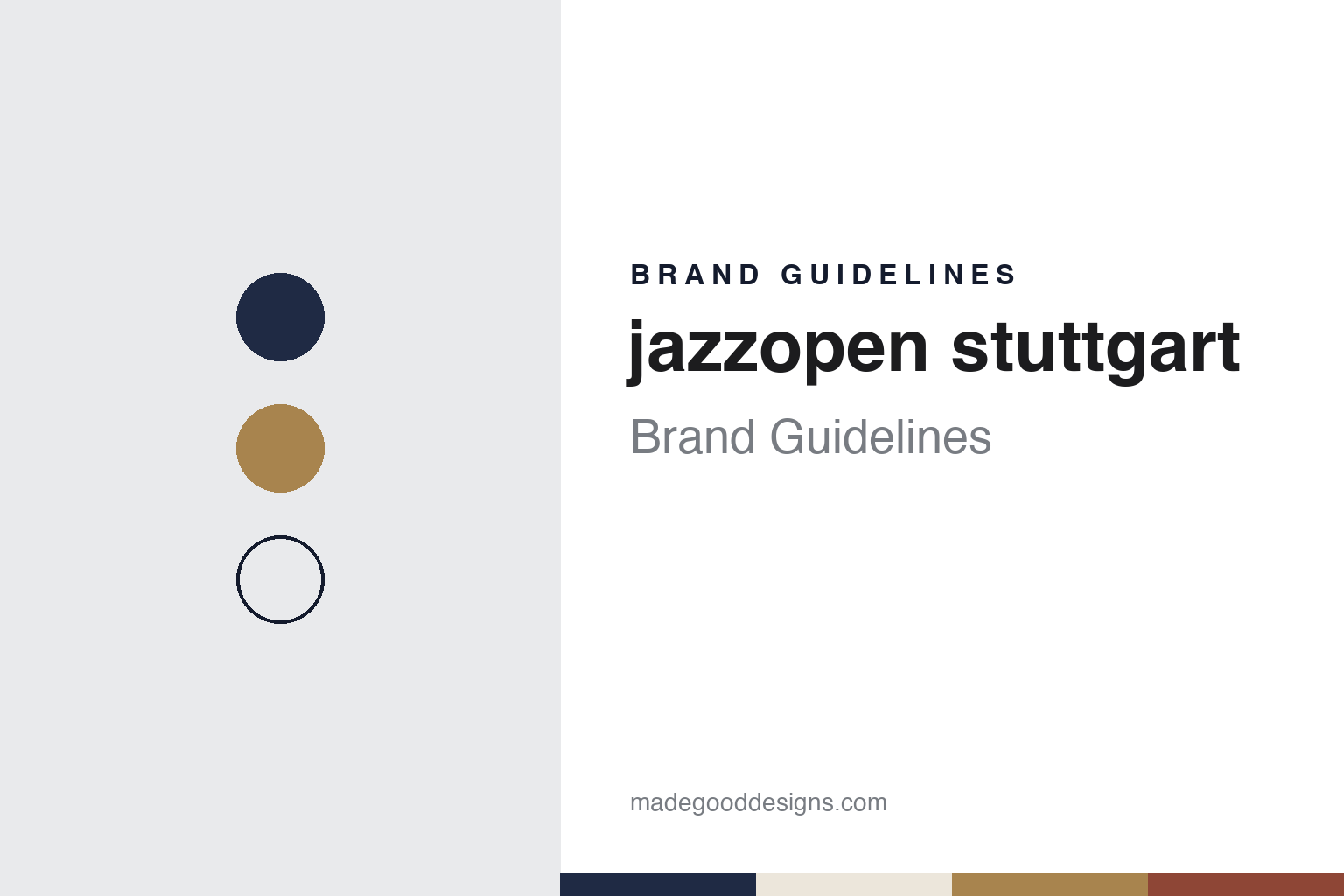
Two constants: an evening navy, sandstone and brass palette and an open sans register. Abstract homage — not a Jazz Open poster or mark; no logo, artwork or photograph is reproduced.
From Liederhalle to Schlossplatz
A Stuttgart festival that began in a concert hall.
jazzopen stuttgart is a summer music festival held in the centre of Stuttgart, the capital of Baden-Württemberg. For much of its history it wrote its name in lower case, a form still used by its friends’ society, the jazzopen stuttgart e.V.; its own website now styles it Jazz Open Stuttgart, and the Stuttgarter Zeitung also writes Jazz Open, so this guide uses that form in running text.
The festival dates from 1994. German Wikipedia describes it as the successor to the Stuttgarter Jazzgipfel, a series that the Theaterhaus Stuttgart ran with the regional broadcaster Süddeutscher Rundfunk from 1988 to 1992. The festival’s own account says it began in 1994 as a small festival for connoisseurs at the Liederhalle, Stuttgart’s concert hall. Its published line-up history lists Randy Crawford, Pat Metheny and Ornette Coleman among the names of that first year. In July 2024 the Stuttgarter Zeitung marked the festival’s 30th birthday and noted that a thick, colourful book had been published for the anniversary.
The organiser is Opus Festivals GmbH, a Stuttgart promoter whose managing director and partner is Jürgen Schlensog, according to the festival’s legal notice and team page. German Wikipedia says the Opus company has run the festival since 1994; the festival’s own history says Schlensog took it over in 2008, so the two accounts differ on the early years. The team page describes a core staff of about ten people who also develop other live-music series.
The decisive change of setting came in 2011, when the festival moved onto the Schlossplatz, the square in the city centre, the Stuttgarter Zeitung reported in 2024. Since then the festival’s two main stages have been the Schlossplatz and the arcaded courtyard of the Altes Schloss, the old castle, which the festival says mainly host the larger mainstream acts.
Colour
Jazz and beyond, across a city centre.
The festival describes its programme as “Jazz & Beyond”: jazz forms a large part of the programme, but the bills also include rock, pop, soul and blues, as German Wikipedia notes. The festival says jazz concerts are mainly presented on its club stages, while the two open-air main stages carry the bigger names. Its website lists the venues of recent editions as the Schlossplatz, the Altes Schloss, the SpardaWelt, the BIX Jazzclub and the Fruchtkasten, home of the Haus der Musik, together with a set of free Open Stages.
Those free stages have grown. For the 30th edition in 2024 the Stuttgarter Zeitung reported that the number of free Open Stage concerts had tripled, under the motto “16 concerts, 4 stages, 0 euros,” with classic jazz and swing bands in the music pavilion on the Königstraße and more experimental acts in the Stadtpalais.
The calendar is short and fixed. The festival says it now runs for twelve days at the beginning of July, and the Stuttgarter Zeitung wrote in June 2025 that it brings visitors into the city centre over twelve days in July. Attendance figures are the organiser’s: German Wikipedia records 15,000 visitors in 2007, 45,000 in 2018 and 75,000 in 2026, and the festival gives a figure of more than 75,000 on its website.
Broadcasting has carried the name beyond Stuttgart. German Wikipedia says concerts have been recorded for the radio stations SWR1 and SWR2 and for television on ARD, SWR and 3sat; in 2013 a concert was streamed live for the first time, on Arte Live Web, and in 2015 SWR television showed a three-hour festival documentary. The festival has also issued double-album compilations, one covering 1994 to 2008 and another 2008 to 2016, German Wikipedia lists. Since 2010 the festival has presented the German Jazz Trophy during its run.
Typography
Jazz festivals and their places.
A jazz festival is rarely remembered for a single concert. Its identity is carried by a setting and a date: a converted cannery where every stage sits under one roof, a palace square turned into an open-air arena for a summer fortnight, a riverside town that fills with music in spring, a harbour city whose clubs host a festival in the dark months of winter, or a racecourse in New Orleans whose stands and paddocks become a field of stages. The setting gives the festival its look, and the calendar fixes it in the memory, whether that is a run of late-May nights, a numbered week in August or a pair of spring weekends.
Print is the second layer. Many festivals commission a new poster every year, and the run of posters becomes a record of the festival in its own right, with each edition’s artist or designer named alongside the date. Some keep the same wordmark for decades and let the artwork change; others redraw the name as the programme widens. Edition numbers and founding years often sit beside the title, so that the long count becomes part of the identity.
Behind each name stands an organisation. Jazz clubs, non-profit foundations, associations, municipal bodies and production companies keep festivals going across changes of venue, director and programme, and festival names often survive moves from one hall, park or district to another. When a festival changes its title or passes to a new organiser, the repeated elements, from the place name to the poster series, carry it across the change.
Audiences meet the identity in practical form: programme booklets, day schedules and stage maps, wristbands and festival passes, venue signs and apps that list who plays where and when. The guides in this group look at jazz festivals through those elements. The colours and typefaces shown are our own interpretation, not official assets.
Aa
An open, wide sans for a festival that writes its name plainly. (Specimen set in Archivo, a sans STAND-IN; NOT the Jazz Open logo or lettering.)
Stuttgart and Modena
A second edition in Emilia-Romagna.
In June 2025 the Stuttgarter Zeitung reported that the festival would gain a second base in the historic centre of Modena, in Italy’s Emilia-Romagna region, with a first Italian edition directly after the Stuttgart dates, and that the carmaker Ferrari, based in nearby Maranello, was the premium sponsor of the Italian edition. That edition took place as Jazz Open Modena from 13 to 18 July 2026. The Bologna daily il Resto del Carlino described it in February 2026 as an offshoot of the Stuttgart festival under Schlensog’s artistic direction, with its main stage on the Piazza Roma, in front of the Palazzo Ducale, and further concerts at the Baluardo della Cittadella, a former bastion, and in the Giardini Ducali, the ducal gardens, set aside for emerging artists. The festival’s legal notice names a separate company, Jazzopen Italia S.r.l. of Modena, as the organiser there. German Wikipedia gives an attendance of about 25,000 for the Modena edition.
The festival’s web addresses reflect the two cities: a shared site at jazzopen.com links to separate Stuttgart and Modena sites, and the organiser’s own company site sits under the opus.live domain. il Resto del Carlino used the slogan “Jazz & beyond” to explain the name: open in the sense of a stage under a summer sky and an approach that crosses genres.
For visitors, the festival’s identity is tied to its squares more than to a single symbol. The open Schlossplatz main stage and the arcaded courtyard of the Altes Schloss give the festival two different settings in the city centre, while the free Open Stages carry its name to the Königstraße and the Stadtpalais. The lower-case “jazzopen” of the society and the older recordings sits beside the two-word “Jazz Open” of the current website, and both point to the same idea of openness the Italian paper picked out.
For a design guide, jazzopen stuttgart shows how a city festival can build its identity on a square and a fixed week in July, and carry it to a second city. Compare JazzFest Berlin, another German jazz festival, and Elbjazz, which also uses a city’s landmarks as its stages. For this guide we use evening navy, sandstone and brass with a sans, an unofficial interpretation; no product or logo is reproduced.
Explore & save
Keep jazzopen stuttgart’s identity on hand — save it to a board in the Made Good inspiration library.
jazzopen stuttgart identity set
Pin the evening navy, sandstone and brass palette and the open sans register to your own board.
Source & notes
Frequently Asked Questions
What font can I use to match the jazzopen stuttgart look?
This guide describes jazzopen stuttgart’s type as “An open, wide sans for a festival that writes its name plainly”. Its type specimen is set in Archivo from Google Fonts as a stand-in; Archivo is not jazzopen stuttgart’s own lettering.
What colours are in the jazzopen stuttgart palette?
This guide’s jazzopen stuttgart palette is Evening navy #1F2A44, Night ink #141B2D, Sandstone #ECE6DB, Brass #A8844E and Brick #8E4636. The tones are the guide’s own unofficial interpretation, not official jazzopen stuttgart hex codes.
When was jazzopen stuttgart founded?
jazzopen stuttgart was founded in 1994, in Stuttgart, Germany.