Oslo Architecture Triennale Brand Guidelines
Oslo’s architecture festival, reset every third autumn around a single question.
Aa
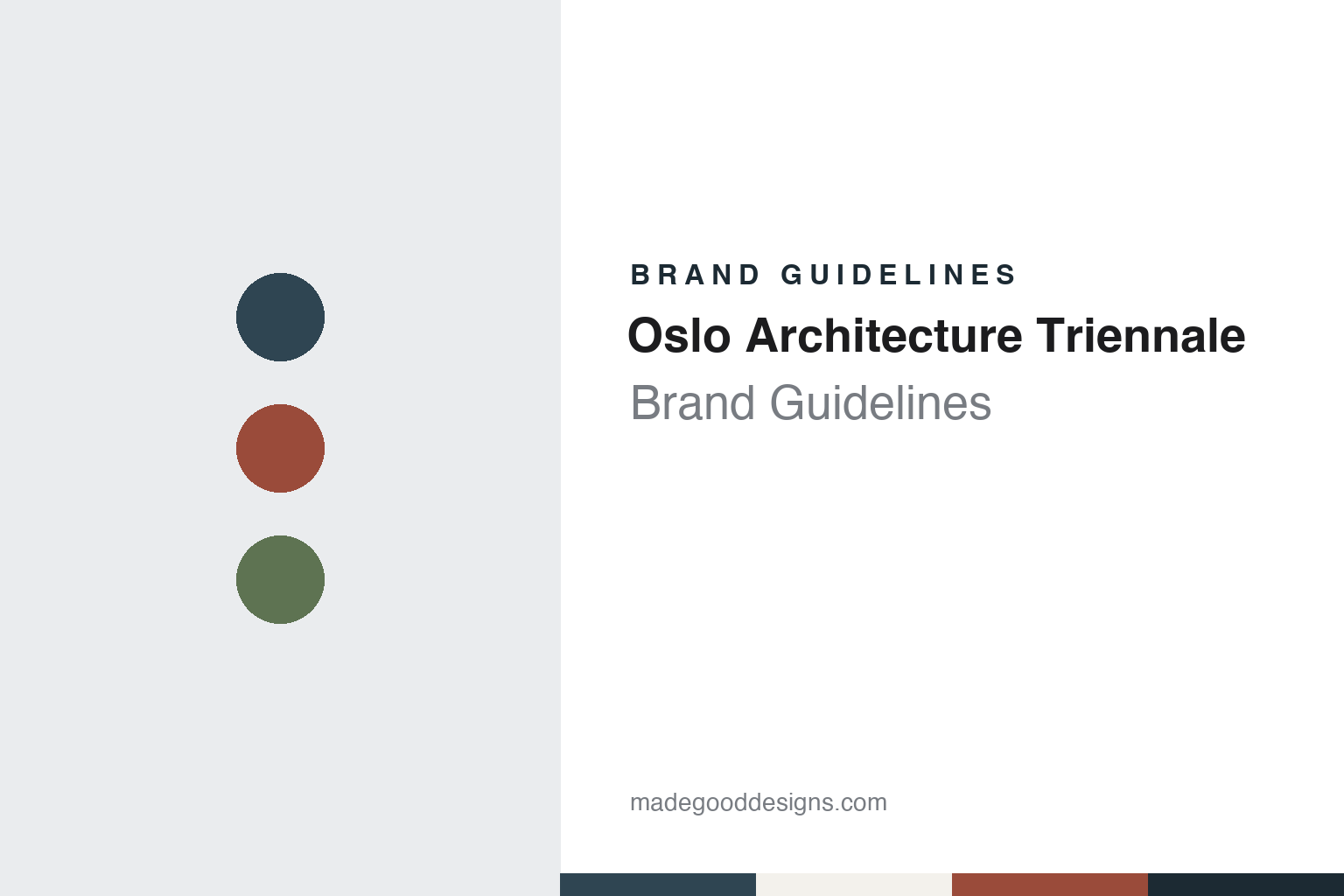
Two constants: a fjord slate, brick and moss palette and a grotesque sans register. Abstract homage — not an Oslo Architecture Triennale asset; no logo, poster or campaign image is reproduced.
Ways of living
From an architects’ association to an association of its own.
The Oslo Architecture Triennale is an architecture festival held in Oslo every third autumn. Norwegian Wikipedia dates it to 2000, when the first edition was organised by the National Association of Norwegian Architects (NAL). The triennale’s own archive gives that first edition’s dates as 15 September to 15 October 2000 and its theme as “Ways of living”; the exhibition was staged in a large hall and exit route beneath the then-new National Theatre station in central Oslo.
NAL also organised the second edition, “Visions for the capital,” from 9 to 19 October 2003, when the practice MMW built a pavilion called “Larven” on Rådhusplassen, the square in front of Oslo City Hall, and three practices were invited to propose visions for the Oslo region. The third edition came in 2007 rather than 2006: Norwegian Wikipedia says NAL had a new national board and needed more time to prepare. That edition, “The Culture of Risk,” ran from 27 September to 5 October 2007, was curated by the Oslo architecture office Spacegroup, and included a special issue of the Norwegian magazine Arkitektur N. Editions have followed at three-year intervals since: 2010, 2013, 2016, 2019 and 2022.
From 2010 the triennale has been run by its own non-profit association, which Norwegian Wikipedia says was set up in response to the government’s first national architecture policy, arkitektur.nå. The triennale’s website describes it as an “ideal association” formed by six member organisations that also make up its board: the Association of Consulting Architects in Norway, the Oslo School of Architecture and Design (AHO), Design and Architecture Norway (DOGA), Oslo arkitektforening, NAL and the National Museum – Architecture. It says it is financed through public support from the City of Oslo and Arts Council Norway, through member fees, and through partners and sponsors. Since 2015, Norwegian Wikipedia adds, the association has also had associated members from architecture and urban development.
Colour
One theme, one curator, one city.
Each edition is built around a single theme that shapes its exhibitions, conferences and publications. In 2010, “Man Made” ran from 22 September to 3 October, with a main exhibition on Nordic landscape architecture produced by Norsk Form with the Danish Architecture Center, which the archive says was later shown at the centre in Copenhagen in 2011. In 2013 the Belgian collective Rotor curated “Behind the Green Door – Architecture and the desire for sustainability,” for which it gathered more than 600 objects carrying claims of sustainability from over 200 architecture offices, companies and organisations; the exhibition ran at DogA until 1 December 2013 and was also published as a book.
The 2016 edition, “After Belonging,” ran from 8 September to 27 November and was curated by After Belonging Agency, a group of five architects based in New York and Rotterdam, according to Norwegian Wikipedia. The triennale counts 150 events in 41 venues that year, and Lars Müller Publishers issued the accompanying book. In 2019 a team of four curators presented “Enough: The Architecture of Degrowth,” from 26 September to 24 November. Dezeen reported in November 2019 that the show asked what architecture could do to support degrowth, an economic strategy that calls for less production and consumption, and quoted the curator Phineas Harper describing degrowth as “a designed reduction of total energy and material use.” Metropolis, in October 2019, described a “Library” of texts, board games and installations inside the National Museum – Architecture, with further venues at DOGA and at ROM for Art and Architecture, and noted that the official publication, Gross Ideas, was a collection of short stories rather than a catalogue. The triennale’s archive adds that theatre and performance were core to that programme.
The 2022 edition, “Mission Neighbourhood – (Re)forming Communities,” ran from 22 September to 30 October. Norwegian Wikipedia names Christian Pagh as the triennale’s director and curator from 2021. The triennale says the heart of that edition was the Oslo Neighbourhood Lab, a pop-up laboratory, exhibition space and culture house in the former Munch Museum at Tøyen, and that the 51 days of programme held 80 events at 30 venues.
Typography
Design and documentation.
Design weeks and architecture biennials usually announce themselves with a city and a rhythm. Most take a city name plus “design week,” or “biennial” and “triennale” for events that return every two or three years; a few coin a word of their own, as DesignArt Tokyo did in 2017 by joining design and art into one name, Dezeen reported. The name tells visitors where to go and roughly when, and each edition then adds a year or a number to it.
The organisations behind them vary. DesignArt Tokyo is run by a company set up by a group of Tokyo designers and architects, working through an executive committee for each festival. Beijing Design Week is carried out by a company acting for an organising committee, with a design association among its partners. Elsewhere the same role falls to associations, foundations, museums, city agencies or trade-fair companies, and the organiser often stays in the background while the city takes the title.
Most of these events are spread out rather than gathered in one hall. Visitors follow district trails and showroom maps: Beijing Design Week’s Design Hop has led from the courtyard houses of Dashilar to the former power plant of 751 D·Park, and in 2013 a Japanese designer drew a map and identity for Dashilar, Wallpaper* reported. DesignArt Tokyo places its exhibitions in shop windows, galleries and showrooms from Omotesando to Ginza.
Each edition usually brings a curated theme, a guest city or country, and a catalogue, poster and campaign identity designed anew, so the look of a festival changes from year to year while its name stays fixed. This guide records the dated facts about each event, its organisers, venues and editions, and uses palettes and typefaces of our own; no official logo or campaign image is reproduced.
Aa
A plain grotesque sans for festival titles posed as questions. (Specimen set in Archivo, a sans STAND-IN; NOT the Oslo Architecture Triennale logo.)
What if Nature Comes First?
A brick church as the 2026 venue.
The ninth edition took place in 2026 under the question “What if Nature Comes First?” The triennale’s report, published on 5 October 2026, says it ran from 17 September to 1 October in the Sofienberg Church, a brick church of 1877 that is no longer used for services and is being turned into a culture venue by the local Sofienbergprosjektet. Its exhibition of more than 30 contributions was organised through four scales — materials, structures, territories and systems — which also ordered the programme of talks, walks, workshops and film screenings. The exhibition was built from materials borrowed from Ombygg, a reuse centre for building materials, and the triennale says they were returned intact as complete modules. Its website names Line Ramstad as director.
The organisation also works between festivals. In May 2025 it reported co-hosting a conversation at the Finnish Pavilion during the Venice Architecture Biennale, together with ArchInfo and the Lisbon Architecture Triennale. Its publications have ranged from Rotor’s 2013 book on sustainability claims to the 2016 volume from Lars Müller Publishers and the 2019 short-story collection, and its office is at Sentralen in central Oslo.
For a design guide, the Oslo Architecture Triennale shows how a recurring festival can be reset each time around a single question, a curatorial team and a venue, from an underground station hall in 2000 to a former museum in 2022 and a church in 2026. Compare the Lisbon Architecture Triennale, its partner at Venice in 2025, and the Chicago Architecture Biennial. For this guide we use a fjord slate, a brick red and a moss green on birch white with a sans, an unofficial interpretation; no product or logo is reproduced.
Explore & save
Keep Oslo Architecture Triennale’s identity on hand — save it to a board in the Made Good inspiration library.
Oslo Architecture Triennale identity set
Pin the fjord slate, brick and moss palette and the grotesque sans register to your own board.
Source & notes
Frequently Asked Questions
What font can I use to match the Oslo Architecture Triennale look?
This guide describes Oslo Architecture Triennale’s type as “A plain grotesque sans for festival titles posed as questions”. Its type specimen is set in Archivo from Google Fonts as a stand-in; Archivo is not Oslo Architecture Triennale’s own lettering.
What colours are in the Oslo Architecture Triennale palette?
This guide’s Oslo Architecture Triennale palette is Fjord slate #2F4552, Night ink #1C2A33, Birch white #F3F1EC, Church brick #9A4B3A and Moss green #5E7352. The tones are the guide’s own unofficial interpretation, not official Oslo Architecture Triennale hex codes.
When was Oslo Architecture Triennale founded?
Oslo Architecture Triennale was founded in 2000, in Oslo, Norway.