Lisbon Architecture Triennale Brand Guidelines
Lisbon’s architecture forum, with a palace for a home and the city for a stage.
Aa
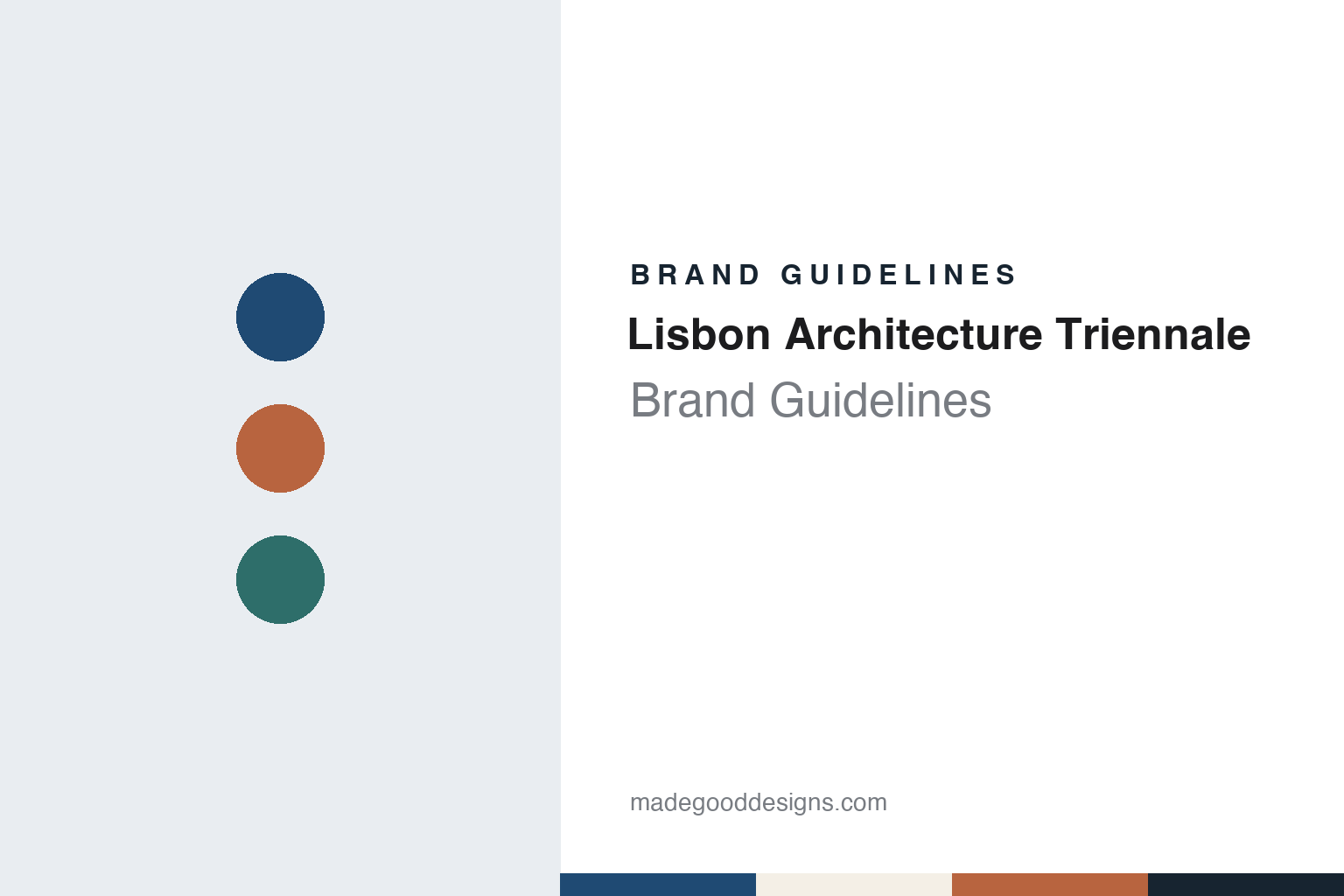
Two constants: a tile blue, limestone and terracotta palette and an editorial serif register. Abstract homage — not a Lisbon Architecture Triennale asset; no logo, poster or campaign image is reproduced.
Urban Voids
A forum every three years, and a palace in between.
The Lisbon Architecture Triennale — in Portuguese, Trienal de Arquitectura de Lisboa — is a non-profit association in Lisbon that holds a large architecture forum every three years. Its first edition, “Urban Voids,” ran from 31 May to 31 July 2007. The triennale’s archive names the architect José Mateus as chief curator of that edition and as founder and president of the organisation; he worked with a team of 23 Portuguese and international curators on exhibitions, an international conference and five competitions.
Those first exhibitions were spread across four sites, the archive says: the Portugal Pavilion, designed by Álvaro Siza for Expo ’98, which served as the main space and headquarters; the Cordoaria Nacional; the EDP Foundation at the Tejo Power Station, which hosted a cycle on architecture and music; and the town of Cascais, west of Lisbon. The theme looked at abandoned and undefined spaces in cities and their peripheries, and two exhibitions at the Cordoaria examined such voids in the metropolitan areas of Lisbon and Porto.
The organisation says it was declared of “Cultural Interest” by the Ministry of Culture in 2010 and received Public Utility status in 2013. Portuguese Wikipedia describes it as a non-profit organisation whose activities in Lisbon include Open House Lisboa, conference cycles and the triennale itself. Its homepage lists associates including the Ordem dos Arquitectos, Casa da Arquitectura and Fundação EDP.
Its base is the Palácio Sinel de Cordes in Campo de Santa Clara, near the Feira da Ladra flea market. The triennale says the mid-18th-century palace belongs to the Municipality of Lisbon, served as an elementary school from the 1930s until 2006, and stood closed until the triennale’s arrival in 2012; it now holds the organisation’s cultural programme and a creative cluster.
Colour
A new title and team each time.
Each edition takes a new title and a new curatorial team. The second, “Let’s Talk About Houses,” ran from 14 September 2010 to 16 January 2011, with four exhibitions, an international conference and four competitions. The third, “Close, Closer,” ran from 12 September to 15 December 2013 under a chief curator working with three curators. The fourth, “The Form of Form,” ran from 5 October to 12 December 2016 and, according to the triennale, comprised four exhibitions, a series of talks, seven “Satellites,” 12 associated projects and four publications. For the fifth, “The Poetics of Reason,” from 3 October to 2 December 2019, the curatorial team was chosen through an open call launched in 2016 and led by a Paris-based architect and theorist, and the programme rested on five central exhibitions, ten associated projects and conferences; the triennale reports more than 92,000 visitors to that edition.
The sixth edition, “Terra” — Latin for earth — ran from 29 September to 5 December 2022 and was chief-curated by Cristina Veríssimo and Diogo Burnay, whom Dezeen described in October 2022 as Portuguese architects and educators; the magazine called the 14-week event a call to action centred on sustainability and on a balance between communities, resources and processes. The triennale lists four exhibitions, four books, three days of conferences and a selection of independent projects. Dezeen reported that “Multiplicity” filled rooms of the National Museum of Contemporary Art, that “Retroactive” was shown at the Museum of Art, Architecture and Technology (MAAT), and that “Cycles,” on the circular economy of materials, was at Garagem Sul, with a mound of cork as its focal point; it named MVRDV and Tomoaki Uno Architects among the contributors.
The seventh edition, “How Heavy is a City?”, ran from 2 October to 8 December 2025. ArchDaily reported on 1 October 2025 that it was curated by the founders of the practice Territorial Agency and that it started from the observation that global cities are made of nearly 30 trillion tons of materials. The triennale organised the edition into three lines of research — “Fluxes,” “Spectres” and “Lighter” — each producing an exhibition, a book chapter and a talk series, with “Fluxes” at MAAT – Central Tejo and “Spectres” at MUDE, the Design Museum.
Typography
Design and documentation.
Design weeks and architecture biennials usually announce themselves with a city and a rhythm. Most take a city name plus “design week,” or “biennial” and “triennale” for events that return every two or three years; a few coin a word of their own, as DesignArt Tokyo did in 2017 by joining design and art into one name, Dezeen reported. The name tells visitors where to go and roughly when, and each edition then adds a year or a number to it.
The organisations behind them vary. DesignArt Tokyo is run by a company set up by a group of Tokyo designers and architects, working through an executive committee for each festival. Beijing Design Week is carried out by a company acting for an organising committee, with a design association among its partners. Elsewhere the same role falls to associations, foundations, museums, city agencies or trade-fair companies, and the organiser often stays in the background while the city takes the title.
Most of these events are spread out rather than gathered in one hall. Visitors follow district trails and showroom maps: Beijing Design Week’s Design Hop has led from the courtyard houses of Dashilar to the former power plant of 751 D·Park, and in 2013 a Japanese designer drew a map and identity for Dashilar, Wallpaper* reported. DesignArt Tokyo places its exhibitions in shop windows, galleries and showrooms from Omotesando to Ginza.
Each edition usually brings a curated theme, a guest city or country, and a catalogue, poster and campaign identity designed anew, so the look of a festival changes from year to year while its name stays fixed. This guide records the dated facts about each event, its organisers, venues and editions, and uses palettes and typefaces of our own; no official logo or campaign image is reproduced.
Aa
An editorial serif for edition titles and catalogues. (Specimen set in Fraunces, a serif STAND-IN; NOT the Lisbon Architecture Triennale logo.)
Open House and beyond
Programmes between the editions.
Between editions the triennale runs other programmes. It has organised Open House Lisboa every year since 2012, opening palaces, private houses, schools and churches to the public over one weekend, and in 2015 and 2016 it organised Open House Porto with Casa da Arquitectura. Its Critical Distance conference series, held in partnership with the Centro Cultural de Belém, began in 2011 and brings international architects to Lisbon; its first cycle ran from 2011 to 2013 and its second from 2014 to 2016. It also publishes books, among them four for the 2022 edition, and runs an education programme alongside its exhibitions at the palace.
The triennale also works with its peers abroad. In May 2025 the Oslo Architecture Triennale reported co-hosting a conversation with ArchInfo and the Lisbon Architecture Triennale at the Finnish Pavilion during the Venice Architecture Biennale.
For a design guide, the Lisbon Architecture Triennale shows how an architecture event can keep a permanent home — a rehabilitated 18th-century palace — while each edition moves through the city’s museums under a new title and team, from the Portugal Pavilion in 2007 to MAAT and MUDE in 2025. Compare the Oslo Architecture Triennale, its partner at Venice in 2025, and the Venice Biennale. For this guide we use a tile blue, a terracotta and a river teal on limestone with a serif, an unofficial interpretation; no product or logo is reproduced.
Explore & save
Keep Lisbon Architecture Triennale’s identity on hand — save it to a board in the Made Good inspiration library.
Lisbon Architecture Triennale identity set
Pin the tile blue, limestone and terracotta palette and the editorial serif register to your own board.
Source & notes
Frequently Asked Questions
What font can I use to match the Lisbon Architecture Triennale look?
This guide describes Lisbon Architecture Triennale’s type as “An editorial serif for edition titles and catalogues”. Its type specimen is set in Fraunces from Google Fonts as a stand-in; Fraunces is not Lisbon Architecture Triennale’s own lettering.
What colours are in the Lisbon Architecture Triennale palette?
This guide’s Lisbon Architecture Triennale palette is Tile blue #1F4A73, Harbour ink #172430, Limestone #F4EFE6, Terracotta #B8643F and River teal #2E6E6A. The tones are the guide’s own unofficial interpretation, not official Lisbon Architecture Triennale hex codes.
When was Lisbon Architecture Triennale founded?
Lisbon Architecture Triennale was founded in 2007 (first edition), in Lisbon, Portugal.
Who founded Lisbon Architecture Triennale?
Lisbon Architecture Triennale was founded by José Mateus in 2007 (first edition).
Where is Lisbon Architecture Triennale based?
On where Lisbon Architecture Triennale is based, this guide says: Palácio Sinel de Cordes, Campo de Santa Clara (since 2012).