Moers Festival Brand Guidelines
The Whitsun festival of improvised music on the Lower Rhine.
Aa
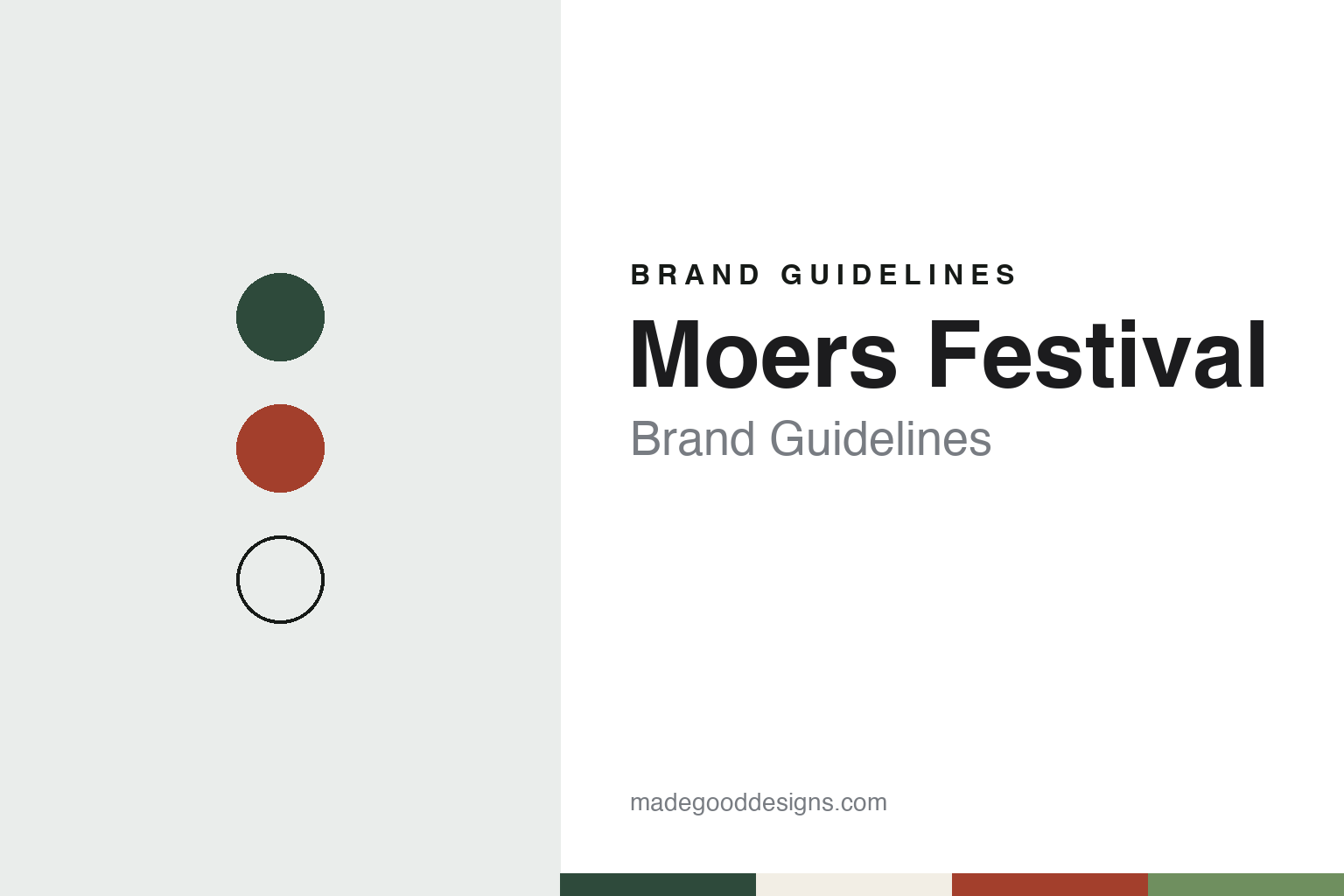
Two constants: a park green, tent red and programme paper palette and a storybook serif register. Abstract homage — not a mœrs festival poster or mark; no logo, artwork or photograph is reproduced.
A castle courtyard in 1972
New jazz at Whitsun in a Lower Rhine town.
The Moers Festival is an annual music festival in Moers, a town on the Lower Rhine in North Rhine-Westphalia, held over the Whitsun (Pentecost) weekend. Since 2006 it has used the word mark mœrs festival, written in lower case with the œ ligature, German Wikipedia says; this guide uses Moers Festival in running text.
It began in 1972 as the Internationales New Jazz Festival Moers. The festival’s own archive dates the first edition to 10 and 11 June 1972 in the Schlosshof, the courtyard of Moers castle, with the town’s cultural office, the Kulturamt der Stadt Moers, as organiser and Burkhard Hennen as artistic director. The Berlin daily taz described the opening in June 2006: the Polish musician Michał Urbaniak and his band played the castle courtyard on 10 June 1972 before about 800 people, at the height of European free jazz, and the first line-up also included the saxophonist Peter Brötzmann.
The festival grew quickly. German Wikipedia says it ran for two days at first, three the following year, and from 1974 to 2010 for four days at Whitsun. By the third edition, taz wrote, the courtyard could no longer hold the crowds, and the festival moved across the Moersbach stream into the town’s large Freizeitpark, the leisure park, where it was held in the open air from 1975. In the early 1980s it moved indoors to the town’s ice rink — taz gives 1982 and German Wikipedia 1983 to 1986 — and in 1987 it returned to the park under a large circus tent, which stayed its main stage until 2013.
Hennen widened the format over the years. German Wikipedia says he added morning “projects” in 1979, in which musicians from different groups improvised together, and an African Dance Night in 1985, held until 2005. According to taz, the “NewJazz” label was dropped from the name after the move into the tent and kept on posters only as a reminder of earlier years. English Wikipedia says Hennen also set up the label Moers Music to release recordings made at the festival.
Colour
Three artistic directors in five decades.
Hennen led the festival for 34 years, until 2005. That year a new company, Festival Moers Kultur GmbH, was founded, and it appointed Reiner Michalke as artistic director, German Wikipedia says; the festival describes the organiser today as the Moers Kultur GmbH, which has run it since 2005. taz reported in June 2006 that Michalke’s first edition, the 35th festival, opened with the Norwegian-Tunisian project “Fly.” Under Michalke the one-day African Dance Night gave way to night-time projects around the site and in the town centre, and in 2008 he set up the Improviser in Residence programme with the local improvised-music network nimm!, under which a musician lives and works in Moers for a year.
The festival was shortened to three days from 2011 and returned to four in 2014. That year it moved into a permanent venue for the first time: a former tennis hall at the Solimare site, converted into a festival hall for about 2,000 people, German Wikipedia says. In December 2016 the bassist and composer Tim Isfort, who comes from Moers, became artistic director. German Wikipedia says that under Isfort the programme spread across many venues in the town, with staged press conferences, invented bands and youth projects such as the composition competition moerster class.
The festival’s own description lists the formats it has added: the moers sessions, its morning sessions or projects; the improviser in residence, since 2008; discussions, since 2017; youth projects, since 2018; and hybrid formats including a virtual-reality space called moersland, since 2021. In 2020 the festival was held online, and in 2021 it was mostly broadcast by the Franco-German channel arte, with four evenings before an audience on a new open-air site in the town park, German Wikipedia says.
The music is described as improvised and experimental. German Wikipedia says the festival broadened from free jazz to world music and to soul, funk and hip-hop, and the festival itself says it has opened out over five decades from a pure new-jazz festival.
Typography
Jazz festivals and their places.
A jazz festival is rarely remembered for a single concert. Its identity is carried by a setting and a date: a converted cannery where every stage sits under one roof, a palace square turned into an open-air arena for a summer fortnight, a riverside town that fills with music in spring, a harbour city whose clubs host a festival in the dark months of winter, or a racecourse in New Orleans whose stands and paddocks become a field of stages. The setting gives the festival its look, and the calendar fixes it in the memory, whether that is a run of late-May nights, a numbered week in August or a pair of spring weekends.
Print is the second layer. Many festivals commission a new poster every year, and the run of posters becomes a record of the festival in its own right, with each edition’s artist or designer named alongside the date. Some keep the same wordmark for decades and let the artwork change; others redraw the name as the programme widens. Edition numbers and founding years often sit beside the title, so that the long count becomes part of the identity.
Behind each name stands an organisation. Jazz clubs, non-profit foundations, associations, municipal bodies and production companies keep festivals going across changes of venue, director and programme, and festival names often survive moves from one hall, park or district to another. When a festival changes its title or passes to a new organiser, the repeated elements, from the place name to the poster series, carry it across the change.
Audiences meet the identity in practical form: programme booklets, day schedules and stage maps, wristbands and festival passes, venue signs and apps that list who plays where and when. The guides in this group look at jazz festivals through those elements. The colours and typefaces shown are our own interpretation, not official assets.
Aa
A soft, storybook serif for a festival that themes each year. (Specimen set in Fraunces, a serif STAND-IN; NOT the mœrs festival logo or lettering.)
Back to the old town
The Kastellplatz in 2026.
In 2026 the festival moved its main stage to the Kastellplatz, in Moers’s old town close to the castle courtyard where it began, and for the first time ran over five days, from 21 to 25 May 2026, the festival says; camping returned to the Freizeitpark, on its balloon meadow. Each edition carries a motto, and the festival publishes it as a long, playful subtitle: in 2025 it was “Jazzfestival für Musik / Miteinander / Freysinn und: Klangfriede!”, and in 2026 the theme was fairy tales, under the motto “… wie im Märchen” (“… like in a fairy tale”).
Reviewing that 55th edition in June 2026, the Free Jazz Collective wrote that the printed programme presented the fairy-tale theme in surreal prose and thematic illustrations, and that the festival spread through the old town: the castle courtyard, a main stage across the market place and a tree-lined stage area in the town park for the morning-style Moers Sessions. On the main stage, the review reported, the trumpeter Nate Wooley presented a newly commissioned piece with the New York new-music group Yarn/Wire. The festival says it worked that year with the Huddersfield Contemporary Music Festival in England on a shared project of workshops and concerts.
The festival’s visual life has long been tied to its programme books and posters. The broadcaster arte published a review of the festival’s years in 2014 illustrated with the covers of its programme booklets, German Wikipedia notes, and English Wikipedia lists a run of albums recorded live at the festival from 1974 onwards.
For a design guide, Moers Festival shows how a festival can keep one name while its sites move from a castle courtyard to a park, a tent, a hall and back to the old town, with a new theme each Whitsun. Compare JazzFest Berlin, another long-running German festival for new jazz, and jazzopen stuttgart, a German jazz festival that also plays a castle courtyard. For this guide we use park green, tent red and programme paper with a serif, an unofficial interpretation; no product or logo is reproduced.
Explore & save
Keep Moers Festival’s identity on hand — save it to a board in the Made Good inspiration library.
Moers Festival identity set
Pin the park green, tent red and programme paper palette and the storybook serif register to your own board.
Source & notes
Frequently Asked Questions
What font can I use to match the Moers Festival look?
This guide describes Moers Festival’s type as “A soft, storybook serif for a festival that themes each year”. Its type specimen is set in Fraunces from Google Fonts as a stand-in; Fraunces is not Moers Festival’s own lettering.
What colours are in the Moers Festival palette?
This guide’s Moers Festival palette is Park green #2E4A3B, Ink #161A17, Tent red #A33F2C, Meadow #6F8F5F and Programme paper #F2EEE5. The tones are the guide’s own unofficial interpretation, not official Moers Festival hex codes.
When was Moers Festival founded?
Moers Festival was founded in 1972 (as Internationales New Jazz Festival Moers), in Moers, North Rhine-Westphalia, Germany.
Who founded Moers Festival?
Moers Festival was founded in 1972 (as Internationales New Jazz Festival Moers) by Burkhard Hennen, artistic director 1972–2005.