Vienna Design Week Brand Guidelines
Ten autumn days and a new focus district each year.
Aa
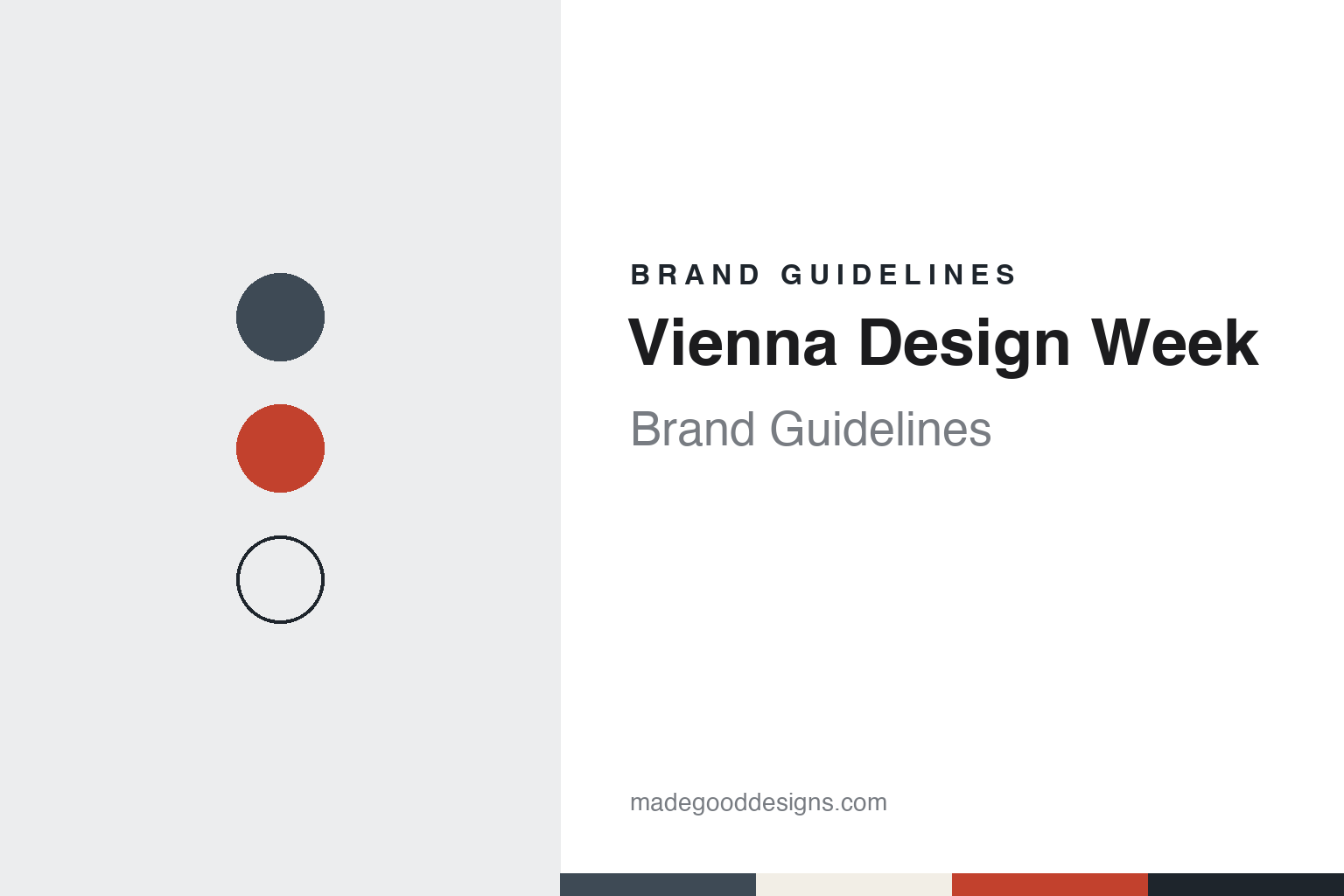
Two constants: a Danube slate, poster red and plaster white palette and a Viennese serif register. Abstract homage — not a Vienna Design Week asset; no logo, poster or map is reproduced.
Three curators and a craft project
Announced in 2006, first held in 2007.
Vienna Design Week is a ten-day design festival held across the Austrian capital each autumn. Its first edition ran in 2007, from 3 to 21 October, according to German Wikipedia, and the festival has since settled into a slot from late September to early October. The 2025 edition, the 19th, ran from 26 September to 5 October, the Austrian broadcaster ORF reported, and the 2026 edition, the 20th, from 25 September to 4 October.
It was started by three Viennese curators, Lilli Hollein, Tulga Beyerle and Thomas Geisler. German Wikipedia, citing a 2016 book about the festival, says the three began a project called Passionswege in 2006, on the meeting of craft and design, and organised a conference with the University of Applied Arts Vienna the same year; both became the basis of the new festival in 2007. When they announced it in autumn 2006, ORF reported in 2026, the founders wanted to place Vienna beside design cities such as Milan and London, and to make design less elitist and luxurious and more concerned with useful things.
The founders led the festival together until 2010. Beyerle and Hollein were co-directors from 2010 to 2013, and Hollein then led the team alone, German Wikipedia says. After Hollein was appointed director general of the Museum of Applied Arts, the MAK, in Vienna in May 2021, the festival’s vice-director succeeded her as festival director. The organiser is a registered association based in Vienna, listed in the festival’s legal notice as the Vienna Design Office, Verein Neigungsgruppe Design. German Wikipedia says that entry is free.
The programme grew with the years. German Wikipedia, citing the festival, gives 12,000 visitors at 26 events in 2007 and more than 36,000 visitors at 184 events in 2015. For 2025 the Milan events site Fuorisalone counted more than 200 events at more than 50 venues, and ORF reported that the festival headquarters alone offered 2,000 square metres of exhibitions, workshops and installations.
Colour
Passionswege, Stadtarbeit and the focus district.
The festival is built from recurring formats, with a changing emphasis each year. Passionswege, its oldest format, pairs designers with long-established Viennese craft workshops, and the results are shown in the workshops themselves during the festival. German Wikipedia names past participants including the glassmaker J. & L. Lobmeyr and the Augarten porcelain manufactory. In 2025 a Frankfurt-based designer worked with the woodcarving workshop Stadlhofer, which has revived the old technique of chip carving, on a series of small wooden houses that double as storage boxes, each floor carved with its own pattern, Wallpaper* and ORF reported.
Stadtarbeit is the social-design format: projects are gathered through an open call, and a jury selects them and gives them a budget for their realisation, shown in public space so that visitors need no prior knowledge to understand them, ORF said in 2026. Urban Food & Design, run since 2018 with the Vienna Business Agency, presents projects on producing, distributing and selling food in the city, German Wikipedia says. FOKUS is a curated group exhibition; its fourth edition, in 2025, took ageing as its theme and was put together by a guest curator from the Estonian Museum of Applied Art and Design in Tallinn, Falter reported. The festival’s own list of formats adds Debut and Re:Form.
Two elements move every year: the Festivalzentrale, the festival headquarters, and the Fokusbezirk, the focus district, where much of the programme gathers. German Wikipedia lists focus districts from Hernals in 2010 and Leopoldstadt in 2011 through Favoriten, Neubau and Alsergrund to Brigittenau in 2021, and headquarters that included the Palais Schwarzenberg in 2014, the former Ankerbrot bread factory in 2015 and the former Sophienspital in 2018. In 2025, Falter reported, the focus district was Wieden, the fourth district, and the headquarters a former car dealership on Wiedner Hauptstraße, which Wallpaper* identified as a former Mercedes-Benz showroom. In 2026 the headquarters moved to an office high-rise on Hietzinger Kai in the 13th district, ORF reported.
A guest country or city joins each edition. German Wikipedia lists Switzerland in 2007, Sweden in 2010 and Finland in 2019. In 2025 Frankfurt was the exchange city, Wallpaper* reported, and in 2026 artists from Luxembourg were the guests, among them a listening exhibition called Two-O-Eight, named after the frequency of Radio Luxembourg, ORF reported.
Typography
Design weeks and architecture biennials.
Design weeks and architecture biennials usually announce themselves with a city and a rhythm. Most take a city name plus “design week,” or “biennial” and “triennale” for events that return every two or three years; a few coin a word of their own, as DesignArt Tokyo did in 2017 by joining design and art into one name, Dezeen reported. The name tells visitors where to go and roughly when, and each edition then adds a year or a number to it.
The organisations behind them vary. DesignArt Tokyo is run by a company set up by a group of Tokyo designers and architects, working through an executive committee for each festival. Beijing Design Week is carried out by a company acting for an organising committee, with a design association among its partners. Elsewhere the same role falls to associations, foundations, museums, city agencies or trade-fair companies, and the organiser often stays in the background while the city takes the title.
Most of these events are spread out rather than gathered in one hall. Visitors follow district trails and showroom maps: Beijing Design Week’s Design Hop has led from the courtyard houses of Dashilar to the former power plant of 751 D·Park, and in 2013 a Japanese designer drew a map and identity for Dashilar, Wallpaper* reported. DesignArt Tokyo places its exhibitions in shop windows, galleries and showrooms from Omotesando to Ginza.
Each edition usually brings a curated theme, a guest city or country, and a catalogue, poster and campaign identity designed anew, so the look of a festival changes from year to year while its name stays fixed. This guide records the dated facts about each event, its organisers, venues and editions, and uses palettes and typefaces of our own; no official logo or campaign image is reproduced.
Aa
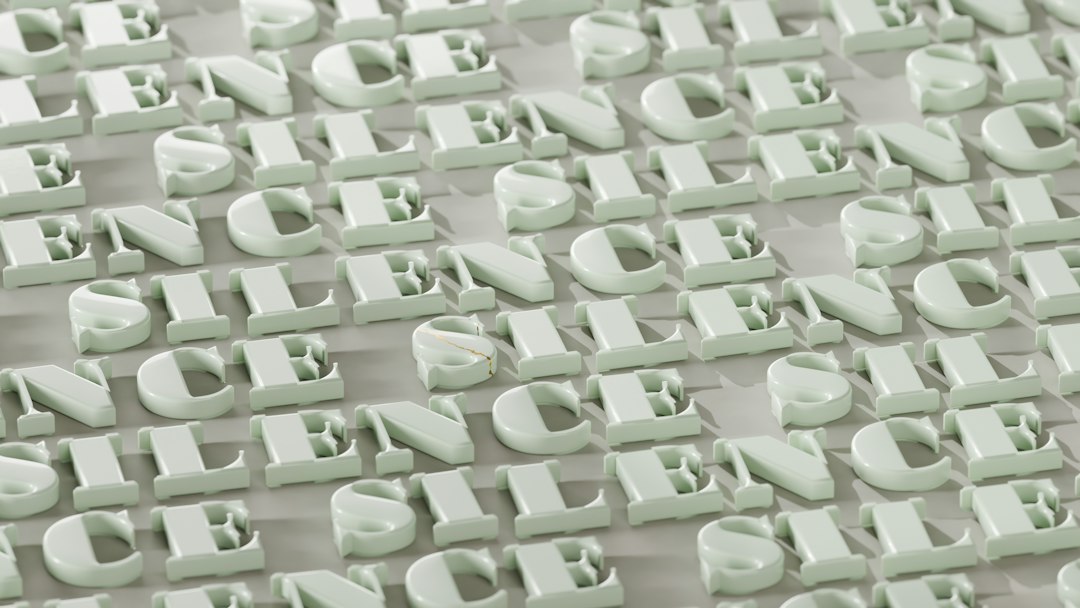
A Viennese serif for a festival that moves each autumn. (Specimen set in Libre Caslon Text, a serif STAND-IN; NOT the Vienna Design Week logo.)
Vienna Design Week
A festival told through its posters.
Companies and public bodies take part through partnerships. In 2025 IKEA, a sponsor of the festival, showed an installation made with the Viennese interior studio Atelier Karasinski and inspired by the Frankfurt Kitchen, the prototype of the modern fitted kitchen, Falter reported. The same year the Vienna Business Agency’s Biofabrique Vienna project presented dyes made from avocado stones, red-cabbage leftovers and invasive plants, and a city-wood archive showed products made from felled Viennese trees, ORF reported. In 2026 the University of Applied Arts Vienna showed projects alongside design schools from Karlsruhe and Potsdam, ORF said.
The festival’s visual identity has been carried above all by its posters. ORF reported in 2026 that the founders meant the posters to convey their idea of a less elitist design, and that for the 20th edition the MAK was showing the poster campaigns from 29 September to 1 November 2026. The campaigns were designed by graphic studios including Bueronardin, Fredmansky and Studio Sirene, ORF said. Wallpaper* wrote in 2025 that the festival reinvents its identity with each edition, much as it changes its locations, and that it has often moved into forgotten buildings of Vienna’s past; in 2024, the magazine noted, it took over a new and still unfinished building for its headquarters.
The festival describes its own programme as a mix of product, furniture and industrial design, architecture, graphic design and social design, and says it runs at around fifty locations across the city with largely free admission.
For a design guide, Vienna Design Week shows how a festival can keep its name and formats steady while changing its district, headquarters, guest and posters every year. Compare Helsinki Design Week, the September festival in the Finnish capital, and IKEA, a sponsor of the 2025 edition. For this guide we use a Danube slate, a poster red and a plaster white with a serif, an unofficial interpretation; no product or logo is reproduced.
Explore & save
Keep Vienna Design Week’s identity on hand — save it to a board in the Made Good inspiration library.
Vienna Design Week identity set
Pin the Vienna Design Week Danube slate, poster red and plaster white palette and the Viennese serif register to your own board.
Source & notes
Frequently Asked Questions
What font can I use to match the Vienna Design Week look?
This guide describes Vienna Design Week’s type as “A Viennese serif for a festival that moves each autumn”. Its type specimen is set in Libre Caslon Text from Google Fonts as a stand-in; Libre Caslon Text is not Vienna Design Week’s own lettering.
What colours are in the Vienna Design Week palette?
This guide’s Vienna Design Week palette is Danube slate #3E4A55, Coffeehouse black #1E252C, Poster red #C2412D, Plaster white #F2EEE6 and Paper #F7F5F0. The tones are the guide’s own unofficial interpretation, not official Vienna Design Week hex codes.
Who founded Vienna Design Week?
Vienna Design Week was founded by Lilli Hollein, Tulga Beyerle and Thomas Geisler.