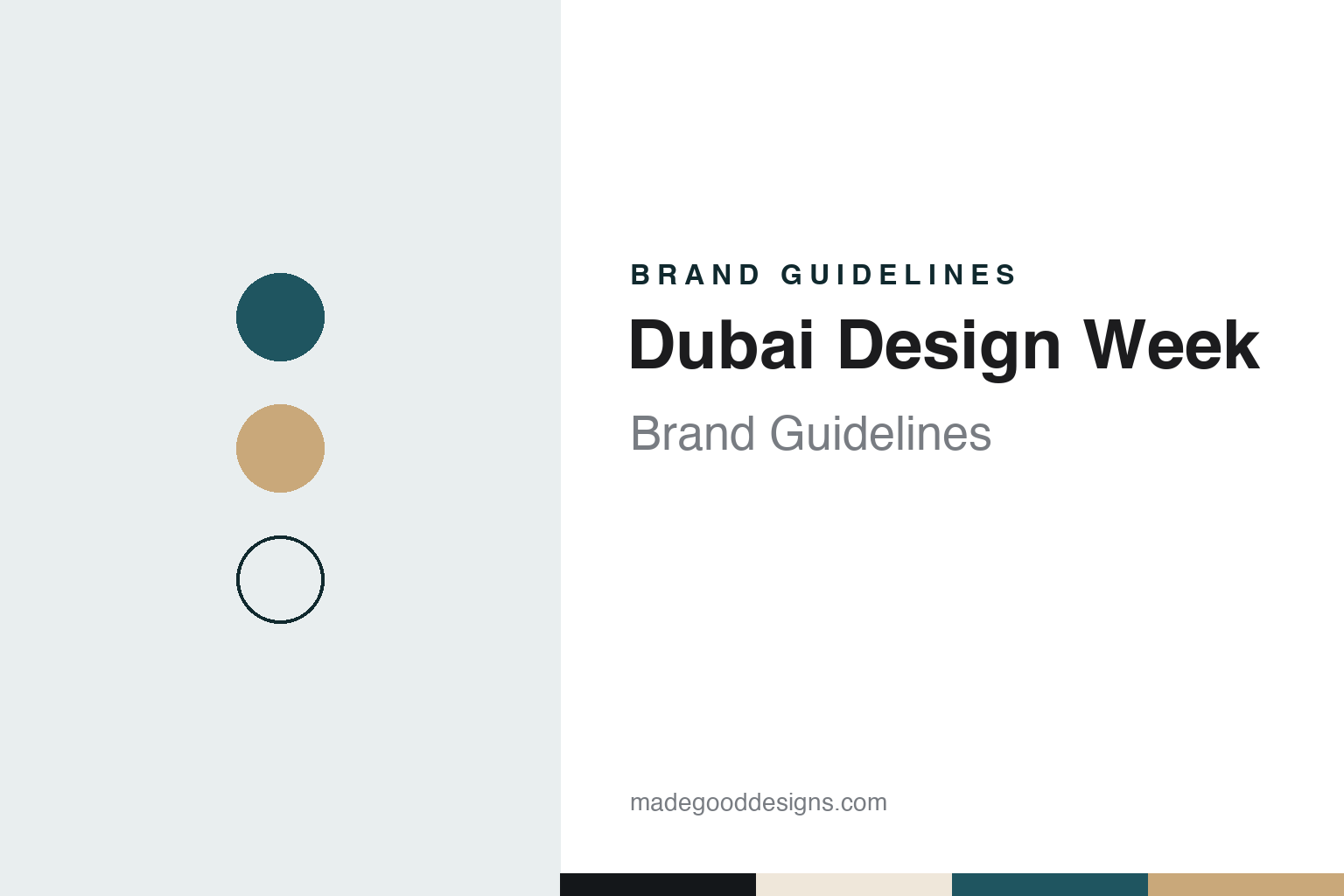
Dubai Design Week Brand Guidelines
A November festival built around a design district.
Aa
Two constants: a night ink, gulf teal and dune sand palette and a geometric sans register. Abstract homage — not a Dubai Design Week mark; no logo, poster or exhibited object is reproduced.
A first edition in 2015
An Art Dubai project in a new design district.
Dubai Design Week was first held from 26 to 31 October 2015. Dezeen reported in September 2015 that it was organised in partnership with Art Dubai, the company behind the city’s spring art fair, and Dubai Design District, known as d3, a creative quarter then still being built. Architectural Record, covering the inaugural week in November 2015, described it as run by the same company that produces Art Dubai. English Wikipedia says the festival is owned and managed by Art Dubai Group, staged with d3 and supported by Dubai Culture and Arts Authority. The same article lists the fields the week covers, from architecture, interior design and product and furniture design to jewellery, industrial design and service design, and describes a programme of mostly free exhibitions, talks and workshops held across the city, with d3 as the main hub and a design market alongside the fair.
The week did not arrive alone. Dezeen noted in November 2015 that Art Dubai had already started the collectible design fair Design Days Dubai in 2012 and the trade fair Downtown Design before the design week, and quoted Cyril Zammit, then Art Dubai’s director of design, describing the festival as a response to the growing role of design in the city. Sources differ on when Downtown Design began: English Wikipedia gives 2013, Dezeen in 2015 described it as set up the previous year, and designboom called the 2015 fair its third edition.
d3 itself shaped the first edition. Architectural Record described the district’s first phase as 11 low-rise buildings on the edge of downtown, their curtain walls fronted by chevron-shaped metal screens whose patterns, at different points, suggest sand dunes or Arabic calligraphy. The opening talk was held in the atrium of one of them.
Colour
Graduates, pavilions and a trade fair.
The 2015 programme set the pattern for later years. The Global Grad Show, curated by the designer and writer Brendan McGetrick, gathered 50 projects by recent graduates of ten design schools, among them London’s Royal College of Art, the Swiss school ÉCAL, MIT and Eindhoven University of Technology, Dezeen reported; the projects were grouped under seven headings: health, home, work, play, energy, construction and memory. Architectural Record also singled out Brilliant Beirut, an exhibition on the Lebanese capital’s design culture.
A second strand was Abwab, Arabic for “doors.” In 2015 it took the form of six pavilions of identical size and shape, designed by the Dubai firm LOCI architecture + design and set along the walkways of d3, designboom reported. Their outer skins were made of sand poured between transparent layers, and they held work from Jordan, Kuwait, Pakistan, Saudi Arabia, Tunisia and the United Arab Emirates. Thirteen further installations were placed around the city, some on the beach. Abwab has continued as a yearly feature; English Wikipedia describes it as the festival’s platform for designers from the Middle East, North Africa and South Asia. Dezeen described the 2025 exhibition as showing “textiles, narrative and the architecture of ornaments,” and the festival’s website presents the 2026 group show, In Other Words, as an exhibition on how language is communicated, interpreted and remembered.
The commercial anchor is Downtown Design, the festival’s design fair. In 2015 Architectural Record described a small furniture fair that brought brands such as Kartell together with Emirati designers. Dezeen’s guide to the 2025 week listed furniture, lighting and textile brands at Downtown Design, together with its Forum conference and Editions, a showcase that sits beside the main fair. In 2026, the festival’s website says, Downtown Design returned from 4 to 8 November.
Typography
How design weeks present themselves.
Design weeks and architecture biennials usually announce themselves with a city and a rhythm. Most take a city name plus “design week,” or “biennial” and “triennale” for events that return every two or three years; a few coin a word of their own, as DesignArt Tokyo did in 2017 by joining design and art into one name, Dezeen reported. The name tells visitors where to go and roughly when, and each edition then adds a year or a number to it.
The organisations behind them vary. DesignArt Tokyo is run by a company set up by a group of Tokyo designers and architects, working through an executive committee for each festival. Beijing Design Week is carried out by a company acting for an organising committee, with a design association among its partners. Elsewhere the same role falls to associations, foundations, museums, city agencies or trade-fair companies, and the organiser often stays in the background while the city takes the title.
Most of these events are spread out rather than gathered in one hall. Visitors follow district trails and showroom maps: Beijing Design Week’s Design Hop has led from the courtyard houses of Dashilar to the former power plant of 751 D·Park, and in 2013 a Japanese designer drew a map and identity for Dashilar, Wallpaper* reported. DesignArt Tokyo places its exhibitions in shop windows, galleries and showrooms from Omotesando to Ginza.
Each edition usually brings a curated theme, a guest city or country, and a catalogue, poster and campaign identity designed anew, so the look of a festival changes from year to year while its name stays fixed. This guide records the dated facts about each event, its organisers, venues and editions, and uses palettes and typefaces of our own; no official logo or campaign image is reproduced.
Aa
A geometric sans for a district of glass and screens. (Specimen set in Manrope, a sans STAND-IN; NOT the Dubai Design Week logo.)
The November week
A decade on, the festival still centres on d3.
The festival has kept its numbering and its six-day length. Dezeen’s events guide gave the dates of the 2025 edition as 4 to 9 November 2025, with most events held in d3, which it described as home to studios and brands including Zaha Hadid Architects and Lasvit. That year’s programme, Dezeen reported, included a wooden pavilion called Chatai by the Japanese firm Nikken Sekkei, a lounge by the surfaces company Cosentino with the design firm Etereo, and the Urban Commissions programme, which in 2025 centred on the courtyard.
The festival’s own website describes the parts that return each year: Downtown Design; The Forum, a talks series with designers and other creative figures; Abwab; Urban Commissions, an open competition on how spatial design shapes shared life in the public realm, which it says reached its eighth edition; workshops in a Maker Space at d3; and the Marketplace, a weekend-long outdoor market for artisans and makers held in the district.
What gives the festival its character in coverage is its setting: a purpose-built district whose screens, in Architectural Record’s description, suggest dunes and calligraphy, and a programme that mixes a commercial fair with commissioned pavilions, installations and, in its first year, graduate work. The palette and type in this guide are our own interpretation.
For a design guide, Dubai Design Week shows how a festival can grow out of a single district and a trade fair rather than a historic city centre. Compare Design Week Mexico, which also pairs local craft with invited designers from abroad, and the London Design Festival, a citywide week in a long-established design capital. For this guide we use night ink, a gulf teal, dune sand and pale stone with a geometric sans, an unofficial interpretation; no product or logo is reproduced.
Explore & save
Keep Dubai Design Week’s identity on hand — save it to a board in the Made Good inspiration library.
Dubai Design Week identity set
Pin the night ink, gulf teal and dune sand palette and the geometric sans register to your own board.
Source & notes
Frequently Asked Questions
What font can I use to match the Dubai Design Week look?
This guide describes Dubai Design Week’s type as “A geometric sans for a district of glass and screens”. Its type specimen is set in Manrope from Google Fonts as a stand-in; Manrope is not Dubai Design Week’s own lettering.
What colours are in the Dubai Design Week palette?
This guide’s Dubai Design Week palette is Night ink #14171A, Gulf teal #1F5560, Dune sand #C9A87A, Pale stone #EFE7DA and Paper #F9F7F3. The tones are the guide’s own unofficial interpretation, not official Dubai Design Week hex codes.
When was Dubai Design Week founded?
Dubai Design Week was founded in 2015, in Dubai, United Arab Emirates.