BIO Biennial of Design Ljubljana Brand Guidelines
From an industrial design show to a curated biennial.
Aa
Two constants: a teal, paper white and orange palette and a grotesque sans register. Abstract homage — not a BIO poster, identity or mark; no logo or exhibition graphic is reproduced.
Biennial of Industrial Design
A meeting place for designers and industry, from 1964.
BIO, the Biennial of Design in Ljubljana, began as the Bienale industrijskega oblikovanja, the Biennial of Industrial Design. The biennial’s own history page traces its founding work to 1963 and dates its first edition, BIO 1, to 1964, when it was held in Ljubljana as a Yugoslav exhibition with international participation. Culture.si, the Slovenian culture portal, gives the same pair of dates: established in 1963 and held in Ljubljana since 1964. The history page says the founders wanted an event where designers and business leaders could meet, and where products would be shown together with the case for good design in industry and trade.
The early format relied on selection by others. From BIO 2, the works on show were chosen by national design associations, a practice that lasted until BIO 21, the history page says. After the first three editions money ran short, and the event was revived by making it international only every fourth year: BIO 4, 6 and 8 were Yugoslav editions and BIO 5, 7 and 9 international ones, until BIO 10 dropped that pattern. Exhibits at BIO 1, according to the same page, included a set of folding glasses and a club suite of furniture.
Culture.si adds that the biennial has run under the aegis of the Museum of Architecture and Design (MAO) since the museum was founded in 1972, and that the BIO secretariat became an associate member of ICSID, the international council of industrial-design societies, in 1977. Venues moved around the city: BIO 19, in 2004, was the first edition held in the large exhibition space at Fužine Castle, the home of MAO. BIO 20, in October 2006, showed more than 350 exhibits by designers from 17 countries, grouped as industrial products, visual messages and design projects, Culture.si says.
Colour
Open calls, curators and one theme per edition.
The change from a product show to a curated biennial came in steps. BIO 21, in 2008, replaced national selections with an open call, the history page says. Culture.si adds that an international selection committee judged every entry on the same terms for the first time, that 126 works from 18 countries were shown out of 421 submitted, and that the event received a new corporate identity designed by the Slovenian studio Gigodesign. On the name, the sources differ: the biennial’s history page says it officially became the Design Biennial in 2011, while Culture.si says it carried the industrial-design name until 2012. BIO 23, in 2012, addressed “Design Relations” and was curated by Studio Organisation in Design; the history page calls it the first fully curated, thematic edition.
The 24th biennial, in 2014, marked fifty years and was called BIO 50. Culture.si describes a collaborative process of about six months in which Slovene and international mentors and participants worked in thematic groups such as Affordable Living, Knowing Food, Hidden Crafts and Nanotourism, with an exhibition on the biennial’s fifty-year history beside the main show. The history page treats this as the point at which BIO became a production platform rather than a static exhibition.
Later editions each took one theme. BIO 25, in 2017, was titled “Faraway, So Close” and looked at the Slovenian landscape and at places a short distance from the capital, Culture.si says. BIO 26, “Common Knowledge,” dealt with information and ran from 14 November 2019 to 9 February 2020 at MAO and other sites in Ljubljana. BIO 27, “Super Vernaculars,” was announced by MAO in July 2021 with the London-based curator, writer and consultant Jane Withers; dated 26 May to 29 September 2022, it looked at vernacular and indigenous building and design traditions as a source for contemporary work. BIO 28, “Double Agent – Do You Speak Flower?,” curated by Professor Alexandra Midal, ran from 21 November 2024 to 6 April 2025, according to Culture.si, which also notes the biennial’s 60th anniversary in 2024.
Typography
Design and documentation.
Design weeks and architecture biennials usually announce themselves with a city and a rhythm. Most take a city name plus “design week,” or “biennial” and “triennale” for events that return every two or three years; a few coin a word of their own, as DesignArt Tokyo did in 2017 by joining design and art into one name, Dezeen reported. The name tells visitors where to go and roughly when, and each edition then adds a year or a number to it.
The organisations behind them vary. DesignArt Tokyo is run by a company set up by a group of Tokyo designers and architects, working through an executive committee for each festival. Beijing Design Week is carried out by a company acting for an organising committee, with a design association among its partners. Elsewhere the same role falls to associations, foundations, museums, city agencies or trade-fair companies, and the organiser often stays in the background while the city takes the title.
Most of these events are spread out rather than gathered in one hall. Visitors follow district trails and showroom maps: Beijing Design Week’s Design Hop has led from the courtyard houses of Dashilar to the former power plant of 751 D·Park, and in 2013 a Japanese designer drew a map and identity for Dashilar, Wallpaper* reported. DesignArt Tokyo places its exhibitions in shop windows, galleries and showrooms from Omotesando to Ginza.
Each edition usually brings a curated theme, a guest city or country, and a catalogue, poster and campaign identity designed anew, so the look of a festival changes from year to year while its name stays fixed. This guide records the dated facts about each event, its organisers, venues and editions, and uses palettes and typefaces of our own; no official logo or campaign image is reproduced.
Aa
A grotesque sans for numbered, themed editions. (Specimen set in Space Grotesk, a sans STAND-IN; NOT the BIO logo or any edition identity.)
BIO today
A museum, a partner and a new theme every edition.
The biennial’s website names the current organisers. MAO, which it describes as the central national institution for architecture and design, organises BIO in cooperation with the Centre for Creativity (CzK). MAO is responsible for the curatorial direction, the international profile and the archive of past editions; CzK supports research and production, work with local communities and projects meant to continue after the exhibition closes, the site says. The history page notes that the regular exhibitions built up the museum’s design archive over the decades, and it reproduces early material such as the poster for BIO 1 in 1964 and the poster for BIO 3 in 1968, both in the MAO collection.
The 29th edition, BIO 29, is titled “Mehka polja” (Soft Fields). MAO named Martina Muzi as curator in January 2026, working with an associate research curator, and the curatorial text published in February 2026 asks how knowledge held inside research, industrial and infrastructure settings can be opened up and shared through design. The biennial’s website dates the edition from 3 December 2026 to 4 April 2027 across three venues: MAO and the Mala galerija Banke Slovenije in Ljubljana, and the Libertas cultural centre in Koper, on the coast. The programme is organised in strands, among them “Experimental practices,” nine design-research projects developed in Slovenia with local partners, and “Works with resonance,” projects first made in other places.
For a design guide, BIO shows how an event can keep its name and its numbering while its subject moves from finished products to collaborative processes, with each edition given its own title and curator. Compare Vienna Design Week, where projects made with BIO were shown in 2018, and London Design Festival, which hosted a presentation of the same work that year, according to Culture.si. For this guide we use a deep teal, a warm paper white and a signal orange with a sans, an unofficial interpretation; no product or logo is reproduced.
Explore & save
Keep BIO Biennial of Design Ljubljana’s identity on hand — save it to a board in the Made Good inspiration library.
BIO Biennial of Design Ljubljana identity set
Pin the teal, paper white and orange palette and the grotesque sans register to your own board.
Source & notes
Frequently Asked Questions
What font can I use to match the BIO Biennial of Design Ljubljana look?
This guide describes BIO Biennial of Design Ljubljana’s type as “A grotesque sans for numbered, themed editions”. Its type specimen is set in Space Grotesk from Google Fonts as a stand-in; Space Grotesk is not BIO Biennial of Design Ljubljana’s own lettering.
What colours are in the BIO Biennial of Design Ljubljana palette?
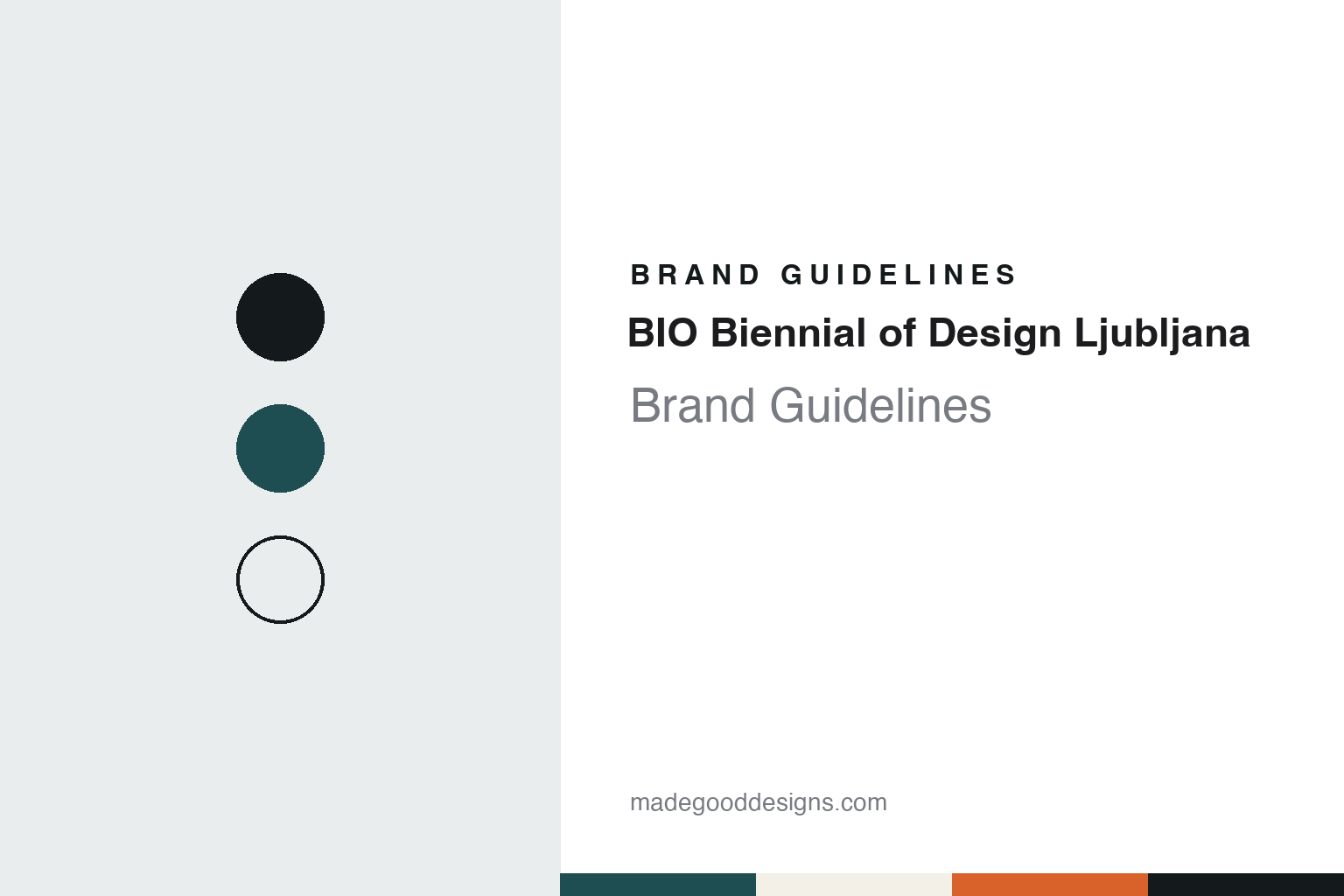
This guide’s BIO Biennial of Design Ljubljana palette is Ljubljana teal #1F4E52, Ink #141A1B, Paper white #F3F0E8, Signal orange #D9622B and Pale stone #FAF8F3. The tones are the guide’s own unofficial interpretation, not official BIO Biennial of Design Ljubljana hex codes.
When was BIO Biennial of Design Ljubljana founded?
BIO Biennial of Design Ljubljana was founded in 1963; first edition 1964, in Ljubljana, Slovenia.