Design Week Mexico Brand Guidelines
Mexico City’s October design festival, built around a guest country and a guest state.
Aa
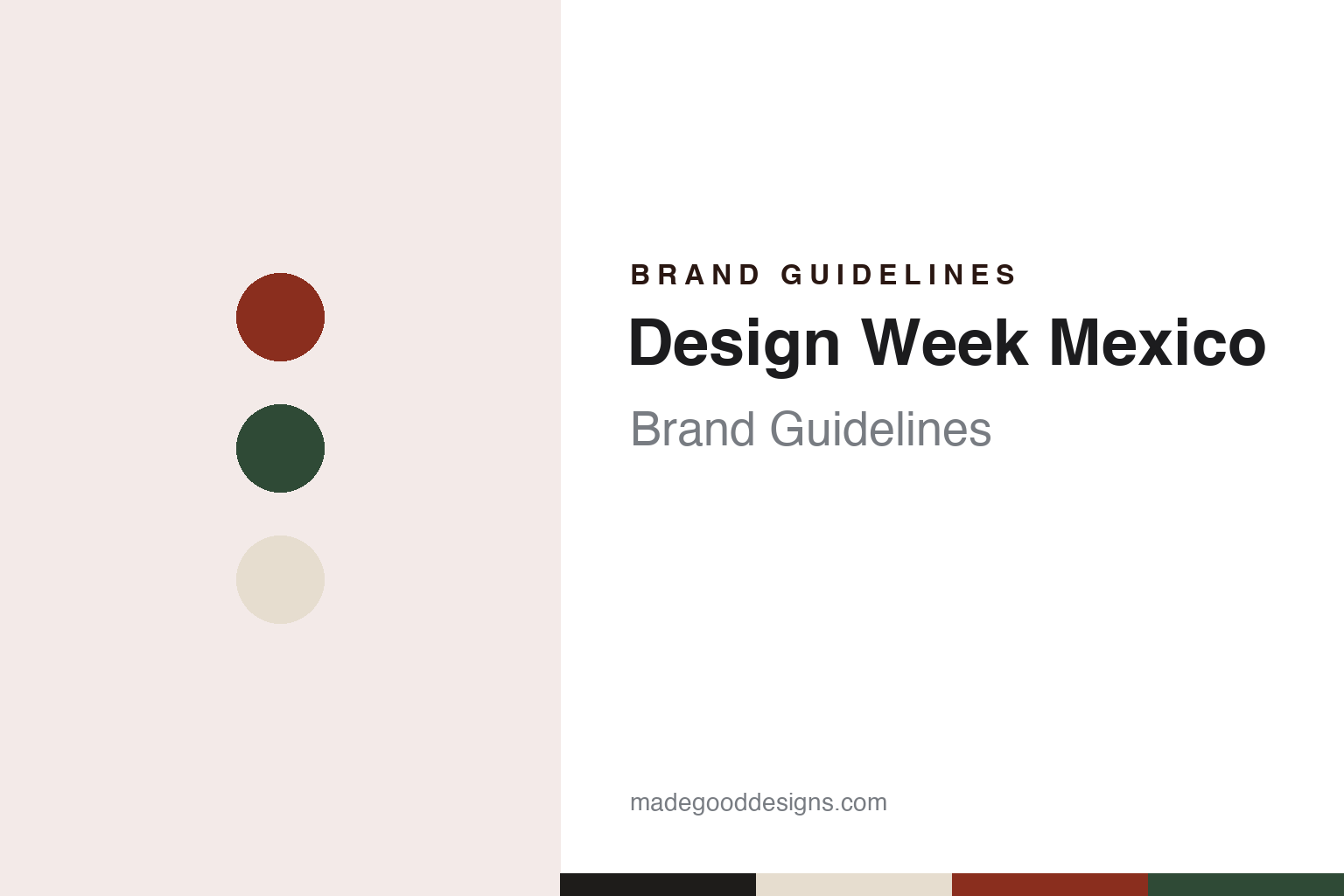
Two constants: a volcanic black, clay red and park green palette and a grotesque sans register. Abstract homage — not a Design Week Mexico mark; no logo, poster or exhibited object is reproduced.
A city festival
Four partners and a citywide programme in Mexico City.
Design Week Mexico is an annual design festival held across Mexico City each October. It was founded in 2009 by four partners, among them Emilio Cabrero, whom Wallpaper* described in 2017 as its director, and Andrea Cesarman, who is also a co-founder of the Mexico City architecture firm C Cúbica, according to the festival’s own published history and a 2017 report in Wallpaper*. The festival says it set out to present design as part of everyday life, through exhibitions, talks, installations and documentaries aimed at professionals, students and the general public.
The editions are numbered, which makes the timeline easy to follow. The ninth ran from 11 to 15 October 2017, as ArchDaily and Wallpaper* both reported, and the 2018 week took place from 10 to 14 October, according to Dezeen. The Mexico City listings magazine Chilango described the 2025 festival as the seventeenth edition, held under the motto “Diseñado en México” (Designed in Mexico).
Over that time the week has spread from a few exhibitions into a citywide calendar that runs well beyond its core days. In 2025, Chilango reported, the craft residency exhibition opened on 7 October and closed on 2 November, while the Inédito showcase stayed open until 11 January 2026. The festival’s programme also includes guided routes through showrooms, workshops and design shops in several of the city’s neighbourhoods.
Colour
A guest country, a guest state and a pavilion in the park.
The festival’s defining format is the guest country. Since 2013 each edition has invited one nation to bring its designers to Mexico City: the festival lists Brazil as the first, in 2013, followed by the United Kingdom in 2014, Italy in 2015, Germany in 2016 and Switzerland in 2017. Later guests, according to the festival’s website, were Cuba in 2019, the United States for 2020 and 2021, Brazil again in 2022, France in 2023, Colombia in 2024 and Argentina in 2025; Chilango also named Argentina as the 2025 guest. For 2026 the festival lists Chile, with Doha as a guest city.
Since 2015 the festival has paired that country with a guest Mexican state, beginning with Chiapas. Jalisco followed in 2016 and Puebla in 2017; later guests included Yucatán, Oaxaca, Querétaro and Aguascalientes, and in 2025 the festival presented a “Focus México” spanning ten states. The two halves meet in a residency called Visión & Tradición, in which young designers from the guest country and from Mexico work with craftspeople from the guest state. Wallpaper* described the 2017 residency as connecting Mexican and Swiss industrial designers with artisans; in 2025, Chilango reported, the Mexican–Argentine pieces were shown at the Museo Nacional de Antropología. In 2020 and 2021, the festival says, the partnership and residency ran in a virtual format.
The other fixed point is Chapultepec Park, where the festival has commissioned a temporary architecture pavilion with the Museo Tamayo, the museum designed by Teodoro González de León and Abraham Zabludovsky. In 2017 the Mexico City studio Materia built Parteluz, a pavilion of 70 white concrete columns set in two curving arcs and linked by double pine beams, ArchDaily reported; earlier pavilions included one by C Cúbica with Palomba Serafini Associati. In 2018 the architect Fernanda Canales built Museo Abierto (Open Museum), a closed black volume that opens inside onto three patios lined with mirrors. Dezeen, reporting on it in October 2018, said the yearly pavilion is seen as Mexico City’s equivalent of London’s Serpentine Pavilion.
The 2018 week coincided with Mexico City’s year as the World Design Organization’s World Design Capital, a link that ArchDaily noted in 2017 and that the festival’s own history credits to its initiative.
Typography
How design weeks present themselves.
Design weeks and architecture biennials usually announce themselves with a city and a rhythm. Most take a city name plus “design week,” or “biennial” and “triennale” for events that return every two or three years; a few coin a word of their own, as DesignArt Tokyo did in 2017 by joining design and art into one name, Dezeen reported. The name tells visitors where to go and roughly when, and each edition then adds a year or a number to it.
The organisations behind them vary. DesignArt Tokyo is run by a company set up by a group of Tokyo designers and architects, working through an executive committee for each festival. Beijing Design Week is carried out by a company acting for an organising committee, with a design association among its partners. Elsewhere the same role falls to associations, foundations, museums, city agencies or trade-fair companies, and the organiser often stays in the background while the city takes the title.
Most of these events are spread out rather than gathered in one hall. Visitors follow district trails and showroom maps: Beijing Design Week’s Design Hop has led from the courtyard houses of Dashilar to the former power plant of 751 D·Park, and in 2013 a Japanese designer drew a map and identity for Dashilar, Wallpaper* reported. DesignArt Tokyo places its exhibitions in shop windows, galleries and showrooms from Omotesando to Ginza.
Each edition usually brings a curated theme, a guest city or country, and a catalogue, poster and campaign identity designed anew, so the look of a festival changes from year to year while its name stays fixed. This guide records the dated facts about each event, its organisers, venues and editions, and uses palettes and typefaces of our own; no official logo or campaign image is reproduced.
Aa
A grotesque sans with a firm, public voice. (Specimen set in Archivo, a sans STAND-IN; NOT the Design Week Mexico logo.)
Inédito and Design House
New work in a pavilion, whole rooms in a house.
Two showcases recur every year. Inédito presents design pieces that have not been shown or sold before. In 2017 it was shown at the Museo Tamayo, Wallpaper* reported; by 2025, Chilango reported, it had reached its eleventh edition and moved to Espacio CDMX, Arquitectura y Diseño, in Chapultepec. Dezeen, in October 2025, described it as set in a modernist pavilion in the park, recently renovated, with a new layout, and listed studios such as Drusch Design, which made a tiled coffee table with the manufacturer Interceramic, and Muntanya Lab, which showed bio-based furniture made with the oat-milk company Oatly.
Design House takes over a single house each year and hands its rooms to architects and interior designers. In 2017 Wallpaper* counted 17 rooms, each inspired by a Mexican figure; in 2025 it moved to a house in Lomas de Chapultepec, with pieces labelled by QR codes so visitors could find their makers, Chilango reported. In Parque Lincoln, in Polanco, the festival has also set up Diseño Contenido, twenty shipping containers turned into open-air showrooms, Chilango reported in 2025, beside an experimental pavilion programme in the same park.
Across the editions described here, the structure stays constant: a guest country, a guest state, a pavilion in the park, a showcase of unseen work and a house full of rooms. The palette and type in this guide are our own interpretation of that mix of volcanic stone, concrete, parkland and craft.
For a design guide, Design Week Mexico shows how a festival can build an identity from a repeatable format rather than a single venue. Compare Dubai Design Week, another young festival that grew around a design district, and the Serpentine, whose summer pavilion Mexico City’s is compared with. For this guide we use volcanic black, a clay red, a park green and pale concrete with a grotesque sans, an unofficial interpretation; no product or logo is reproduced.
Explore & save
Keep Design Week Mexico’s identity on hand — save it to a board in the Made Good inspiration library.
Design Week Mexico identity set
Pin the volcanic black, clay red and park green palette and the grotesque sans register to your own board.
Source & notes
Frequently Asked Questions
What font can I use to match the Design Week Mexico look?
This guide describes Design Week Mexico’s type as “A grotesque sans with a firm, public voice”. Its type specimen is set in Archivo from Google Fonts as a stand-in; Archivo is not Design Week Mexico’s own lettering.
What colours are in the Design Week Mexico palette?
This guide’s Design Week Mexico palette is Volcanic black #1E1C1A, Cochineal clay #8A2E1E, Chapultepec green #2F4A36, Pale concrete #E6DDCF and Paper #F8F6F2. The tones are the guide’s own unofficial interpretation, not official Design Week Mexico hex codes.
When was Design Week Mexico founded?
Design Week Mexico was founded in 2009, in Mexico City, Mexico.