Helsinki Design Week Brand Guidelines
The September festival run by a Helsinki production company.
Aa
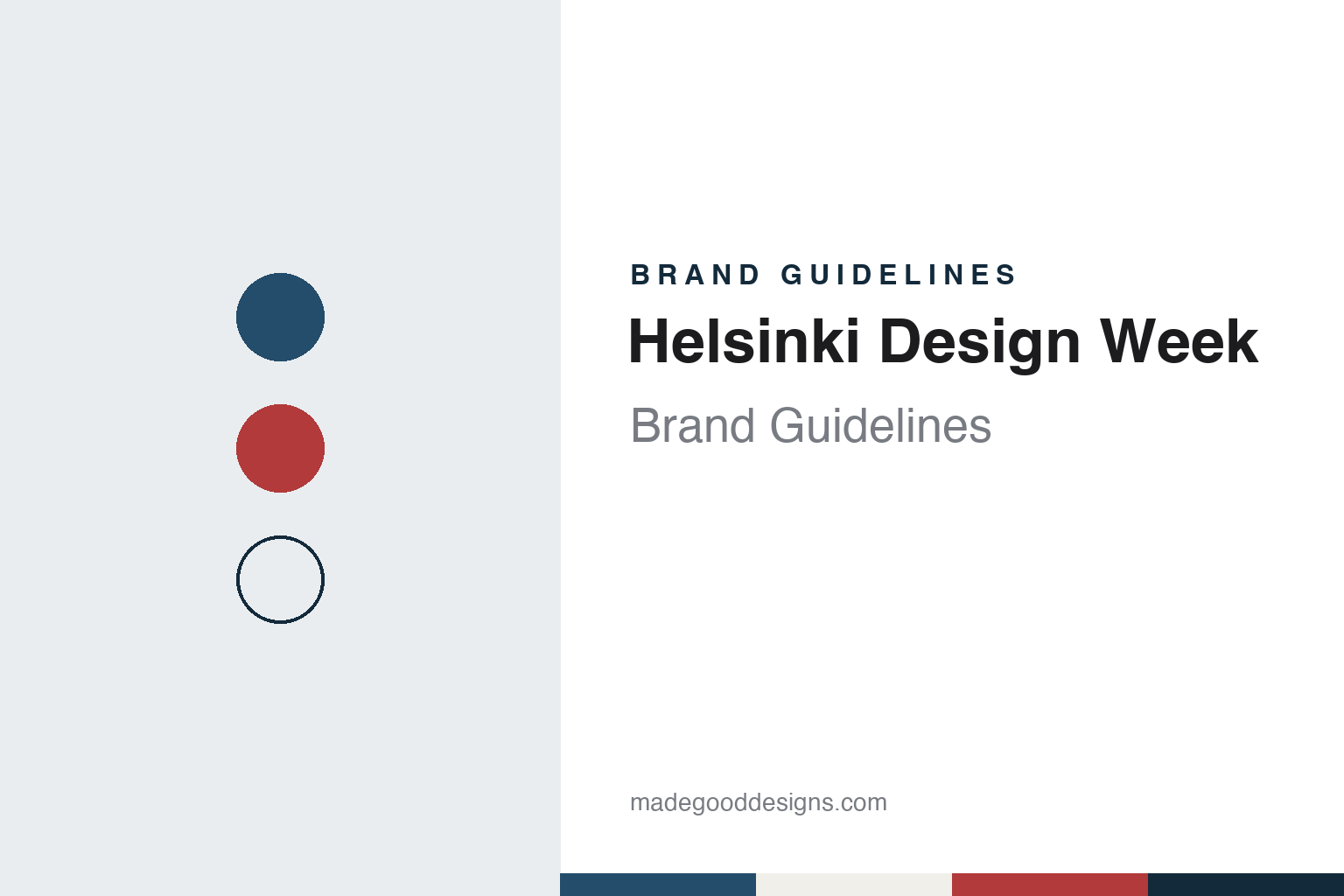
Two constants: a Baltic blue, lingonberry red and birch white palette and a northern sans register. Abstract homage — not a Helsinki Design Week asset; no logo, campaign image or map is reproduced.
A festival with a production company behind it
Founded in 2005, produced by Luovi.
Helsinki Design Week is the September design festival of the Finnish capital. Finnish Wikipedia dates its founding to 2005, and the edition numbers in the press fit that date: Dezeen called the 2024 festival the 19th edition, and the 2025 festival marked the event’s 20th anniversary. Each year it gathers exhibitions, talks, product launches, open studios and evening events across the city under one calendar, which Finnish Wikipedia divides into main events, partner events and satellite events.
The festival is not run by the city. It was founded by Kari Korkman and is produced by his company, Luovi Productions Oy, according to Finnish Wikipedia. Monocle’s Helsinki correspondent wrote in September 2025 that Korkman still served as chief executive, that people often assume the city organises the event, and that the festival is run by the Korkman family through Luovi Productions, a company name that is rarely mentioned. Anni Korkman is the festival’s programme director, Dezeen and Monocle reported. The City of Helsinki works with the festival as a partner: in 2025 the two organised a symposium together, and the city opened its City Hall and the historic Bock House to festival visitors, the city said in its announcement of the programme.
Luovi also started a design and architecture media title, Helsinki Design Weekly, a newsletter, website and radio programme in Finnish and English, Finnish Wikipedia says. It is a separate publication from the festival, though it comes from the same company.
The dates fall in early to mid September. In 2012 the festival ran until 16 September, the Finnish broadcaster Yle reported, as part of Helsinki’s year as World Design Capital, with the theme “co-creation” and international exhibitions at the Cable Factory, Kaapelitehdas. Yle also noted that organisers of a dozen similar events from around the world had come to Helsinki that week to meet one another. The 2024 edition ran from 6 to 15 September and the 2025 edition from 5 to 14 September, according to Dezeen.
Colour
Open Studios, Design Diplomacy and a moving hub.
Several formats return every year. Finnish Wikipedia lists the Design Market, a stock-sale event at Kaapelitehdas; Design Diplomacy, a series of talks held in ambassadors’ residences; PechaKucha Night, a fast-paced evening of short presentations; Open Studios, an evening when creative workspaces open their doors; a children’s design week; and Helsinki Design Night, a club evening. In 2025 the city’s programme announcement placed the Design Market at Kaapelitehdas on the opening weekend, Open Studios on 5 and 12 September, Design Diplomacy from 10 to 12 September and PechaKucha Night on 12 September in the Old Church, next door to the festival hub.
Open Studios was the subject of the programme director’s interview with Dezeen in 2024. That year’s theme, “Underneath,” was chosen to honour every part of the design process rather than only the finished product, and the workspaces that took part included Studio Bom, a shared space in north-east Helsinki where designers from different fields work together, and Minestrone Workshop, a contemporary wood workshop in the Vallila neighbourhood set up that year. “Lots of design festivals only present the end result or just launch new things,” Anni Korkman told the magazine. The 2024 theme followed “Once Upon a Time” in 2023, and the two formed a trilogy with the anniversary edition of 2025.
The main venue changes each year. Finnish Wikipedia names past hubs including the Olympic Stadium, a palace in Renaissance style at Erottaja, the former Enso-Gutzeit headquarters known as the “Sugar Cube,” a city block in Punavuori and a former banking hall in Hakaniemi. In 2025 the hub was Suomitalo, a commercial building of 1911 in the city centre, where the main exhibition filled a series of rooms on the fourth floor, Wallpaper* reported. A pop-up restaurant run by the team behind Kuurna occupied an upper floor, set with furniture and tableware from, among others, the Danish brand Hay, Monocle reported.
The festival also runs alongside Habitare, the furniture and interiors fair, which Wallpaper* dates to 1970 and which Yle listed within the festival’s programme as early as 2012. In 2025 the fair’s theme was “touch,” and the architecture studio Collaboratorio built a pavilion at its centre from rammed-earth bricks, with elm trunks and roots placed around it, Dezeen and Wallpaper* reported.
Typography
Design weeks and architecture biennials.
Design weeks and architecture biennials usually announce themselves with a city and a rhythm. Most take a city name plus “design week,” or “biennial” and “triennale” for events that return every two or three years; a few coin a word of their own, as DesignArt Tokyo did in 2017 by joining design and art into one name, Dezeen reported. The name tells visitors where to go and roughly when, and each edition then adds a year or a number to it.
The organisations behind them vary. DesignArt Tokyo is run by a company set up by a group of Tokyo designers and architects, working through an executive committee for each festival. Beijing Design Week is carried out by a company acting for an organising committee, with a design association among its partners. Elsewhere the same role falls to associations, foundations, museums, city agencies or trade-fair companies, and the organiser often stays in the background while the city takes the title.
Most of these events are spread out rather than gathered in one hall. Visitors follow district trails and showroom maps: Beijing Design Week’s Design Hop has led from the courtyard houses of Dashilar to the former power plant of 751 D·Park, and in 2013 a Japanese designer drew a map and identity for Dashilar, Wallpaper* reported. DesignArt Tokyo places its exhibitions in shop windows, galleries and showrooms from Omotesando to Ginza.
Each edition usually brings a curated theme, a guest city or country, and a catalogue, poster and campaign identity designed anew, so the look of a festival changes from year to year while its name stays fixed. This guide records the dated facts about each event, its organisers, venues and editions, and uses palettes and typefaces of our own; no official logo or campaign image is reproduced.
Aa
A northern sans for a city name and a month. (Specimen set in Figtree, a sans STAND-IN; NOT the Helsinki Design Week logo.)
Helsinki Design Week
A theme, an exhibition and a hub each year.
The anniversary edition of 2025 took the theme “Celebration,” according to the City of Helsinki. Its main exhibition, Designing Happiness, was curated by Anniina Koivu and asked whether happiness can be designed. Wallpaper* described rooms arranged by theme, among them health, community, music and nature, with an exhibition design by the studio XPO that turned silver-wrapped gift boxes into plinths and hung the exhibition texts from silver balloons on gift tags. On the opening night, Dezeen and Wallpaper* both reported, the founder told the audience that he had yet to meet a pessimistic designer. The same week, the result of the international competition for Helsinki’s new Architecture and Design Museum was announced, with the local practice JKMM chosen, Wallpaper* reported.
Finnish brands use the week to show new work. In 2025 Artek, marking its 90th anniversary, presented furniture made with Marimekko: versions of the Stool 60, Bench 153B and Table 90D with inlays of wood, metal, glass and stone in Marimekko motifs, Dezeen reported. In 2026, Monocle reported, the festival focused on design’s role in making cities more lively, with about 250 talks, exhibitions and showcases across the capital. An installation called HDW Lab on Aleksanterinkatu, the main shopping street, asked passers-by for ideas for a better-designed city, and a recreation of the Futuro House, the round Finnish building type first conceived in 1968, was fitted with interiors by Marimekko. Wallpaper* noted the same year that a temporary space for the new museum had opened overlooking its building site.
The festival’s identity rests on its name, its month and a theme set anew each year rather than on one fixed venue; each edition brings a new hub building and a new exhibition design.
For a design guide, Helsinki Design Week shows how a private production company can carry a city’s name and give an annual festival continuity through recurring formats, while the venue and theme change every September. Compare Artek and Marimekko, two Finnish brands that presented work during the week, and Vienna Design Week, the autumn festival in the Austrian capital. For this guide we use a Baltic blue, a lingonberry red and a birch white with a sans, an unofficial interpretation; no product or logo is reproduced.
Explore & save
Keep Helsinki Design Week’s identity on hand — save it to a board in the Made Good inspiration library.
Helsinki Design Week identity set
Pin the Helsinki Design Week Baltic blue, lingonberry red and birch white palette and the northern sans register to your own board.
Source & notes
Frequently Asked Questions
What font can I use to match the Helsinki Design Week look?
This guide describes Helsinki Design Week’s type as “A northern sans for a city name and a month”. Its type specimen is set in Figtree from Google Fonts as a stand-in; Figtree is not Helsinki Design Week’s own lettering.
What colours are in the Helsinki Design Week palette?
This guide’s Helsinki Design Week palette is Baltic blue #244C6B, Night harbour #132A3B, Lingonberry red #B23A3A, Birch white #F1EFE9 and Paper #F7F6F2. The tones are the guide’s own unofficial interpretation, not official Helsinki Design Week hex codes.
When was Helsinki Design Week founded?
Helsinki Design Week was founded in 2005, in Helsinki, Finland.
Who founded Helsinki Design Week?
Helsinki Design Week was founded by Kari Korkman in 2005.