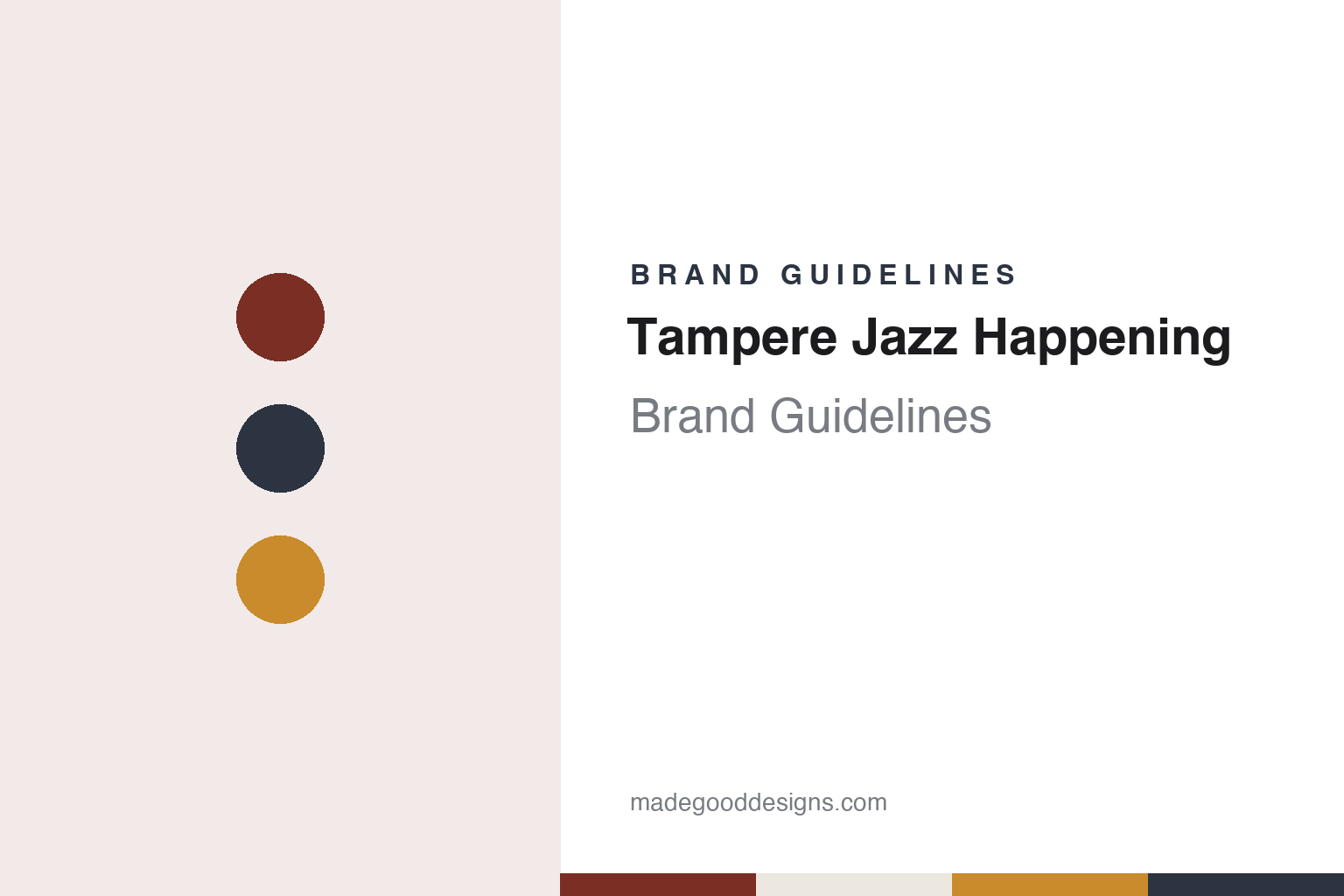
Tampere Jazz Happening Brand Guidelines
A November festival in a brick customs house beside the railway station.
Aa
Two constants: a customs brick, November dusk and lamp amber palette and a slab-serif register. Abstract homage — not a Tampere Jazz Happening logo, poster or mark; nothing of the festival’s own identity is reproduced.
Since 1982
A city festival at the turn of October and November.
Tampere Jazz Happening was first held in 1982 in Tampere, which Jazz in Europe describes as Finland’s third city by size, and Finnish Wikipedia says it has been part of the city’s annual calendar every year since. The edition of 2026 was the 45th. The festival is organised by Tampereen Musiikkijuhlat, or Tampere Music Festivals, the festival office of the City of Tampere: the festival’s website carries the names of both, and Finnish Wikipedia places the office within the city’s cultural services. According to English Wikipedia, the same office also runs the Tampere Vocal Music Festival, first held in 1975, and the Tampere Biennale of new Finnish music, held since 1986.
The festival takes place over four days around All Saints’ weekend, at the turn of October and November. The City of Tampere gave the dates of the 2025 edition as 30 October to 2 November, and announced on 1 September 2026 that the 45th edition would open with a free concert at Klubi on Thursday 29 October and continue through the weekend. English Wikipedia describes a programme of improvised music, world music and rock-influenced jazz, with workshops and art exhibitions alongside the concerts; Finnish Wikipedia adds jazz films.
Writing for Svenska Yle in October 2015, its jazz writer said the musical line the organisers chose in 1982 had been kept, and that in 33 years the festival had grown only a little, remaining a small festival on a small site. The festival keeps an online archive in which every musician and group that has played since 1982 can be looked up by year. Finnish Wikipedia, citing that archive, lists Ornette Coleman among the performers in 1995. English Wikipedia notes a live album from the 2000 edition, Live at the Tampere Jazz Happening 2000.
Colour
Tullikamari, Pakkahuone, Klubi and Telakka.
The festival’s home is Tullikamari, the old customs house beside Tampere’s railway station. Finnish Wikipedia describes a neo-Renaissance building designed by Georg Schreck and completed in 1901: a two-storey customs house joined to a one-storey packing hall, the Pakkahuone, restored for cultural use in the late 1980s. The Pakkahuone holds up to 1,200 people and the Klubi, inside the customs house, up to 450, and the building also houses the office of Tampere Music Festivals. The festival’s third stage is Telakka, a restaurant and event venue a minute’s walk away, which Jazz in Europe describes as the second, smaller venue where much of the Finnish programme is played. Yle in 2015 summed up the setting as old brick buildings a stone’s throw from the station.
In 2025 Tullikamari was closed for renovation, and the 44th edition moved its main concerts to the Paja Kongressi, Jazz in Europe reported on 5 November 2025. The 45th edition reopened the building to the public: the City of Tampere announced that the festival would mark the opening of the refurbished Tullikamari, and the same magazine wrote on 4 November 2026 that the main venue was back in use after about a year and a half of renovation, with new technical equipment in the hall. The festival also added two side events at the Laikku cultural centre in 2026, it says.
The 2025 edition was the last programmed by Juhamatti Kauppinen, who had shaped the festival for more than twenty years, Jazz in Europe reported; Finnish Wikipedia gives his years as 2002 to 2025. That edition included the American guitarist Mary Halvorson with her Amaryllis Sextet. His successor as artistic director is Martyna van Nieuwland, a Polish curator who has lived in Finland for several years, according to the magazine. Her first programme, in 2026, took the Netherlands as its theme country, opening with a Netherjazz concert of three Dutch groups at Klubi. The festival counted 23 groups over the four days; an ensemble marking the centenary of jazz in Finland played the Saturday at Pakkahuone, and the vibraphonist Joel Ross closed the international programme on the Sunday with his Gospel Music project, according to the festival and the City of Tampere.
The festival is also a meeting point for Finland’s jazz community. The Finnish Jazz Federation’s annual prize-giving took place at the Pakkahuone on 30 October 2026 during the festival, the festival reported. In 2015 the festival opened with Young Nordic Jazz Comets, a showcase of five new acts, one from each Nordic country, Yle reported.
Typography
Setting, season and the people who keep a name going.
A jazz festival is rarely remembered for a single concert. Its identity is carried by a setting and a date: a converted cannery where every stage sits under one roof, a palace square turned into an open-air arena for a summer fortnight, a riverside town that fills with music in spring, a harbour city whose clubs host a festival in the dark months of winter, or a racecourse in New Orleans whose stands and paddocks become a field of stages. The setting gives the festival its look, and the calendar fixes it in the memory, whether that is a run of late-May nights, a numbered week in August or a pair of spring weekends.
Print is the second layer. Many festivals commission a new poster every year, and the run of posters becomes a record of the festival in its own right, with each edition’s artist or designer named alongside the date. Some keep the same wordmark for decades and let the artwork change; others redraw the name as the programme widens. Edition numbers and founding years often sit beside the title, so that the long count becomes part of the identity.
Behind each name stands an organisation. Jazz clubs, non-profit foundations, associations, municipal bodies and production companies keep festivals going across changes of venue, director and programme, and festival names often survive moves from one hall, park or district to another. When a festival changes its title or passes to a new organiser, the repeated elements, from the place name to the poster series, carry it across the change.
Audiences meet the identity in practical form: programme booklets, day schedules and stage maps, wristbands and festival passes, venue signs and apps that list who plays where and when. The guides in this group look at jazz festivals through those elements. The colours and typefaces shown are our own interpretation, not official assets.
Aa
A sturdy slab serif with the weight of brick and the calm of a printed programme. (Specimen set in Bitter, a serif STAND-IN; NOT the Tampere Jazz Happening logo.)
Tampere Jazz Happening
A building and a weekend as the identity.
Tampere Jazz Happening’s identity rests on two fixed points: a building and a weekend. The building is the brick customs house by the railway station, with its packing hall as the main room and its club as the opening stage; when the building closed for renovation in 2025 the festival moved, and its return in 2026 was presented by the City of Tampere as the reopening of Tullikamari itself. The weekend is All Saints’ at the turn of October and November; Svenska Yle in 2015 called the festival a welcome point of light and sound in the autumn dark. Even the name is a fixed point: the festival has kept the word “Happening” since its first edition in 1982.
The scale has stayed close to that setting. With a main hall, a club and a nearby restaurant stage, the festival runs its days in a short walk between rooms, and in both 2025 and 2026, as Jazz in Europe described them, the international programme filled the main hall while Finnish groups played at Telakka. The festival’s online archive, searchable by musician and year back to 1982, is part of the same record-keeping identity.
The festival links to its Nordic neighbours through its line-ups. The Swedish group Cosmic Ear, which appears in Swedish Wikipedia’s list of performers at the 2025 Stockholm Jazz Festival, opened the Friday programme at the Pakkahuone in 2026, Jazz in Europe reported.
For a design guide, Tampere Jazz Happening shows how a festival can hold one name for more than four decades by staying in one building and one week of the year. Compare Pori Jazz, another Finnish jazz festival, and Stockholm Jazz Festival, the October festival in Sweden where Cosmic Ear played in 2025. For this guide we use a customs-house brick red, a November dusk blue, a lamp amber and a birch white with a serif, an unofficial interpretation; no product or logo is reproduced.
Explore & save
Keep Tampere Jazz Happening’s identity on hand — save it to a board in the Made Good inspiration library.
Tampere Jazz Happening identity set
Pin the customs brick, November dusk and lamp amber palette and the slab-serif register to your own board.
Source & notes
Frequently Asked Questions
What font can I use to match the Tampere Jazz Happening look?
This guide describes Tampere Jazz Happening’s type as “A sturdy slab serif with the weight of brick and the calm of a printed programme”. Its type specimen is set in Bitter from Google Fonts as a stand-in; Bitter is not Tampere Jazz Happening’s own lettering.
What colours are in the Tampere Jazz Happening palette?
This guide’s Tampere Jazz Happening palette is Customs brick #7A2E24, November dusk #2C3442, Lamp amber #C98B2B, Birch white #EDE8DF and Slate #5E6470. The tones are the guide’s own unofficial interpretation, not official Tampere Jazz Happening hex codes.
When was Tampere Jazz Happening founded?
Tampere Jazz Happening was founded in 1982, in Tampere, Finland.