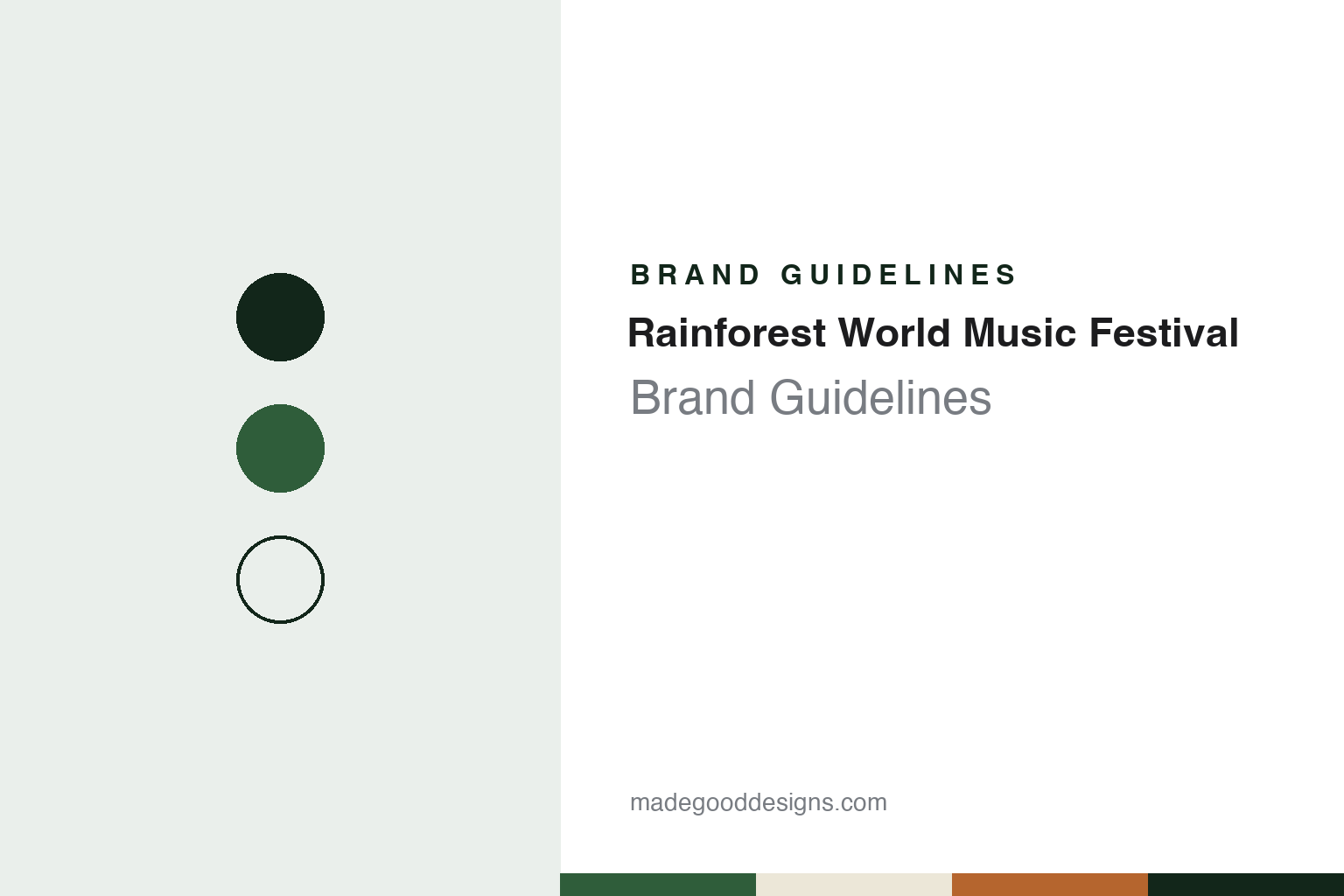
Rainforest World Music Festival Brand Guidelines
World music at the foot of Mount Santubong, near Kuching.
Aa
Two constants: a canopy green, rattan cream and hornbill orange palette and an open-air sans register. Abstract homage — not a Rainforest World Music Festival poster or mark; no logo or artwork is reproduced.
A sape and a tourism board
A field recording trip, a showcase in Marseille and a first festival.
The Rainforest World Music Festival grew out of research into the music of Sarawak, the Malaysian state on the island of Borneo. The New Straits Times reported in June 2026 that the festival was inspired by the Canadian musician Randy Raine-Reusch, who had become fascinated by Sarawak’s music, particularly the melodies of the sape, while researching in the state in 1997. His interest in the traditional instruments of the Orang Ulu communities led him to work with the Sarawak Tourism Board on an international festival. Going Places, the Malaysia Airlines magazine, wrote in 2017 that the idea took shape when Raine-Reusch travelled upriver to record traditional music and then began talking through a festival with friends in the region.
A trial came first. According to the New Straits Times, a group of Sarawak musicians, among them several sape players, was brought together and rehearsed with Raine-Reusch in Kuching before performing at the World Music Expo (WOMEX) in Marseille, France, where agents, managers and European festival directors responded well. In March 1998, the paper reported, the tourism board approved funding for a festival, with the cultural group Society Atelier Sarawak providing technical support and Raine-Reusch appointed main consultant. English Wikipedia, citing a 2007 history of the festival, adds that the funding came with the condition that the tourism board itself be the organiser, and that its staff have filled behind-the-scenes roles ever since.
The first festival, in 1998, drew about 300 people. The Sarawak Tribune reported in 2025 that many of them had complimentary tickets, that the Sarawak Cultural Village had only recently opened, and that world music was then an unfamiliar idea to local audiences. The paper also described the festival as one of the flagship projects of Sarawak’s Second Tourism Master Plan, a strategy for cultural tourism, and named Raine-Reusch among an early planning team that also included tourism board staff and members of Society Atelier Sarawak.
Growth followed. By its tenth edition, held from 13 to 15 July 2007, the festival drew a record 21,000 visitors, Malaysiakini reported, with about 1,500 musicians, performers and officials taking part. The 2017 edition marked the festival’s 20th anniversary, Going Places noted.
Colour
Longhouses, a lake and two stages.
The festival has always been held at the Sarawak Cultural Village, at Damai on the Santubong peninsula, about 35 kilometres north of Kuching, English Wikipedia says. Going Places described the village in 2017 as a seven-hectare showcase of the 28 ethnic groups of Sarawak, run as a “living museum,” with workshops and performances held in buildings of traditional architecture beneath the cliffs and rainforest of Mount Santubong. Around 8,000 people filled the site each night, the magazine wrote.
The days follow a fixed pattern. English Wikipedia describes afternoon workshops, small concerts and demonstrations held inside the traditional houses of the village, where performers and audiences sit at the same level, followed by evening concerts on two main stages; between 18 and 20 groups usually appear over the weekend. Malaysiakini’s report on the 2007 festival gives a picture of the format: a tabla workshop in the Iban Longhouse, one of the smaller workshop venues, and a percussion session called Rhythm in the Rainforest in the Dewan Lagenda hall. On the main stage that year the Kelapang Kelabit Bamboo Band from Bario, Sarawak, opened the first night with 30 players on bamboo instruments; the Zimbabwean group Black Umfolosi sang a cappella, and the Scottish band Shooglenifty played Celtic dance music on fiddle, banjo and mandolin, the report said.
The programme mixes Sarawak’s own traditions with music from many countries. The festival describes its range as running from traditional music to world fusion and contemporary world music, with an emphasis on acoustic traditional instruments. Going Places quoted the festival’s then artistic director, Jun-Lin Yeoh, a classical pianist, in 2017, saying that she tried to make each act very different from the others; Raine-Reusch had served as artistic director before her. The New Straits Times noted in 2026 that the festival had also been a stage for presenting sape music to wider audiences.
Dates have moved within the middle of the year. English Wikipedia’s list of editions shows the festival in July for most years to 2012, in late June in 2013 and 2014, in August in 2015 and 2016, and back in July from 2017 to 2019; the 2021 edition was held online, and later editions have taken place in June. The New Straits Times reported that the 2025 festival drew more than 30,000 visitors. The 29th edition ran from 26 to 28 June 2026, under the theme “Regenerations: Roots & Rhythms,” the festival says.
Typography
Setting and calendar.
A folk festival rarely has a single building to stand for it. Its identity is carried instead by a place and a date: a seaside town that turns its gardens and promenade into stages for a week, an island whose villages and halls share the programme, a showground or estate field where marquees go up for a long weekend, a cultural village set in a rainforest, or a run of community halls in the cold months. The setting gives the festival its name, and the calendar fixes it in the memory, whether that is the week that takes in the first Monday in August or a bank holiday weekend at the end of summer.
The programme is the second layer. Concert marquees, standing big tops, dance houses, storytelling tents and children’s areas are usually given names of their own, and those names recur in programmes, on site maps and on stage boards year after year. Dance displays and processions take the festival out into the streets, so that teams of morris, sword, rapper or clog dancers become part of the look of the event as much as any printed material.
Print and lettering then travel from one edition to the next. A festival may commission a new poster each year while keeping the same wordmark, or keep a house style while changing its artwork; edition numbers, founding years and the name of the host town often sit beside the title on programmes, wristbands and listings. When a festival changes its name, moves to a new site or passes to a new organiser, these repeated elements are what carry its identity across the change.
The guides in this group look at folk festivals through those elements: where they are held, when they fall in the year, how their sites and stages are named, and how their names and printed matter have been handled over time. The colours and typefaces shown are our own interpretation, not official assets.
Aa
A sturdy sans for an open-air festival in a forest setting. (Specimen set in Archivo, a sans STAND-IN; NOT the Rainforest World Music Festival logo.)
Rainforest World Music Festival
A tourism board, a cultural village and a yearly theme.
The festival is organised by the Sarawak Tourism Board, the state’s tourism promotion agency. The festival publishes its programme, tickets and visitor information on its own website, rwmf.net; the 2026 edition was launched at an official event in Kuching in March 2026, the festival says. The Sarawak Tribune reported in 2025 that the festival’s 20th edition had been marked with a book, Song and Rhythm, co-written by a former chief executive of the tourism board.
The journey to the site is part of the experience. For 2026 the festival told visitors to collect their wristbands at Damai Central before entering the Sarawak Cultural Village, and ran a free official shuttle bus between Kuching and the village; early-bird ticket holders could collect a limited-edition festival bandana with their wristbands. Its visitor guide includes a festival map, an information booth and eco stations for waste, and asks guests to “respect the culture” and leave no trace.
The 2026 edition carried a theme, which gave the year’s programme a title of its own: “Regenerations: Roots & Rhythms,” which the festival describes as a reconnection with cultural roots alongside contemporary musical expression. For a designer, the setting is the main material: longhouses and other traditional buildings, a lake, the main stages and the forested mountain behind them.
For a design guide, Rainforest World Music Festival shows how a festival can borrow its identity from a landscape and a living-heritage site, and keep it through a fixed format of workshops by day and concerts by night. Compare Fuji Rock Festival, another Asian music festival held outdoors in a mountain setting, and Orkney Folk Festival, which spreads its programme across many small venues instead of a single site. For this guide we use a canopy green, rattan cream and a hornbill orange with a sans, an unofficial interpretation; no product or logo is reproduced.
Explore & save
Keep Rainforest World Music Festival’s identity on hand — save it to a board in the Made Good inspiration library.
Rainforest World Music Festival identity set
Pin the Rainforest World Music Festival canopy green, rattan cream and hornbill orange palette and the open-air sans register to your own board.
Source & notes
Frequently Asked Questions
What font can I use to match the Rainforest World Music Festival look?
This guide describes Rainforest World Music Festival’s type as “A sturdy sans for an open-air festival in a forest setting”. Its type specimen is set in Archivo from Google Fonts as a stand-in; Archivo is not Rainforest World Music Festival’s own lettering.
What colours are in the Rainforest World Music Festival palette?
This guide’s Rainforest World Music Festival palette is Canopy green #2F5D3A, Ink #12261A, Rattan cream #ECE7D8, Hornbill orange #B5652E and Paper #F7F6F1. The tones are the guide’s own unofficial interpretation, not official Rainforest World Music Festival hex codes.