Oslo Jazzfestival Brand Guidelines
An August jazz week spread across the clubs, churches and stages of Oslo since 1986.
Aa
Two constants: a harbour blue, August brass and granite grey palette and a city programme serif register. Abstract homage — not an Oslo Jazzfestival poster or mark; no logo, artwork or programme is reproduced.
From trad jazz to the whole city
A volunteer festival of 1986 that became a foundation and marked forty years in 2026.
Oslo Jazzfestival is a jazz festival held each August in the Norwegian capital. Norwegian Wikipedia says a preparatory project in 1984 and 1985 was initiated by the trombonist Aage Teigen, and that the first festival was organised in 1986 by just over forty volunteers, with a programme made up largely of traditional jazz: dixieland, trad and New Orleans jazz. The festival itself dates its start to 1986. In July 2016 DownBeat quoted the festival’s marketing and communications director, who said it had started out as a festival dedicated to New Orleans and Dixieland jazz and had grown to include all kinds of jazz, and sometimes a few artists from outside it.
The organisation took its present form in 1995, when, Norwegian Wikipedia says, it became a foundation, with Teigen employed as managing director. The festival operates under the name Stiftelsen Oslo Jazzfestival, and in February 2023 the Europe Jazz Network carried its description of itself as a non-profit foundation that produces a festival of around 60 concerts at 15 venues in central Oslo each year, in week 33. The composer and musician Edvard Askeland led the festival from 2007 to 2019, Norwegian Wikipedia says, and a new director took over from 2019 to 2023.
Line Juul became festival director in August 2023. The festival’s announcement of her appointment, published by the Europe Jazz Network on 16 February 2023, said she had been a senior adviser at Arts and Culture Norway and earlier a producer at Nasjonal jazzscene in Oslo. The festival lists a board, a programme council and a small administration, and says volunteers have been central to running the festival since it began.
Anniversaries mark the festival’s run. DownBeat reported on 1 July 2016 that the 30th annual Oslo Jazz Festival would run from 14 to 20 August that year, with the saxophonist Charles Lloyd among the headliners and a specially formed Oslo Jazz Festival Orchestra of Norwegian musicians playing music composed for the occasion. Ten years later the festival marked its 40th anniversary. Its welcome notice for 2026 announced more than 100 events over seven days from Sunday 9 August, with an opening concert at the Oslo Opera House, a talk on the festival’s history at the National Library, and anniversary concerts by Hot Club de Norvège and Ophelia Orchestra, two groups that, the festival says, both played the first festival in 1986. The American drummer Brian Blade was the 2026 festival artist, playing three concerts with Scandinavian musicians.
Colour
Week 33, a run of city venues and a stage for young players.
The calendar sits in the middle of August. The festival’s 2023 description placed it in week 33, and dated editions follow that pattern: 14 to 20 August in 2016, according to DownBeat; 13 to 19 August in 2023, according to the Europe Jazz Network notice; 9 to 15 August in 2026, according to the festival; and, on the festival’s website, 16 to 21 August 2027.
Rather than one site, the festival uses the city. DownBeat counted 18 venues in 2016, from a small Anglican church with room for 100 people to the 1,400-seat opera house, along with jazz clubs such as Herr Nilsen and Nasjonal Jazzscene Victoria. It quoted Askeland, then festival director, on the use of the Norwegian Opera & Ballet for that year’s headline concert and of the historic University Aula for Charles Lloyd’s return to the city.
The festival’s current venue list shows the same spread. Clubs such as Blå, Cosmopolite and Herr Nilsen sit beside Nasjonal jazzscene Victoria; Kulturkirken Jakob, a church used for concerts, and Oslo Cathedral bring in church rooms; and the MUNCH museum, Kunstnernes Hus and the Opera House add larger cultural buildings. The festival also runs a series called Jazz på MUNCH, with autumn concerts at the museum.
Young musicians have a defined place. The festival runs Oslojazz Ung, with workshops for children aged 6 to 16, and Oslojazz Talent, a programme for musicians at university and college level. In 2026 it extended its outdoor stage, Oslojazz Ung utescene, to six days on two sites, at Spikersuppa and by the Deichman Bjørvika library, and sent a jazz parade of young musicians through the city on three afternoons. Its call for players for the 2027 parade band, formed with the Grünerløkka school band, lists three parade days in August.
The festival gives a prize, the Ella-prisen, which Norwegian Wikipedia says was first awarded in 1995. The festival describes it as an annual award to a person who has contributed in a notable way to Oslo’s jazz scene, and says the winner receives a painting.
Typography
Jazz festivals and their settings.
A jazz festival is rarely remembered for a single concert. Its identity is carried by a setting and a date: a converted cannery where every stage sits under one roof, a palace square turned into an open-air arena for a summer fortnight, a riverside town that fills with music in spring, a harbour city whose clubs host a festival in the dark months of winter, or a racecourse in New Orleans whose stands and paddocks become a field of stages. The setting gives the festival its look, and the calendar fixes it in the memory, whether that is a run of late-May nights, a numbered week in August or a pair of spring weekends.
Print is the second layer. Many festivals commission a new poster every year, and the run of posters becomes a record of the festival in its own right, with each edition’s artist or designer named alongside the date. Some keep the same wordmark for decades and let the artwork change; others redraw the name as the programme widens. Edition numbers and founding years often sit beside the title, so that the long count becomes part of the identity.
Behind each name stands an organisation. Jazz clubs, non-profit foundations, associations, municipal bodies and production companies keep festivals going across changes of venue, director and programme, and festival names often survive moves from one hall, park or district to another. When a festival changes its title or passes to a new organiser, the repeated elements, from the place name to the poster series, carry it across the change.
Audiences meet the identity in practical form: programme booklets, day schedules and stage maps, wristbands and festival passes, venue signs and apps that list who plays where and when. The guides in this group look at jazz festivals through those elements. The colours and typefaces shown are our own interpretation, not official assets.
Aa
A city programme serif — read as a venue list, a concert-hall poster and a day schedule. (Specimen set in Young Serif, a serif STAND-IN; NOT the Oslo Jazzfestival logo.)
Oslo Jazzfestival
A city name, a short form and a week in August.
The identity of Oslo Jazzfestival rests on its city and its week. Announcing the 2026 opening concert, a tribute to the music of Oslo, Line Juul said the festival’s identity is deeply rooted in its diverse city. The name itself is plain, the city joined to the genre, and the festival shortens it to “Oslojazz” in the names of its programmes, from Oslojazz Ung and Oslojazz Ung utescene to Oslojazz Talent, so that the short form works as a label across the year.
Its dates do similar work. The festival describes itself by week number as well as by place, and its website keeps the next edition’s dates in the header and footer of every page. The 40th anniversary in 2026 added smaller objects to that picture: the festival says its producer wrote a knitting pattern for an Oslojazz mitten for the jubilee, and the anniversary programme returned to the founding year through concerts by groups from the first festival and a public talk on the festival’s history.
For a design guide, Oslo Jazzfestival shows how a festival can let a whole city act as its site: one August week, a run of named clubs, churches, museums and an opera house, and a short form of the name that labels its programmes. Compare Oslo Opera House, the building where the festival has held headline and opening concerts, and Nattjazz, the Bergen festival that keeps its whole programme under one roof in a former sardine cannery. For this guide we use harbour blue, August brass and granite grey with a serif, an unofficial interpretation; no product or logo is reproduced.
Explore & save
Keep Oslo Jazzfestival’s identity on hand — save it to a board in the Made Good inspiration library.
Oslo Jazzfestival identity set
Pin the Oslo Jazzfestival harbour blue, August brass and granite grey palette and the city programme serif register to your own board.
Source & notes
Frequently Asked Questions
What font can I use to match the Oslo Jazzfestival look?
This guide describes Oslo Jazzfestival’s type as “A city programme serif — read as a venue list, a concert-hall poster and a day schedule”. Its type specimen is set in Young Serif from Google Fonts as a stand-in; Young Serif is not Oslo Jazzfestival’s own lettering.
What colours are in the Oslo Jazzfestival palette?
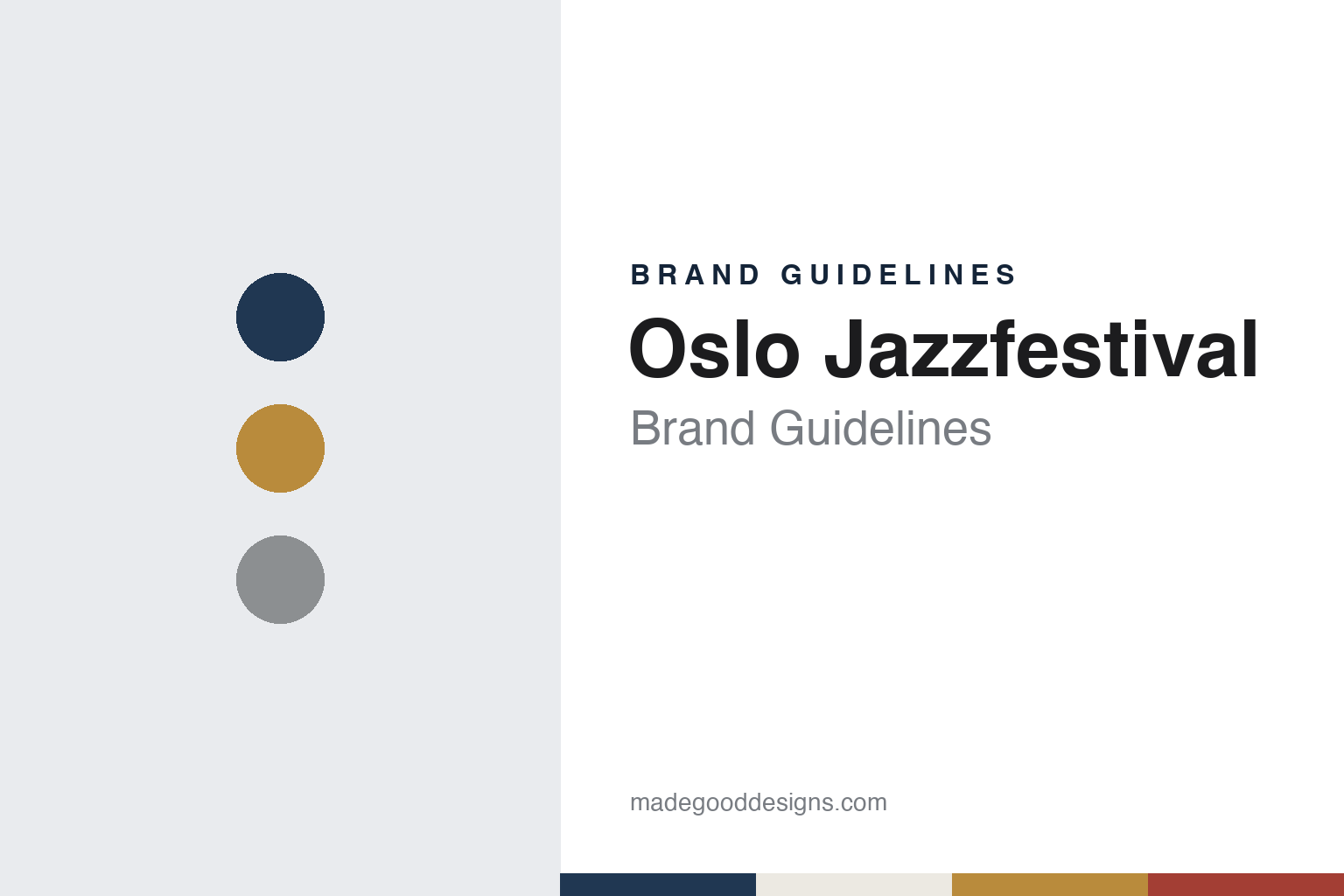
This guide’s Oslo Jazzfestival palette is Harbour blue #203752, Night ink #142438, August brass #B98B3C, Granite grey #8C8F91 and Marble paper #ECE9E2. The tones are the guide’s own unofficial interpretation, not official Oslo Jazzfestival hex codes.