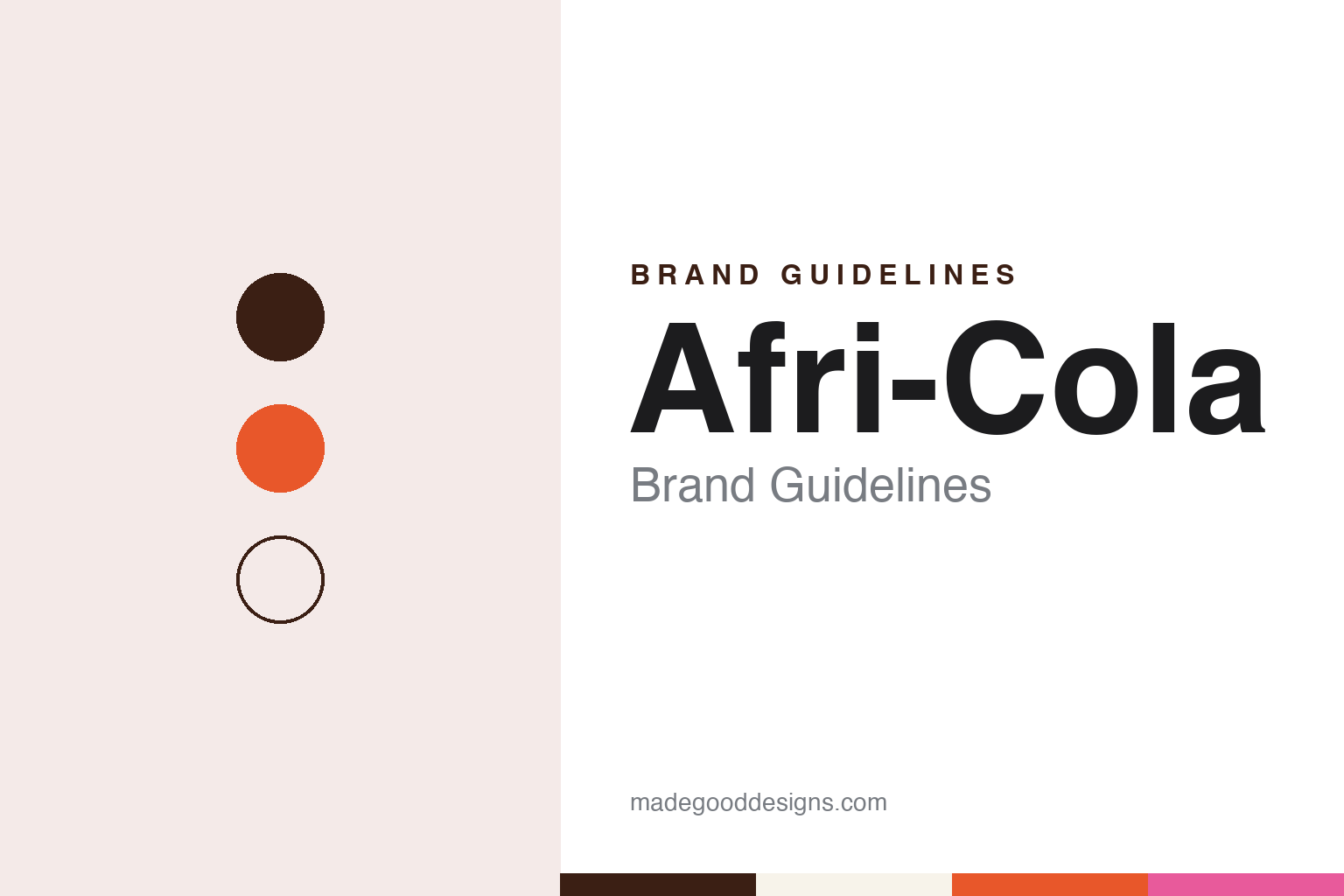
Afri-Cola Brand Guidelines
Cologne’s 1931 cola, its palm and its waisted bottle.
Aa
Two constants: a cola brown, palm white and pop orange palette and a pop-era display sans register. Abstract homage — not an Afri-Cola product or mark; no bottle, palm logo or label is reproduced.
A Cologne essence house
An 1864 essence maker, a 1931 trademark and a family.
Afri-Cola is a Cologne brand older than most of its German rivals. German Wikipedia, citing the German Patent and Trade Mark Office register, says the trademark was registered on 26 June 1931 by F. Blumhoffer Nachfolger GmbH, a Cologne company. The name comes from the “African cola nut,” and the company writes it in lower case, as “afri cola.” The same house later made Bluna, an orange lemonade, and English and German Wikipedia both date Bluna to 1952.
The company itself was much older than the cola. German Wikipedia says F. Blumhoffer Nachfolger was founded in 1864 at the Holzmarkt in Cologne, at first making only essences for spirits, liqueurs and lemonades, and that before 1900 it concentrated on lemonade. The brand’s original home was the Cologne district of Braunsfeld.
The figure most closely linked to the cola is Karl Flach. German Wikipedia’s article on him says he took over the management of Blumhoffer in 1931, that the American caffeinated lemonades and franchise systems he saw in the United States gave him the idea, and that he had Afri-Cola developed and produced in Germany. The brand stayed with the Cologne Flach family for decades: Flach handed the business to his son Alexander Flach in 1988, German Wikipedia says, and until 1998 the brand was run as Afri Cola GmbH in Köln-Braunsfeld.
In the early 1960s the cola put its name on sport. From 1960 to 1962 it sponsored a stage race called the Internationale Afri-Cola Deutschland-Rundfahrt, which German Wikipedia describes as a forerunner of today’s Deutschland Tour. English Wikipedia, citing the Cologne city portal koeln.de, says Afri-Cola was once one of Germany’s most popular cola brands but lost considerable market share from the 1960s onwards.
Colour
A waisted bottle, a white palm and a campaign that made the church protest.
Afri-Cola’s best-known design asset is its bottle. German Wikipedia says the bottle design introduced in 1962, still in use, was created by the designer Jupp Ernst working within a network of artists that included Wilhelm Wagenfeld, Hans Schwippert and Willem Sandberg, citing the Westdeutsche Zeitung in 2005. The small 0.2-litre glass bottle and the Afri-Cola drinking glass still carry indentations at mid-height meant to suggest a woman’s waist. The palm in the logo is the other recognition mark; Der Spiegel’s 2004 brand gallery noted that, with the name “afri,” it signalled exoticism when the brand was created. German Wikipedia’s article on Flach calls it the cola “with the white palm.”
The palm became famous through advertising. As the brand lost ground to Coca-Cola, the company hired the Düsseldorf advertising designer and photographer Charles Wilp, whose campaign of the late 1960s ran under the slogan “sexy-mini-super-flower-pop-op-cola – alles ist in afri-cola.” German Wikipedia describes the television spot of around 1968: young women and men moving behind a pane of glass with water running down it, some of them dressed as nuns. Der Spiegel reported in 2009, in a history of scandalous advertising, that the Catholic Church protested against the spots. German Wikipedia’s article on Flach says Wilp’s campaigns helped make Afri-Cola for a time the best-known German drinks brand.
Later owners returned to that pop register. In 2001 the film director Wim Wenders directed a television spot under the claim “alles ist in afri-cola,” the Frankfurter Allgemeine Zeitung reported that May. In 2002 the line became “… und alles wird afri,” and the commercial’s song, “Everytime,” sung by the Mannheim band The Flames, reached the charts for a few weeks, German Wikipedia says. In 2007 the brand ran a short-film competition, the afri Jungfilmer Award, followed in 2008 by an afri Art Award for works that referred to the brand, the company announced at the time. Its current website, afri.de, calls afri “die Popkultur-Cola.”
Typography
Design and documentation.
The seven brands in this group are all soft-drink names from Germany and Italy: Bionade, fritz-kola, Afri-Cola, Chinotto Neri, Crodino, Lurisia and Sanbittèr. German and Italian soft-drink brands in general sit at many different points in the trade, from family firms that still carry a founder’s name to names that now belong to much larger food and drink groups, and a single brand can be sold everywhere from a corner bar to a supermarket shelf.
A soft-drink brand’s identity is usually carried less by a single recipe than by a bottle, a name and the moment it promises, because the company behind the name may have changed hands, moved its production or grown far beyond the place where it started. That makes the questions behind each name worth asking plainly: who started it, who owns it now, and where its drinks are actually made and bottled.
Each guide separates what independent sources record from what the company says about itself — its founding story, its owners over time, where its drinks are made and how its packaging has changed — and marks plainly what rests only on the company’s own word.
Aa
A pop-era display sans for a cola remembered for its 1968 advertising. (Specimen set in Righteous, a display STAND-IN; NOT the Afri-Cola logo.)
Afri-Cola
A mineral-water group, a recipe U-turn and a relaunch.
The Flach family era ended at the turn of the century. English and German Wikipedia say that in 1998 the Baden-Württemberg drinks group Mineralbrunnen Überkingen-Teinach bought the rights to Afri-Cola and Bluna; German Wikipedia’s article on the group dates its worldwide rights to afri cola from 1999, and to Bluna for western Europe from 1994. The group has its seat in Bad Teinach-Zavelstein, in the Calw district, and German Wikipedia says it is majority-owned by the Karlsberg brewing group of Homburg, which consolidates it in its accounts. Since 2015 the cola has also been bottled by Rhodius Mineralquellen, according to a Rhodius press release of July 2014.
The new owner changed the recipe, lowering the caffeine and raising the sugar, and German Wikipedia says the move proved a mistake. Die Zeit reported in 2005 that a group of former devotees had launched Premium-Cola on a lightly adapted version of the original Afri recipe, and that Afri-Cola then sold around three million litres a year. On 1 April 2006 the company restored the original recipe, an archived page of afri.de said, and a sugar-free variant, Afri White, followed. In 2007 Afri-Cola was the only soft drink served at the G8 summit in Heiligendamm, Reuters reported. A further relaunch in March 2015 renamed the range, the trade site about-drinks.com reported, and an American importer brought the cola back to the West Coast and New York in May 2017 in a 330 ml version of the glass bottle, Beverage Industry reported. Handelsblatt put its German market share at about 0.3% in 2015.
For a design guide, Afri-Cola shows how a 1962 bottle, a white palm and one notorious campaign can keep a small cola famous for decades. Compare fritz-kola, the Hamburg cola from a later generation, and Kofola, the Czechoslovak answer to the American colas. For this guide we use cola brown, palm white and a pop orange with a display sans, an unofficial interpretation; no product or logo is reproduced.
Explore & save
Keep Afri-Cola’s identity on hand — save it to a board in the Made Good inspiration library.
Afri-Cola identity set
Pin the Afri-Cola cola brown, palm white and pop orange palette and the pop-era display sans register to your own board.