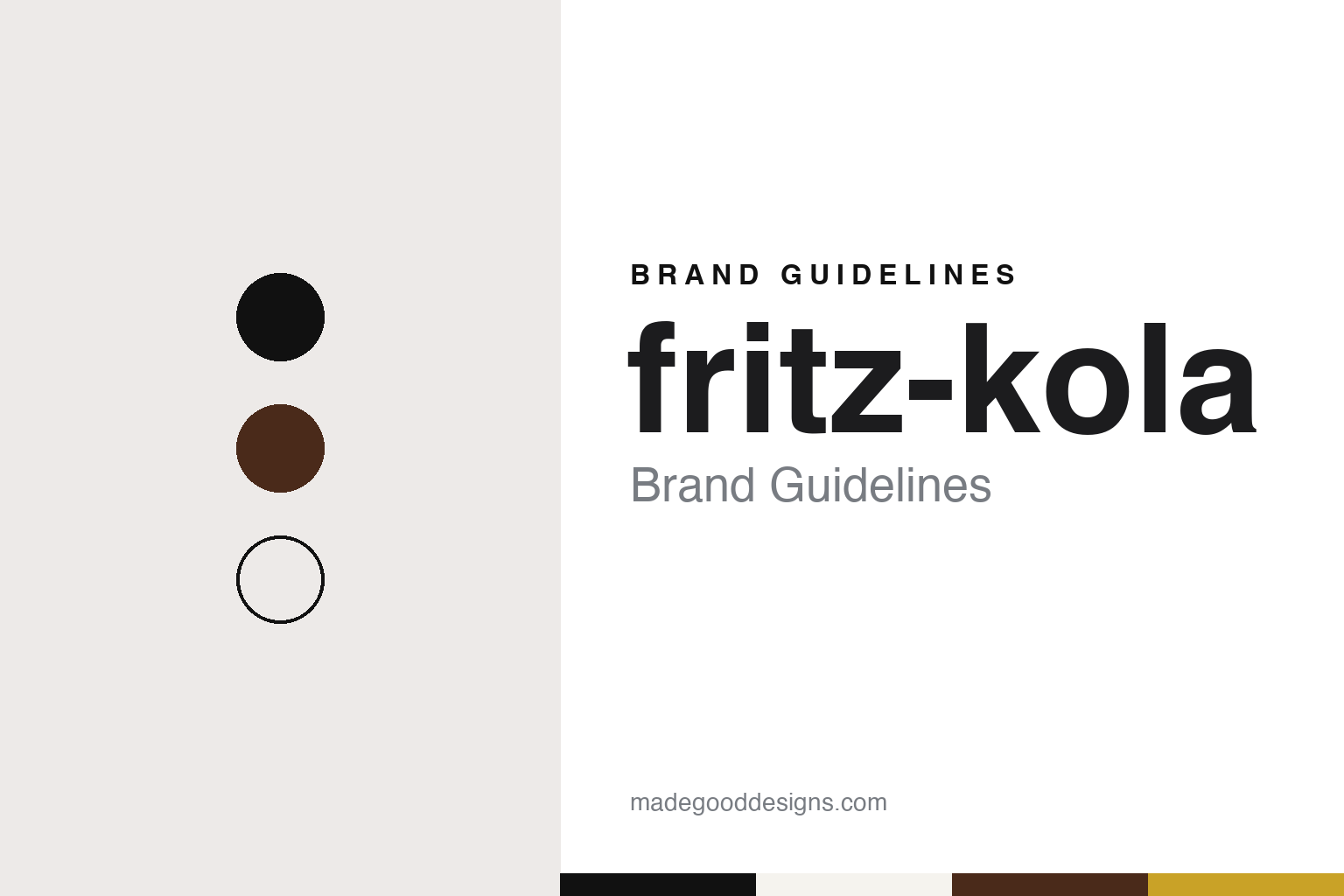
fritz-kola Brand Guidelines
The Hamburg cola with its founders’ faces on the label.
Aa
Two constants: a fritz-kola black, white and brown palette and a bold grotesque register. Abstract homage — not a fritz-kola product or mark; no bottle, label or logo is reproduced.
Two students
Two Hamburg students and a stronger cola.
fritz-kola was started in Hamburg by two students, Lorenz Hampl and Mirco Wolf Wiegert. In spring 2002, looking for a business of their own, they set out to make a new cola, the Frankfurter Allgemeine Zeitung reported in a 2009 profile: a cola “for adults,” less sweet and with plenty of caffeine, whose recipe was developed by a food specialist and whose first batch was produced and bottled by a brewery. The BBC reported in 2020 that they gave it a lemon note and picked the name by asking people outside a shopping centre. The founders considered “Fritz-Kola” a fine north German name, the FAZ reported.
In November 2002 they registered the lettering and emblem as a combined word and figurative mark with the German Patent and Trade Mark Office, German Wikipedia says, and in February 2003 they formed a partnership, Fritz-Kola Hampl und Wiegert, selling direct to bars and restaurants. English Wikipedia gives the launch as 28 February 2003, while the British distributor James Clay gives 2002. The BBC reported that the pair sold their first crates to bars on a returnable basis and did without an office for three years. Fruit lemonades followed in 2004, and from 2005 and 2006 the range reached the drinks wholesale trade, the FAZ reported. A limited company, Fritz-Kola GmbH, was registered in Hamburg in 2008. The drink was sold first in and around Hamburg, with bars and restaurants rather than supermarkets as its main outlet, and it has been sold outside Germany since 2006, the company says.
Colour
A logo made from the founders’ faces.
The identity began on a tight budget. To avoid copyright problems, the founders designed the logo themselves and used “simply their two heads,” the FAZ reported; the BBC described black-and-white labels and a photo-edited picture of the pair’s heads, chosen to save money. The lower-case “fritz-kola” is the brand’s own spelling.
The faces have survived the redesigns. In February 2024 the company announced a new look from 1 March 2024, created with the English design agency Robot Food and the brand illustrator Chris Mitchell: the logo still shows Mirco Wiegert’s face, while Lorenz Hampl’s is replaced by a new face drawn by Mitchell. The same relaunch, the company says, brought a new design for the fritz-limo lemonades, fruit illustrations for fritz-spritz and a tidier label that gathers the key facts about the drink. From 1 April 2024 the company name went back to fritz-kola GmbH, after nearly ten years as Fritz-Kulturgüter GmbH, a name adopted in September 2014 as the lemonade range grew.
Advertising has often been combative. In 2005 the founders said they wanted to break the cola monopoly; a poster showing Coca-Cola being poured away was taken down after Coca-Cola threatened legal action, Die Welt reported that January. Two outdoor posters by the Hamburg agency Red Rabbit were shortlisted at the Cannes advertising festival in 2008, according to German Wikipedia, and a radio campaign, “Drei Tage wach” (“Awake for three days”), was a finalist for the Amboss creative award in 2009, W&V reported. Since 2015 the company has run “Pfand gehört daneben,” an initiative urging people to leave returnable bottles beside public bins, which it took over from its founder, Matthias Gomille; it has also campaigned for drinking from glass.
Typography
Design and documentation.
The seven brands in this group are all soft-drink names from Germany and Italy: Bionade, fritz-kola, Afri-Cola, Chinotto Neri, Crodino, Lurisia and Sanbittèr. German and Italian soft-drink brands in general sit at many different points in the trade, from family firms that still carry a founder’s name to names that now belong to much larger food and drink groups, and a single brand can be sold everywhere from a corner bar to a supermarket shelf.
A soft-drink brand’s identity is usually carried less by a single recipe than by a bottle, a name and the moment it promises, because the company behind the name may have changed hands, moved its production or grown far beyond the place where it started. That makes the questions behind each name worth asking plainly: who started it, who owns it now, and where its drinks are actually made and bottled.
Each guide separates what independent sources record from what the company says about itself — its founding story, its owners over time, where its drinks are made and how its packaging has changed — and marks plainly what rests only on the company’s own word.
Aa
A bold grotesque for a black-and-white label. (Specimen set in Archivo, a sans STAND-IN; NOT the fritz-kola logo.)
fritz-kola
Contract bottlers, glass and now cans.
Ownership has stayed with a founder. Lorenz Hampl sold his shares to Wiegert in 2016, Lebensmittel Zeitung and Austria’s ORF reported that December, and new partners joined; as of August 2020 Wiegert led the company and owned two-thirds of it, the BBC reported. Winfried Rübesam joined him as managing director in 2017 and was later succeeded by Florian Weins, the Hamburger Abendblatt reported in 2022. In 2026 the company moved its head office from a former Colgate factory in Hamburg-Billbrook to the Schanzenviertel, the trade titles Getränke Zeitung and Lebensmittelpraxis reported.
The drinks are made by contract bottlers. German Wikipedia, citing the company’s 2023 accounts and trade press, names plants in Wagenfeld, Güstrow, Sersheim, Eilenburg and Bamberg in Germany and in Borgloon, Belgium, where a bottling line run by a subsidiary together with Konings Juices and Drinks opened in January 2025. Until December 2025 everything was filled in returnable glass bottles; after a pilot in Hamburg, five flavours went on sale in cans across Germany in May 2026, EUWID reported, adding that the company meant cans to remain an addition to glass. Beside the cola, the range includes fritz-limo lemonades, the mischmasch kola-orange mix, fritz-spritz spritzers and an organic kola with Fairtrade sugar, launched in 2018 as “grün & gerecht.” The Anjola lemonades, launched in 2015, belong to the company too. Outside Germany, the BBC named the Netherlands, Poland, Belgium and Austria as its main markets in 2020.
For a design guide, fritz-kola shows how a mark born of a tight budget can last when it is redrawn rather than replaced. Compare Afri-Cola, the older German cola whose revival German Wikipedia ties to the same retro trend, and Bionade, another drink that made its name in Hamburg’s bars. For this guide we use black, white and a kola brown with a bold sans, an unofficial interpretation; no product or logo is reproduced.
Explore & save
Keep fritz-kola’s identity on hand — save it to a board in the Made Good inspiration library.
fritz-kola identity set
Pin the fritz-kola black, white and brown palette and the bold grotesque register to your own board.