Yamazaki Baking Brand Guidelines
The Ichikawa bakery of the sun mark and Lunch Pack.
Aa
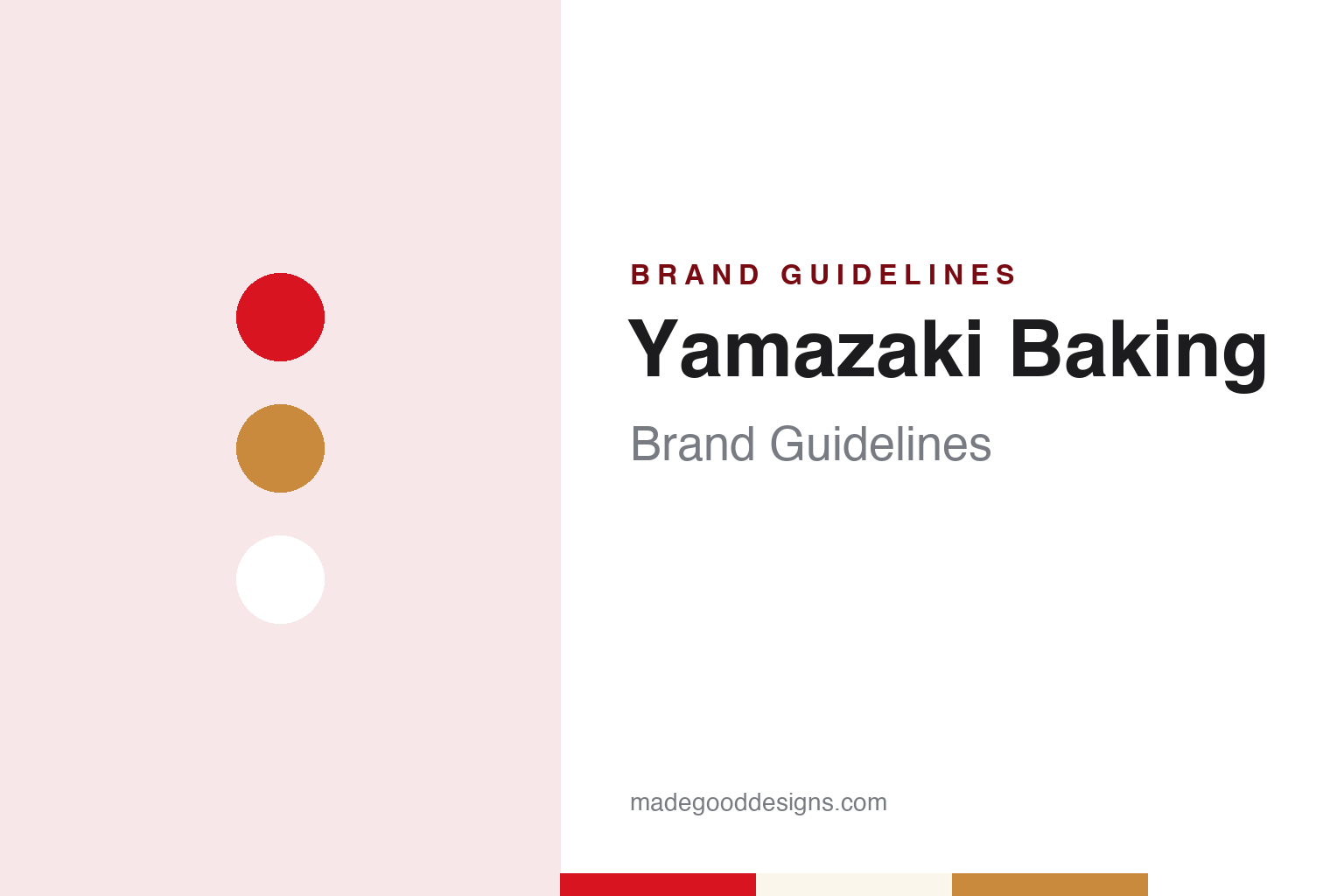
Two constants: a sun red, crust brown and white plate palette and a rounded friendly sans register. Abstract homage — not a Yamazaki Baking product or mark; no pack, logo or character is reproduced.
A bakery under a borrowed name
Rationed flour, a permit and a sister’s surname.
Yamazaki Baking began in Ichikawa, in Chiba prefecture just east of Tokyo, in March 1948. The company’s own history says its founder, Tojuro Iijima, opened the Yamazaki Seipan-sho bakery there that month, baking bread on commission from flour supplied under Japan’s post-war rationing system, and incorporated it as Yamazaki Seipan K.K. in June 1948. Its first products, the company history says, were koppe-pan rolls and a “Russian bread” that proved popular.
The name is not the founder’s own. Japanese Wikipedia says that bread making was then tightly controlled under the food-control system, and that Iijima, who had trained at a bakery in neighbouring Funabashi, could not obtain a permit in the Iijima name because he had been involved in bread making through a farming co-operative where he served as a director. The permit was instead taken out under Yamazaki, the married surname of his younger sister, who had been widowed; that, it says, is how the company came to be called Yamazaki Seipan, “Yamazaki Bread Making.”
The business grew quickly beyond bread. The company history records Japanese sweets from 1949 and Western cakes from 1950, a factory in Ryogoku, Tokyo, in 1951, and in January 1955 a second Ichikawa factory where it began mass-producing shokupan, the square white loaf, and selling it sliced and wrapped. The head office moved to Tokyo in 1962, the year its shares were first listed on the Tokyo Stock Exchange, and to Iwamotocho in Chiyoda in 1973. The company has stayed under Iijima family leadership: Japanese Wikipedia lists Tojuro Iijima as president until 1977, then Ichiro Iijima until 1979 and Nobuhiro Iijima from 1979, and Iijima family interests remain among the largest shareholders.
Colour
A sun mark, a little girl and a white plate.
Yamazaki’s visual identity dates from June 1966. That month, the company history says, it began using the sun mark as its symbol and the Suzy-chan mark as its symbol character; in July it adopted the slogan “Sekai no pan, Yamazaki” (“the world’s bread, Yamazaki”) as it opened its first factory in Osaka. Japanese Wikipedia, drawing on the company, says the sun mark expresses the founder’s ideals: the sun as the source of all things, the hope of being a light on the dinner table, and gratitude to nature and pride in work. It doubles as the company emblem.
Suzy-chan, a little girl biting a slice of bread, is best known from the sides of the company’s delivery trucks. In a 2003 answer to customers, archived on the Wayback Machine, Yamazaki said she was a real three-year-old girl living in Tokyo in 1966.
Since 1981 the company has run the Yamazaki Spring Bread Festival, a “white plate campaign” held each year from around February. Shoppers collect point stickers from eligible products and exchange them at stores for a white plate made by France’s Arc in tempered opal glass, Japanese Wikipedia says; the shape changes from year to year.
Its best-known product is Lunch Pack, launched in 1984 in four flavours: peanut, sweet red bean, yoghurt and green apple. Each pack holds a filling sealed between two slices of soft bread with the crusts cut away. From 2006, Japanese Wikipedia says citing the government small-business agency’s J-Net21, Yamazaki pushed the line with better bread, television advertising aimed at office workers and a change of package design. Peanut was still the top seller in 2012, J-Net21 reported.
Typography
Design and documentation.
The seven brands in this group are all drink and sweet names from Japan: Kirin, Suntory, Pocari Sweat, Mitsuya Cider, Fujiya, Kabaya and Yamazaki. Japanese drink and sweet brands in general sit at many different points in the trade, from family firms that still carry a founder’s name to names that now belong to much larger food and drink groups, and a single brand can be sold everywhere from a vending machine or convenience store to a supermarket shelf.
A drink or sweet brand’s identity is usually carried less by a single product than by a pack, a name and the drink, snack or treat it promises, because the company behind the name may have changed hands, moved its production or grown far beyond the place where it started. That makes the questions behind each name worth asking plainly: who started it, who owns it now, and where its products are actually made and packed.
Each guide separates what independent sources record from what the company says about itself — its founding story, its owners over time, where its products are made and how its packaging has changed — and marks plainly what rests only on the company’s own word.
Aa
A rounded friendly sans for a bakery that put a sun on its trucks. (Specimen set in M PLUS Rounded 1c, a sans STAND-IN; NOT the Yamazaki Baking logo.)
Yamazaki Baking
Biscuits, bakery cafés and a family of brands.
Yamazaki makes far more than bread. In October 1970 it formed Yamazaki-Nabisco with Nabisco of the United States and the trading house Nichimen, and in 1988 it bought Nabisco’s shares, raising its stake from 40% to 80%, the company history says. When the Nabisco licence, by then held by Mondelez International, ended, Yamazaki-Nabisco became Yamazaki Biscuits on 1 September 2016 and stopped making Oreo and Ritz; it launched its own crackers and sandwich biscuits, Levain and Noir, and the online magazine SoraNews24 reported in 2017 that Noir was made at the former Oreo factory in Ibaraki prefecture.
Acquisitions brought in other well-known names. Yamazaki took full control of the snack maker Tohato in July 2006, buying the stakes held by Unison Capital and Bandai Namco, and in November 2008 raised its holding in the confectioner Fujiya from 35% to 51%, making it a subsidiary after supporting Fujiya’s hygiene overhaul in 2007; its 2024 securities report puts the Fujiya stake at 54%. Its Vie de France bakery cafés began in 1983 with a technical tie-up with the French miller Grands Moulins de Paris, and in the United States it bought a Vie de France bakery business in 1991, the trade paper Supermarket News reported, and in 2016 Bakewise Brands, parent of Fleischer’s Bagels and Tom Cat Bakery, Food Business News reported. The company also runs the Daily Yamazaki convenience-store chain, and in 2023 bought the packaged-bread business of the Osaka baker Kobeya.
Production is spread across company-owned and partner factories throughout Japan, Japanese Wikipedia says, though there is no factory in Okinawa, where most products are not sold. Abroad, its first venture was Hong Kong Yamazaki in 1981, and by 2025 its products were sold in Thailand, Malaysia, Singapore, China, Vietnam, Indonesia, the United States, France and Taiwan. Japanese Wikipedia ranks Yamazaki as Japan’s largest bread maker, with about 40% of the domestic bread market, and second in the world after Mexico’s Grupo Bimbo.
For a design guide, Yamazaki Baking shows how a sun mark, a girl on a delivery truck and a white plate given away every spring can hold together a company that runs from sliced bread to biscuits and convenience stores. Compare Bimbo, the Mexico City bakery ranked ahead of it, and Bourbon, the Kashiwazaki biscuit maker. For this guide we use a sun red, a crust brown and a plate white with a rounded sans, an unofficial interpretation; no product or logo is reproduced.
Explore & save
Keep Yamazaki Baking’s identity on hand — save it to a board in the Made Good inspiration library.
Yamazaki Baking identity set
Pin the Yamazaki Baking sun red, crust brown and white plate palette and the rounded friendly sans register to your own board.