Zest-O Brand Guidelines
The Philippine juice drink that began with a pouch.
Aa
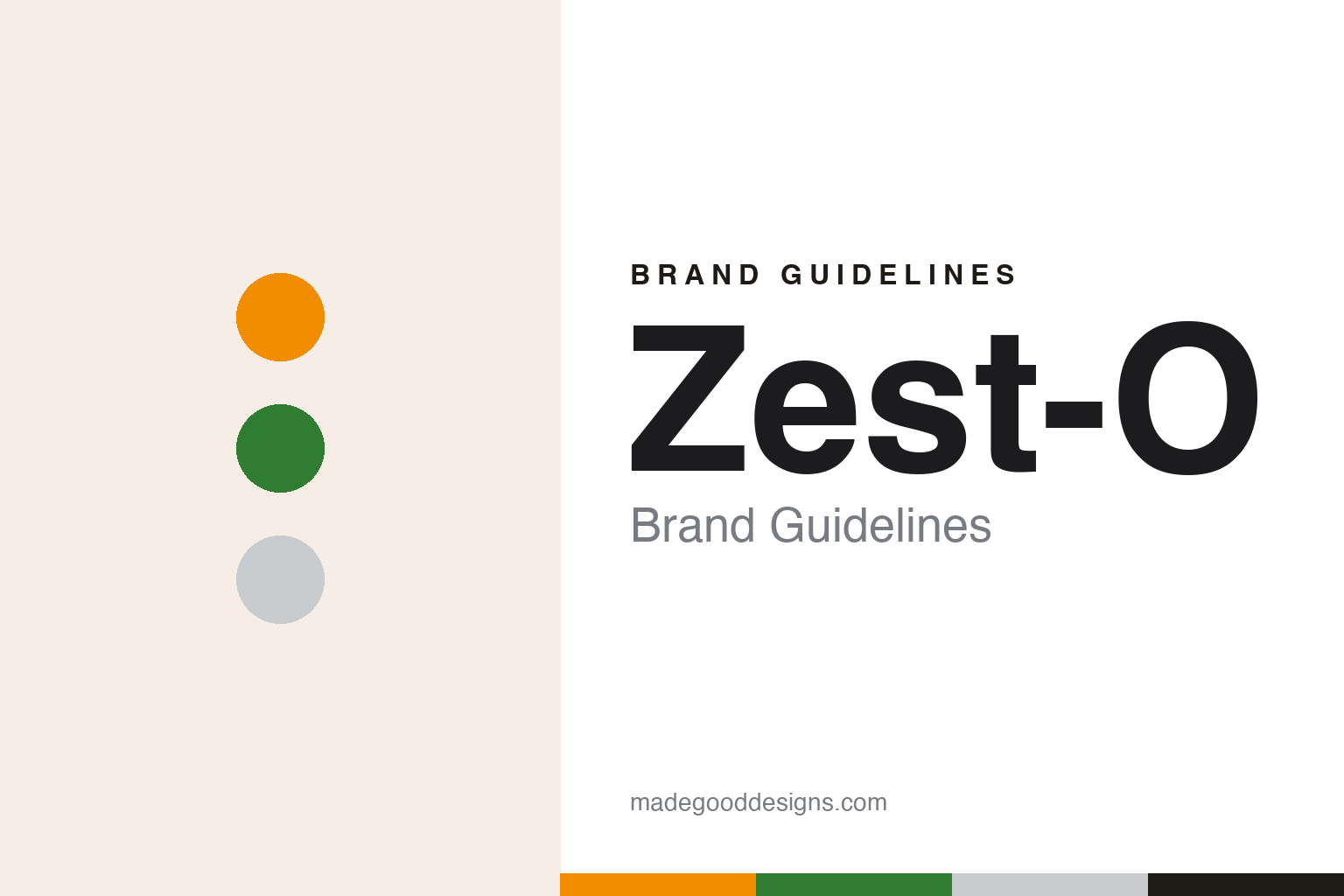
Two constants: a Zest-O orange, green and silver palette and a rounded sans register. Abstract homage — not a Zest-O product or mark; no pack, logo or label is reproduced.
A machine first
A packaging printer, a pouch and an orange drink.
Zest-O began with a packaging machine rather than a recipe. Its founder, Alfredo M. Yao, was already in the packaging trade. The Philippine Star’s STARweek magazine reported in July 2015 that as a young man he had opened a small printing press called Solemar, named after his mother, Soledad, which printed cellophane wrappers for candy and later flexible packaging for multinational companies. He studied at the Mapúa Institute of Technology but did not graduate, the magazine said.
In 1979, at a trade exhibition in Europe, Yao came across the Doypack, a stand-up flexible pouch. He bought a machine and brought it home intending to sell the format to Philippine juice makers; none were interested. “Since I already bought the machine, I decided to manufacture my own juice drink,” he told STARweek. A former client who had worked for an American juice company helped him with an orange recipe, and Zest-O Orange Juice Drink went on sale the following year. Rappler told the same story in 2018, quoting Yao calling the juice makers’ refusal a blessing in disguise.
English Wikipedia dates the company’s founding to 16 January 1980 and says it traded at first as SEMEXCO Marketing Corporation, taking the Zest-O Corporation name in 1995; a 2010 Philippine Daily Inquirer report gave 1981 as the year Yao established the business. Wikipedia describes it as a privately held, family-owned company based in Caloocan, Metro Manila, with Yao as chairman and chief executive and Jeffrey S. Yao as president.
Colour
A name from an art professor.
The name and the first pack were the work of a designer. Yao told STARweek that he showed the pouch to a friend, Mon Dellosa, a fine-arts professor at the University of Santo Tomas, and asked him to design a juice drink around it. Within a week Dellosa came back with a design and a name. “Zest,” Yao recalled being told, is the peel of a citrus fruit, and the added “O” was there to make the word sound rounder. It was meant to be said “Zest-O”; Filipinos, Yao said, pronounced it “Zes-to.”
Yao credited the packaging with the launch. “With the packaging and design, it looked as if it was imported,” he told the magazine. Even the shipping carton was considered: he described a white box carrying the Zest-O banner and a barcode, at a time when, he said, cartons were mostly brown and carried no barcodes.
The pouch became the brand’s signature. STARweek wrote in 2015 that Zest-O had been the baon — the packed school snack — of children of the 1980s and 1990s, in flavours including orange, mango, pineapple and guyabano, and that empty Doypacks were being upcycled into bags, purses and wallets. Yao told the magazine that the drink had not changed in 35 years.
The awards the company cites are for the business rather than for the pack. STARweek reported that Zest-O was named Most Admired ASEAN Enterprise in the innovation category at the first ASEAN Business Awards, held in Singapore in 2007, and that Yao received Ernst & Young’s Master Entrepreneur award in 2005.
Typography
Design and documentation.
The seven brands in this group are all drink names from the Philippines and China: Zest-O, Tanduay, Ginebra San Miguel, Red Horse, Harbin, Snow and Yanjing. Philippine and Chinese drink brands in general sit at many different points in the trade, from family firms that still carry a founder’s name to names that now belong to much larger drinks groups, and a single brand can be sold everywhere from a corner shop to a supermarket shelf.
A drink brand’s identity is usually carried less by a single product than by a bottle, a can, a name and the occasion it promises, because the company behind the name may have changed hands, moved its production or grown far beyond the place where it started. That makes the questions behind each name worth asking plainly: who started it, who owns it now, and where its drinks are actually made and bottled.
Each guide separates what independent sources record from what the company says about itself — its founding story, its owners over time, where its drinks are made and how its packaging has changed — and marks plainly what rests only on the company’s own word.
Aa
A rounded sans for a pouch-born brand. (Specimen set in Nunito, a sans STAND-IN; NOT the Zest-O logo.)
Zest-O
From one orange drink to forty brands.
From one orange drink, Zest-O grew into a broad food and beverage maker. In March 2010 the Philippine Daily Inquirer reported that it held an 80 per cent share of the domestic ready-to-drink juice market, ran five manufacturing plants in the Philippines and exported mango purée to markets including China, Australia, the United States and Europe. The same report listed products well beyond juice, among them Choc-O chocolate milk drink, One iced tea, Quickchow noodles and Tita Frita catsup. It also reported a 50-50 joint venture with Indonesia’s PT Kalbe Farma, named Asiawide Kalbe Philippines, to make bottled Extra Joss energy drinks in the Philippines; Extra Joss had until then been sold there as a powder in sachets, and Yao said existing Zest-O plants had been expanded to make it. The paper added that Yao had long talked of expanding into Indonesia, citing its large population and a climate similar to that of the Philippines.
By 2015, STARweek reported, the company had five plants and 13 branches across the country and more than 40 brands, and Yao said it exported to 40 countries. Rappler wrote in 2018 that the brand had plants in Indonesia, Thailand and Myanmar. Yao’s interests spread beyond drinks: Rappler listed Philippine Business Bank, the RC Cola bottler Asiawide Refreshments and Zest Airways, later part of AirAsia. English Wikipedia lists Plus, Sunglo, Beam and Quickchow among the company’s brands alongside Zest-O itself. Both Rappler and the Cebu newspaper SunStar have called him the Philippines’ “Juice King.”
For a design guide, Zest-O shows how a package can make a product: a stand-up pouch spotted at a European trade fair, a name coined by an art professor in a week, and a carton meant to look imported. Compare Jack ’n Jill, Universal Robina’s Philippine snack brand, and Magnolia, San Miguel’s Manila ice-cream brand. For this guide we use a citrus orange, a leaf green and pouch silver with a rounded sans, an unofficial interpretation; no product or logo is reproduced.
Explore & save
Keep Zest-O’s identity on hand — save it to a board in the Made Good inspiration library.
Zest-O identity set
Pin the Zest-O orange, green and silver palette and the rounded sans register to your own board.