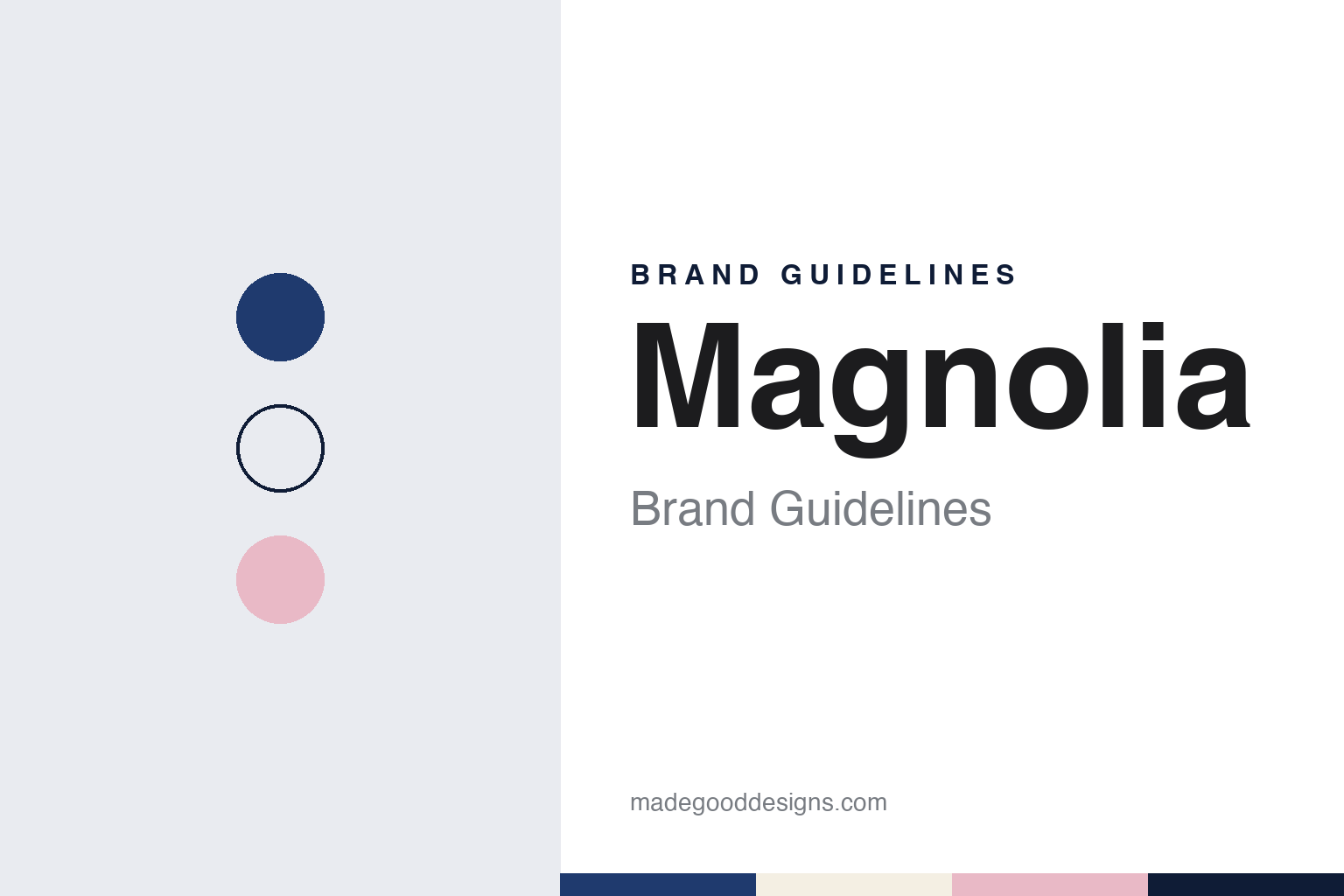
Magnolia Brand Guidelines
San Miguel’s Manila ice cream brand since 1925.
Aa
Two constants: a Magnolia deep blue, flower white and blossom pink palette and a Soft serif register. Abstract homage — not a Magnolia product or mark; no pack, logo or wordmark is reproduced.
Calle Avilés
An Army cook’s ice cream, bought by a brewery.
Magnolia is a food and beverage brand owned by San Miguel Corporation (SMC) and used across several of its subsidiaries. San Miguel Foods traces the group to 1890 and La Fábrica de Cerveza San Miguel, a Manila brewery. English Wikipedia says SMC — then called San Miguel Brewery — established Magnolia commercially as an ice cream brand in 1925, and San Miguel Foods says the same: SMC “ventured in the food industry with Magnolia Ice Cream in 1925.”
The name is older than San Miguel’s ownership. According to English Wikipedia, its history goes back to 1899, when an American, William J. Schober, arrived in the Philippines as a cook with the United States Army. He stayed after the Philippine–American War and introduced a “magnolia pie,” “magnolia ice cream” and a “magnolia ice-drop.” In 1925 he sold his Magnolia business interests to San Miguel Brewery and went on to open the Legaspi Garden Restaurant in Manila’s Port Area.
San Miguel’s first ice cream plant stood on Calle Avilés in the San Miguel district of Manila — the same street as the site of the company’s original brewery, English Wikipedia notes. In 1926 production moved to Calle Echague, now Carlos Palanca Sr. Street, in Quiapo, on a site that had housed the Fábrica de Hielo de Manila, an ice plant SMC had bought in 1924. In 1930, English Wikipedia’s article on San Miguel Corporation adds, the firm opened a plant making carbon dioxide for its soft drinks and dry ice for the refrigeration of its ice cream.
Colour
A plant by Leandro Locsin.
The brand’s best-known building came in 1970. That year production moved to a new Magnolia Dairy Products Plant on Aurora Boulevard in Quezon City, designed by the National Artist Leandro Locsin, according to English Wikipedia. It made ice cream, milk, butter, margarine and processed cheese, and it housed the main Magnolia ice cream parlour.
The parlour format spread. English Wikipedia’s article on Jollibee records that in 1975 Tony Tan Caktiong and his family opened a Magnolia ice cream parlour in Cubao, Quezon City; when its hot meals and sandwiches became more popular than the ice cream, the family turned it into a fast-food restaurant, which became the first Jollibee in 1978.
Magnolia also became the name on chicken. SMC opened its first breeder farm in Cavite in 1972 and a processing plant in Muntinlupa the following year to produce Magnolia Fresh Chicken, English Wikipedia says; San Miguel Foods dates Magnolia Chicken to 1972.
The dairy business was then divided through joint ventures. In 1981, English Wikipedia says, SMC spun its butter, margarine and processed cheese business into Philippine Dairy Products Corporation, a joint venture with the New Zealand Dairy Board; The Philippine Star, reporting SMC’s buyout of its partner, dated the venture to the late 1980s and said SMC controlled 70 percent of it. That company bought the Star and Dari Creme margarine brands from Procter & Gamble Philippines in 1994. In the mid-1990s — Wikipedia articles give both 1994 and 1996 — SMC moved its ice cream and milk business into Magnolia-Nestlé Corporation, a venture with Nestlé. When SMC withdrew in 1998, Nestlé continued the business under its own name and the Aurora Boulevard parlour became Nestlé Creamery. SMC kept the Magnolia brand, which its other products also used, and a non-compete clause kept it out of ice cream and milk for five years, English Wikipedia says.
Typography
Design and documentation.
The seven brands in this group are all Filipino food brands: Datu Puti, Silver Swan, Mang Tomas, Lucky Me!, Rebisco, Magnolia and Century Tuna. Food brands in the Philippines in general sit at many different points in the trade, from family firms that still carry a founder’s vision to names that now belong to much larger food groups, and a single brand can be sold everywhere from a neighbourhood sari-sari store to a supermarket shelf.
A food brand’s identity is usually carried less by a single product than by a pack, a name and the meal or snack it promises, because the company behind the name may have changed hands, moved its factory or grown far beyond the place where it started. That makes the questions behind each name worth asking plainly: who started it, who owns it now, and where its products are actually made and packed.
Each guide separates what independent sources record from what the company says about itself — its founding story, its owners over time, where its products are made and how its packaging has changed — and marks plainly what rests only on the company’s own word.
Aa
A soft serif — the name of a flower. (Specimen set in Fraunces, a serif STAND-IN; NOT the Magnolia logo.)
Magnolia
One name, many aisles.
In July 2002 SMC took full ownership of the dairy company after the New Zealand Dairy Board sold its stake, and renamed it Magnolia, Inc., English Wikipedia says. It sits under San Miguel Food and Beverage, Inc., the name San Miguel Pure Foods took in 2018 when SMC consolidated its brewery and gin businesses into it, San Miguel Foods says. When the non-compete clause expired, Magnolia ice cream and milk returned: San Miguel Foods says San Miguel Pure Foods “relaunched Magnolia milk and Ice cream” in 2004.
On where it is made, English Wikipedia lists Magnolia, Inc. plants at General Trias, Cavite, where butter and margarine production moved in 2000, and Santa Rosa, Laguna, where its main ice cream plant was inaugurated on 19 May 2010. SMC sold the Aurora Boulevard property to Robinsons Land in 2008; the site is now the Robinsons Magnolia mall, opened in August 2012, and the Magnolia Residences towers.
Outside the Philippines the name is contested. English Wikipedia records that Ramar Foods International, of Pittsburg, California, has sold its own Magnolia ice cream in the United States since 1972, with a logo identical to SMC’s, and has no connection with SMC, which exports its ice cream to the US and Canada as San Miguel Gold Label. In August 2015 the US Court of Appeals for the Ninth Circuit denied Ramar’s appeal against a 2013 judgment in SMC’s favour over Magnolia butter, margarine and cheese.
For a design guide, Magnolia shows how one name can travel across ice cream, milk, butter and chicken under a single owner, and return to a category after years away. Compare Rebisco, another long-running Manila food company, and Lucky Me!, a Filipino noodle brand. For this guide we use a deep blue, a flower white and a blossom pink with a serif, an unofficial interpretation; no product or logo is reproduced.
Explore & save
Keep Magnolia’s identity on hand — save it to a board in the Made Good inspiration library.
Magnolia identity set
Pin the Magnolia deep blue, flower white and blossom pink palette and the Soft serif register to your own board.