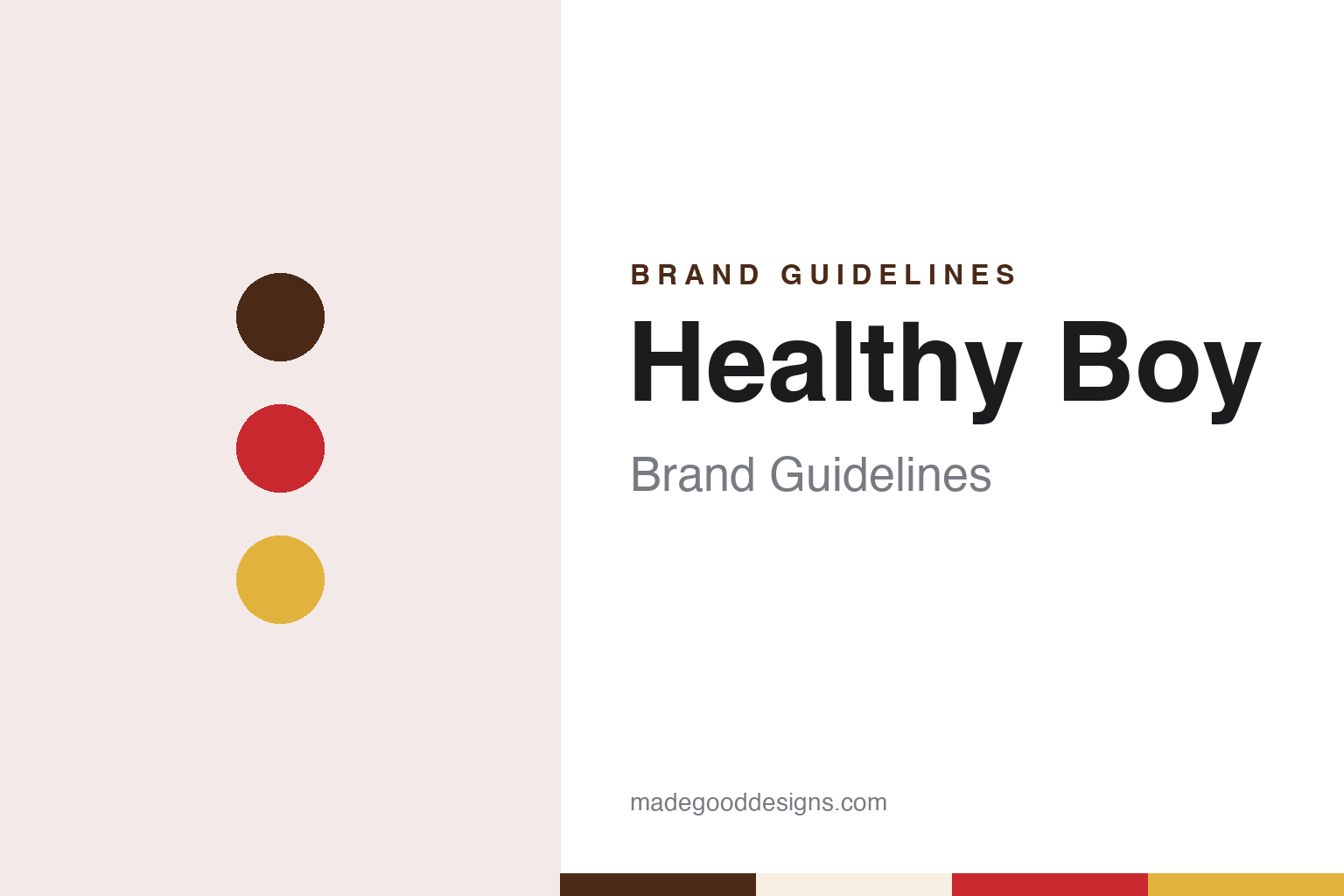
Healthy Boy Brand Guidelines
The Bangkok soy-sauce family firm of 1947.
Aa
Two constants: a soy brown, label red and bottle gold palette and a rounded friendly sans register. Abstract homage — not a Healthy Boy product or mark; no bottle, label or logo is reproduced.
Silom Road, 1947
A family recipe, a father and a son.
Healthy Boy is the English name of Dek Somboon, the soy-sauce brand of Yan Wal Yun Co., Ltd. of Bangkok, whose Chinese name English Wikipedia gives as 仁和園. Wikipedia describes the company as one of the largest sauce makers in Thailand and says its products are largely sold under the Healthy Boy name.
The company dates its start to 1947. Its own history, published on its Thai-language website in 2016, says the soy-sauce technique was handed down from the family’s ancestors by Tong Sae Tang, who ran the first factory on Silom Road in Bangkok and put the first Dek Somboon products on sale that year. In 1953, the company says, Wichian Tangsombutvisit took over from his father and kept refining the products, until its white soy sauce and fermented soybean paste were in use across the country. English Wikipedia, which draws on the company’s website, names Wichian Tangsombutvisit as the founder and also gives 1947 as the founding year.
Demand pushed the business out of its first premises. The company says that as orders for its white soy sauce and soybean paste grew, it built new production and turned its site on Wat Phai Ngoen Road into its head office and warehouse; English Wikipedia says the company moved in 1954 to Sathon, to premises ten times larger. In 1980, according to the company, Wichian Tangsombutvisit built its first modern plant, which it calls Factory 1, on 60 rai of land at Tha Chin in Samut Sakhon province, south-west of Bangkok. The same year, the company says, it began to move from family management to a professional management structure and adopted modern marketing methods, to keep up with demand at home and abroad.
Colour
A standard, a second factory and exports.
Exports followed within a few years. The company says Dek Somboon products were first exported in 1985, and that in 1987 it received the Thai Industrial Standard mark for soy sauce from the Ministry of Industry. English Wikipedia, citing the company, calls Yan Wal Yun the first company to be granted the Thai Industrial Standard in the soy-sauce category. Thai Wikipedia gives the first export year as 1986.
A second factory widened the range. In its timeline the company dates it to 1997 and says it was fitted with production technology from Japan; with it came oyster sauce, chilli sauce, a dipping sauce for chicken and a suki dipping sauce, alongside the soy sauces and soybean paste. A letter from the chairman on the same 2016 website marks the company’s 53rd anniversary in 2000 together with the opening of a second factory in Samut Sakhon, and Thai Wikipedia dates that factory to 1995, so the sources differ on the year.
The same pages list the certificates the company holds or has held: ISO 9001:2000 and HACCP certification from SGS, GMP, halal certification from the Central Islamic Committee of Thailand, kosher certification, the retail food standard IFS, and a licence to use the government’s Thailand’s Brand symbol. They also list a Good Performance Exporter certificate from the commerce and industry ministries, a Prime Minister’s Export Award and a 2015 quality award from the Thai Food and Drug Administration. The company says it was the first soy-sauce and soybean-paste maker in Thailand to gain five certificates within 12 months.
The scale figures come from the company too. Its 2016 website put Dek Somboon’s share of the Thai condiments market at 82%, a figure English Wikipedia repeats as the company’s claim; Thai Wikipedia gives about 90% for white soy sauce and soybean paste. In 2025 the company said its production sites covered more than 100 rai and that its products were sold in more than 70 countries. Thai Wikipedia, which names sales branches in Chiang Mai, Nakhon Sawan and Khon Kaen, gives the number of export countries as 53.
Typography
Design and documentation.
The seven brands in this group all make sauces, snacks or pantry staples, and all of them come from Thailand: Mae Ploy, Tao Kae Noi, Healthy Boy, Squid Brand, Golden Mountain, Lobo and Chaokoh. Thai food brands in general sit at many different points in the trade, from family firms that still carry a founder’s surname to names that now belong to much larger food groups, and a single brand can be sold everywhere from a fresh market to a supermarket shelf abroad.
A food brand’s identity is usually carried less by a single product than by a pack, a name and the dish or snack it promises, because the company behind the name may have changed hands, moved its factory or grown far beyond the town where it started. That makes the questions behind each name worth asking plainly: who started it, who owns it now, and where its products are actually made and packed.
Each guide separates what independent sources record from what the company says about itself — its founding story, its owners over time, where its products are made and how its packaging has changed — and marks plainly what rests only on the company’s own word.
Aa
A rounded friendly sans for a family soy-sauce brand. (Specimen set in Baloo 2, a sans STAND-IN; NOT the Healthy Boy logo.)
Healthy Boy
A family company, new sub-brands and two names.
Yan Wal Yun remains in the Tangsombutvisit family. Its 2025 website names Somwang Tangsombutvisit as president and managing director and quotes him on the aim of taking a Thai brand into the front rank worldwide; Thai Wikipedia also names him as managing director of Yan Wal Yun Corporation Group. The company’s head office is in Bangkok, and its production is in Samut Sakhon, the company says.
The range has spread well beyond the original soy sauce. The company lists its brands as Dek Somboon, Maxchup, i-Chef, Kai Brand, Healthy Fit and DSB-Brand. i-Chef was introduced, the company said in 2016, as a line of ready-made stir-fry sauces in five flavours, among them holy basil and black pepper, designed to finish a dish in about three minutes; by 2025 the line also included larb, tom yum and pad cha. A newer range called What a Sauce, with names such as Sassy Korean and Zap Zeed Jim-Jaew, is aimed, the company says, at a new generation of cooks mixing Western and Eastern food, from pizza and fried chicken to sushi. The company has also made ice cream flavoured with black soy sauce and with soybean paste.
Two names run side by side. The company’s Thai-language website calls the brand Dek Somboon throughout and calls itself “Dek Somboon” Yan Wal Yun, while English Wikipedia uses Healthy Boy for the products sold under the company’s name.
For a design guide, Healthy Boy shows how a family soy-sauce recipe from a Silom Road factory became a brand the company now counts in more than 70 countries. Compare Kikkoman, the Japanese soy-sauce maker, and Lee Kum Kee, the oyster-sauce house founded in 1888. For this guide we use a soy brown, a label red and a bottle gold with a rounded sans, an unofficial interpretation; no product or logo is reproduced.
Explore & save
Keep Healthy Boy’s identity on hand — save it to a board in the Made Good inspiration library.
Healthy Boy identity set
Pin the Healthy Boy soy brown, label red and bottle gold palette and the rounded friendly sans register to your own board.