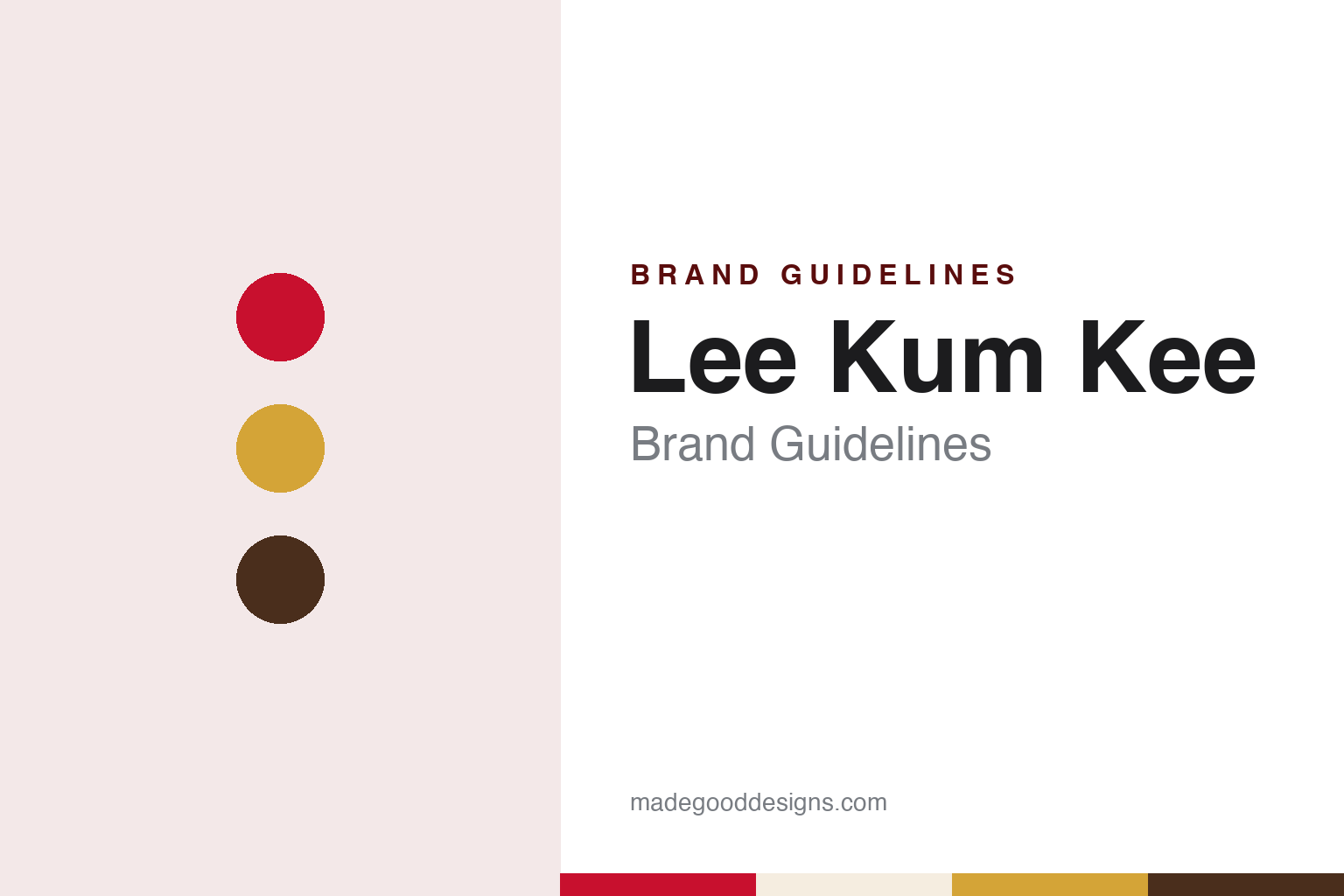
Lee Kum Kee Brand Guidelines
The oyster sauce house of 1888.
Aa
Two constants: a lantern red, gold and oyster brown palette and a sturdy book serif register. Abstract homage — not a Lee Kum Kee product or mark; no bottle, label or logo is reproduced.
An oyster stall in Nanshui
A pot left on the fire and a sauce that outlived it.
Lee Kum Kee traces itself to 1888 and a small cooked-oyster business in Nanshui, then part of Xiangshan county in Guangdong and now a town in the city of Zhuhai. Its founder, Lee Kum Sheung (李錦裳), ran an eatery there that sold cooked oysters, English Wikipedia says, citing the company. The company states plainly that he invented oyster sauce and founded Lee Kum Kee to make it. The story told about that invention is a kitchen accident: Lee left a pot of oysters on the fire for too long, the liquid reduced to a thick brown gravy, and when he tasted it he found it delicious. Macao Magazine, in a 2017 history by Mark O’Neill, called the discovery “largely an accident”; Chinese Wikipedia tells the same story, citing a programme in the RTHK television series Hong Kong Stories. The new business made and sold oyster sauce and shrimp paste.
In 1902 a fire destroyed Lee’s shop and home in Nanshui, Macao Magazine reported, and the family moved to neighbouring Macau, where they set up a production workshop. The company dates its relocation to Macau to the same year and says its distribution then reached across Guangdong and Hong Kong. In 1920 the second generation, led by Lee Shiu Nan, took over, and the company says it then began exporting oyster sauce to the United States.
Hong Kong came next. The company says it moved its headquarters there in 1932 and opened a branch on Queen’s Road Central; Macao Magazine describes branch offices in Hong Kong and Guangzhou in the 1930s and gives 1946 as the year the head office moved. In 1972 the third generation took charge when Lee Man Tat became chairman, a post he held until 2021. English Wikipedia says he bought out his uncles with his father’s help. The company says he introduced new business policies and expansion strategies, and that in 1976 it opened a factory at Wong Chuk Hang in Hong Kong, replacing firewood with steam boilers and diesel.
Colour
From two products to hundreds, and from one kitchen to five countries.
For most of its first century Lee Kum Kee sold very few products. Chinese Wikipedia says that as late as the early 1970s the company relied on two, its premium oyster sauce and shrimp paste, and that under Lee Man Tat it set up a research and development team and learned soy-sauce brewing in Japan. The range widened into soy sauce, hoisin, XO sauce, chilli sauces and ready-to-use cooking sauces. In the 1970s it introduced Panda Brand oyster sauce for international markets, a name that Chinese Wikipedia links to the giant pandas China gave the United States after President Nixon’s 1972 visit; Panda Brand oyster sauce is still on sale in the US. The company now says it offers more than 200 sauces and condiments in more than 100 countries and regions; English Wikipedia gives a figure of more than 300.
The fourth generation — Eddy, David, Charlie, Sammy and Elizabeth Lee — joined in the 1980s, the company says. Production followed the markets. The company opened a plant in Los Angeles in 1991, English Wikipedia places it in the City of Industry, and further production bases followed: Xinhui in Guangdong in 1996, Kuala Lumpur, Malaysia, in 1997, and Huangpu in Guangzhou in 1998, with a base at Jining in Shandong added in 2019 to serve northern China. The Xinhui site is the largest, covering 1.33 million square metres, the company says. In Hong Kong, the Wong Chuk Hang plant has gone; Chinese Wikipedia says its Hong Kong factories there and on Sai Kung Road had stopped operating by 1996, and the company’s Hong Kong base is now in Tai Po.
The company has put its sauces in some unusual places. It says it supplied sauces for China’s Shenzhou-9 mission in 2012 and for the crews of Shenzhou-10 and Shenzhou-11, and that its Sriracha Mayo was accepted for the International Space Station in 2015. It also says that in 1995 it became the first Hong Kong food manufacturer accredited with an ISO 9002 certificate by the Hong Kong Quality Assurance Agency and the British Standards Institution.
Typography
Design and documentation.
The seven brands in this group all make the seasonings, stocks, tomatoes and sauces that sit behind a meal, and they come from Switzerland, Germany, Italy, Britain, Hong Kong and the United States: Maggi, Knorr, Mutti, Cirio, Patak’s, Lee Kum Kee and Old El Paso. Brands in this part of the store cupboard in general sit at many different points in the trade, from family firms that still carry a founder’s surname to names that now belong to much larger food groups, and a single brand can be sold everywhere from a corner shop to a supermarket shelf on another continent.
A sauce or stock brand’s identity is usually carried less by a single product than by a jar, a cube, a tin, a name and the kitchen it promises, because the company behind the name may have changed hands, moved its factory or grown far beyond the town where it started. That makes the questions behind each name worth asking plainly: who started it, who owns it now, and where its products are actually made and packed.
Each guide separates what independent sources record from what the company says about itself — its founding story, its owners over time, where its products are made and how its packaging has changed — and marks plainly what rests only on the company’s own word.
Aa
A sturdy book serif for a sauce house founded in 1888. (Specimen set in Noto Serif, a serif STAND-IN; NOT the Lee Kum Kee logo.)
Lee Kum Kee
A centenary logo and a family that kept control.
Lee Kum Kee’s current identity dates from its centenary. In 1988, the company says, it moved its headquarters to Tai Po in Hong Kong’s New Territories and introduced a new company logo, designed to “symbolise the Company’s mission of building a cultural bridge between the East and the West”; English Wikipedia also dates the logo to 1988. Chinese Wikipedia adds that the trademark and labels had been redesigned once before, in the 1960s, and that in 1992 the company hired a design consultancy to bring its labels into a single system, adding recipes and usage notes and printing foreign-language text to suit export markets. The company states its mission as “Promoting Chinese Cuisines Worldwide”.
Ownership has never left the family. The company describes itself as Hong Kong-based and family-run, and English Wikipedia lists four group chairmen: the founder Lee Kum Sheung, Lee Shiu Nan from 1920, Lee Man Tat from 1972 and Sammy Lee since 2022. Sauces are now one arm of a wider LKK Group, which also includes LKK Health Products, set up in 1992 to sell Chinese herbal health products. The wider group made headlines in July 2017 when it agreed to buy London’s 20 Fenchurch Street, the “Walkie-Talkie” tower, for £1.3 billion, which The Times reported was a record for a single building in Britain. In 2016 the family also funded a $21 million gift to Harvard’s T.H. Chan School of Public Health, creating the Lee Kum Sheung Center for Health and Happiness, the Harvard Gazette reported.
The company has also taken on official supplier roles that put the name in front of new audiences: it says it was named sponsor of Asian sauces at Hong Kong Disneyland in 2005 and an official food and beverage supplier to the 2008 Beijing Olympics. In 2018 it marked its 130th anniversary and opened a European regional office in London.
For a design guide, Lee Kum Kee shows how a single accidental recipe, and a family name can carry one company from a village stall to five production countries. Compare Kikkoman, the Japanese soy-sauce maker, and Fly By Jing, a newer Chinese sauce brand. For this guide we use lantern red, gold and an oyster brown with a sturdy serif, an unofficial interpretation; no product or logo is reproduced.
Explore & save
Keep Lee Kum Kee’s identity on hand — save it to a board in the Made Good inspiration library.
Lee Kum Kee identity set
Pin the Lee Kum Kee lantern red, gold and oyster brown palette and the sturdy book serif register to your own board.