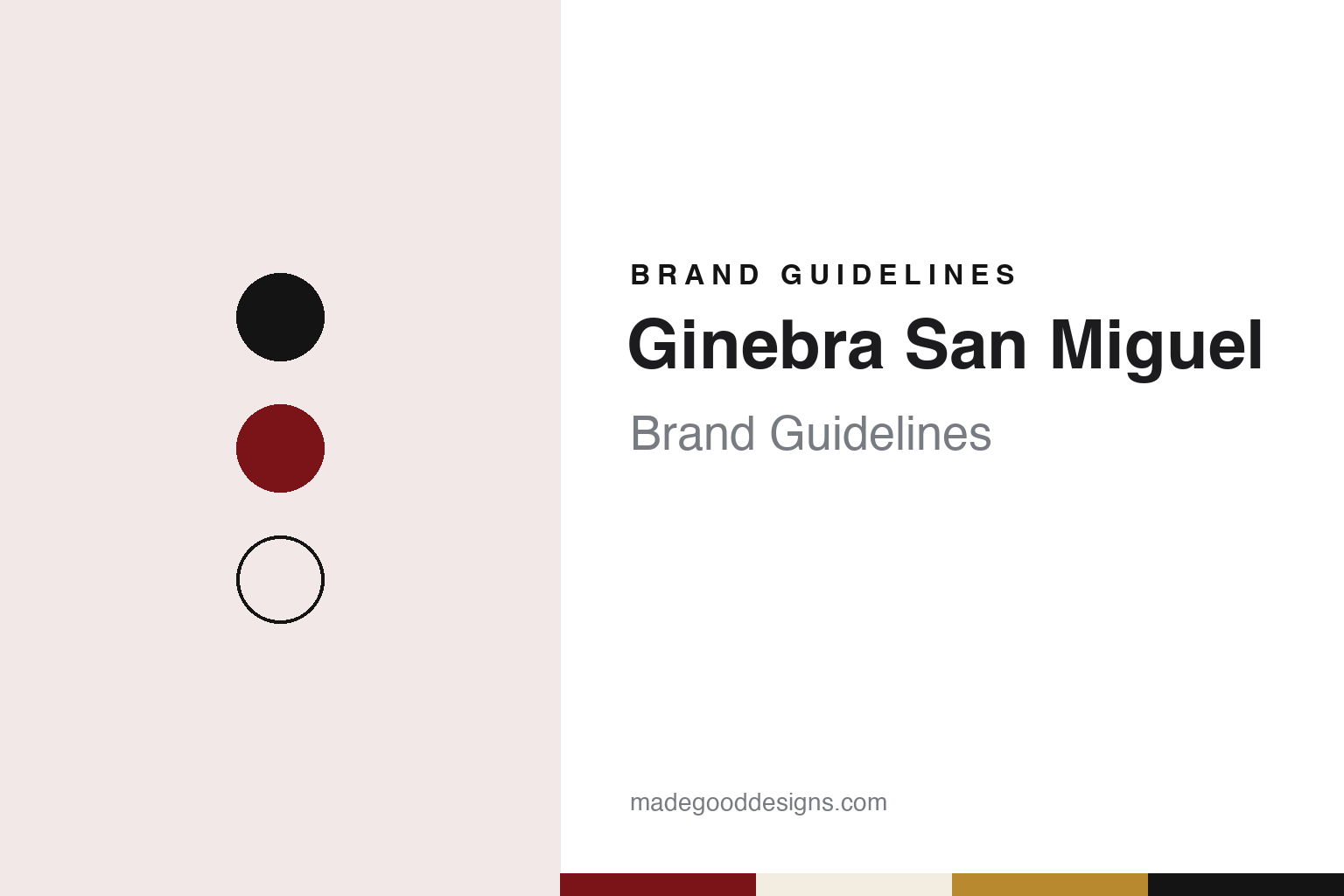
Ginebra San Miguel Brand Guidelines
The Manila gin of 1834 and its archangel label.
Aa
Two constants: a Ginebra San Miguel red and gold palette and a Heritage serif register. Abstract homage — not a Ginebra San Miguel product or mark; no bottle, label or logo is reproduced.
From Ayala to La Tondeña
A Spanish-era distillery and a Tondo rival.
Ginebra San Miguel is older than the company that now carries its name. According to English Wikipedia, in June 1834 Casa Róxas, the partnership that is the ultimate precursor of today’s Ayala Corporation, set up the Destilería de Ayala y Cía in Quiapo, Manila. It made anis, rum, whisky and several gins, among them Ginebra Ayala, Ginebra Nacional and Ginebra San Miguel. The present company, Ginebra San Miguel Inc., says the gin was introduced in 1834 by “a family-owned Spanish era distillery,” and calls it the first Philippine gin.
The company’s own line runs through a second business. La Tondeña was established in 1902 by Carlos T. Palanca Sr. in Tondo, Manila, and took its name from the district, English Wikipedia says; it was incorporated as La Tondeña, Inc. in 1929. On 21 June 1924, according to English Wikipedia citing the Filipinas Heritage Library, La Tondeña bought the Ayala distillery from Ayala y Compañía, and with it the Ginebra San Miguel brand. English Wikipedia also credits La Tondeña with pioneering alcohol made from molasses rather than from the nipa palm.
Under the Palancas the company kept collecting drinks brands. It acquired Añejo Rhum from Tabacalera, the Compañía General de Tabacos de Filipinas, in 1955, and in 1957 the rights to the Kulafu name for a Chinese herbal wine, Vino Kulafu, which the company still sells.
Colour
San Miguel, 1987 to today.
The gin passed to the country’s largest drinks group in 1987. That year, English Wikipedia says, San Miguel Corporation incorporated La Tondeña Distillers, Inc. after acquiring the assets of La Tondeña, Inc. from the Palanca family. On 7 March 2003 the company renamed itself after its flagship, becoming Ginebra San Miguel, Inc., The Philippine Star reported the next day. It is listed on the Philippine Stock Exchange.
In November 2017 San Miguel Corporation announced that it would gather its beverage businesses under San Miguel Pure Foods through a share swap, after which San Miguel Pure Foods would own about 76 per cent of Ginebra San Miguel and be renamed San Miguel Food and Beverage, Reuters and Rappler reported. The same group owns Magnolia and, through San Miguel Brewery, Red Horse beer. The company lists its head office at the San Miguel Properties Centre in Mandaluyong.
Where is the gin made? The company names five plants on its website: Sta. Barbara in Pangasinan, Cauayan in Isabela, Cabuyao in Laguna, Ligao in Albay and Mandaue in Cebu. We give that list as the company’s; it does not say which plant makes which product.
The range has widened beyond the original gin. The company’s current brands include GSM Blue, GSM Premium Gin and 1834 Premium Distilled Gin, a premium line named after the founding year; the company links that date to a royal decree which, it says, opened the port of Manila to international trade in 1834. Other current brands include Primera Light Brandy and Antonov Vodka. Its export pages name three sizes of the flagship gin: the Round, the Frasco and the Hari, Tagalog for “king.” It also owns the professional basketball team Barangay Ginebra San Miguel, which plays in the Philippine Basketball Association.
Typography
Design and documentation.
The seven brands in this group are all drink names from the Philippines and China: Zest-O, Tanduay, Ginebra San Miguel, Red Horse, Harbin, Snow and Yanjing. Philippine and Chinese drink brands in general sit at many different points in the trade, from family firms that still carry a founder’s name to names that now belong to much larger drinks groups, and a single brand can be sold everywhere from a corner shop to a supermarket shelf.
A drink brand’s identity is usually carried less by a single product than by a bottle, a can, a name and the occasion it promises, because the company behind the name may have changed hands, moved its production or grown far beyond the place where it started. That makes the questions behind each name worth asking plainly: who started it, who owns it now, and where its drinks are actually made and bottled.
Each guide separates what independent sources record from what the company says about itself — its founding story, its owners over time, where its drinks are made and how its packaging has changed — and marks plainly what rests only on the company’s own word.
Aa
A heritage serif — a name first used in 1834. (Specimen set in Fraunces, a serif STAND-IN; NOT the Ginebra San Miguel logo.)
Ginebra San Miguel
St Michael on the label.
The brand’s best-known asset is its label. On the face of every bottle, the company says, is “the iconic image of St. Michael the Archangel triumphantly defeating the devil in battle.” The company credits that image to Fernando Amorsolo, later named a National Artist of the Philippines, and says he made it to help fund his studies abroad; on its corporate pages it describes itself as “proudly displaying Fernando Amorsolo’s painting as the logo for its flagship brand.” We give the attribution and the story as the company’s. It adds a saying of its own: that anyone who wants an Amorsolo need only buy a bottle of Ginebra from a nearby store.
The company’s marketing leans on courage and community. Its advertising has used the line “Tatak ng Tapang, Tatak Ginebra” — roughly, the mark of courage, the mark of Ginebra — and it calls its drinkers “One Ginebra Nation.” It also runs Ginumanfest, a concert series that toured provinces and cities in 2023. Since 1988 the brand has issued annual promotional calendars of female celebrities, the “Ginebra San Miguel Super Angels,” inspired by the American series Charlie’s Angels and displayed in barbershops and sari-sari stores, BusinessWorld reported in 2020.
The company’s commercial claims are large. It calls Ginebra San Miguel “the world’s largest-selling gin,” citing the Millionaires’ Club rankings of the trade magazine Drinks International; we give that as the company’s statement. At the 2012 Monde Selection, the Brussels quality awards, the company received eight quality awards, The Daily Tribune reported. No official colour or typeface is published.
For a design guide, Ginebra San Miguel shows how a single painted label can carry a brand for generations. Compare Tanduay, another Manila spirits house with a nineteenth-century start, and Magnolia, a San Miguel brand from the same group. For this guide we use a deep red, parchment and a gold with a serif, an unofficial interpretation; no product or logo is reproduced.
Explore & save
Keep Ginebra San Miguel’s identity on hand — save it to a board in the Made Good inspiration library.
Ginebra San Miguel identity set
Pin the Ginebra San Miguel red and gold palette and the Heritage serif register to your own board.