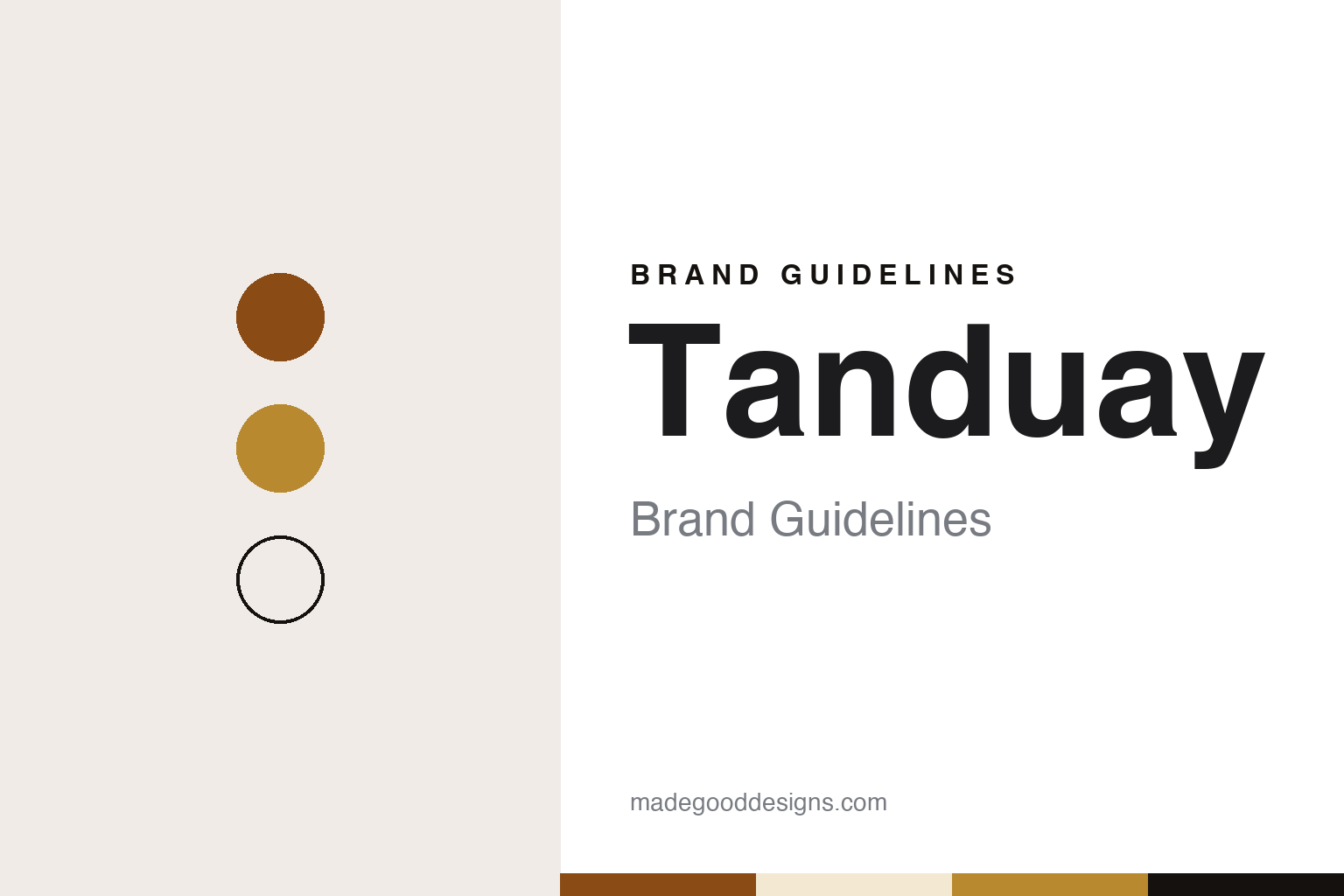
Tanduay Brand Guidelines
The Manila rhum with a heraldic crest since 1854.
Aa
Two constants: a Tanduay amber, cream and gold palette and a heraldic serif register. Abstract homage — not a Tanduay product or mark; no bottle, crest or label is reproduced.
Isla de Tanduay
A Basque partnership and a distillery in Bulacan.
Tanduay dates itself to 1854, though the rum came a little later. According to the company’s own history, as archived in 2014, that was the year the Basque merchants Joaquín Elizalde and Joaquín Ynchausti set up a ship chandlery on the Muelle de la Industria in Binondo, Manila — the partnership that became Ynchausti y Compañía. Distilling arrived in 1856, when Valentín Teus joined the firm, bringing a distillery at Hagonoy, Bulacan, that he had bought from Elías Menchatorre. Because no record shows when the firm first made rum, the company says, tradition gives the rum and the distillery the partnership’s founding year.
Six years after that acquisition a rectifying plant was built on Isla de Tanduay, a low-lying area beside Manila’s San Miguel district, English Wikipedia says; it became the Tanduay distillery. The company traces the name to the Tagalog tangway, which a Tagalog dictionary of 1620 defined as a point of land on the sea, and an 1860 dictionary as a peninsula or isthmus. The early spirits were sold without brand names, as generic aguardiente or ron; by the 1930s, according to Wikipedia, citing The Philippine Star, the Manila distillery’s rum was sold as Tanduay Rhum in 375 ml and 750 ml glass bottles instead of large demijohns.
Ownership passed to the Elizalde side of the partnership, though sources differ on when. The company’s 2014 history says Joaquín Elizalde became majority shareholder in 1893 and the firm was renamed Elizalde & Co.; English Wikipedia, citing Charles Coulombe’s 2005 history Rum, says Elizalde & Company acquired the distillery and other Ynchausti assets in 1934–35. Under the Elizaldes the business ran as Tanduay Distillery, Inc., and the company says four generations of the family built it into one of the largest distilleries in the Philippines.
Colour
Shields, a helmet and a fleur-de-lis.
Tanduay’s label is built around a coat of arms. The company’s former website described the traditional mark as a plumed knight’s helmet, a fleur-de-lis and a pair of escutcheons, and said it “draws its inspiration from European heraldry.” It also said the original logo was “said to have been designed by” Manda Elizalde, a member of the family — a hedged attribution in the company’s own words.
The same page read the symbols one by one. The two shields, it said, signal an alliance of families — the partnership of Teus, Ynchausti and Elizalde. Inside them are a tree, a chevron and, on the right-hand shield, a castle, which the company linked to the House of Castile and the firm’s Iberian roots. English Wikipedia says the left-hand shield is based on the Ynchausti family’s arms. The company said the crest was chosen because Tanduay was being sold abroad and needed a trademark that conveyed permanence and heritage.
In 2004 Tanduay marked its 150th year with an anniversary logo whose central colours were red and gold, which the company described as Asian colours of celebration and prosperity; it added a globe for international reach and a gold square border, and kept the original crest inside. The bottle is part of the identity as well: Wikipedia describes the 375 ml lapád (“wide”) flask as Tanduay’s signature bottle.
Basketball has been the brand’s other public face. Tanduay has lent its name to Philippine Basketball Association teams, the Tanduay Rhum Masters, and from 2017 it signed sponsorships with NBA sides: the Brooklyn Nets and Barclays Center in March 2017, NBA.com reported; the Golden State Warriors that October, according to Spin.ph; and the Milwaukee Bucks and Phoenix Suns in 2021, deals that ABS-CBN News said made it the first Philippine company to back five NBA teams.
Typography
Design and documentation.
The seven brands in this group are all drink names from the Philippines and China: Zest-O, Tanduay, Ginebra San Miguel, Red Horse, Harbin, Snow and Yanjing. Philippine and Chinese drink brands in general sit at many different points in the trade, from family firms that still carry a founder’s name to names that now belong to much larger drinks groups, and a single brand can be sold everywhere from a corner shop to a supermarket shelf.
A drink brand’s identity is usually carried less by a single product than by a bottle, a can, a name and the occasion it promises, because the company behind the name may have changed hands, moved its production or grown far beyond the place where it started. That makes the questions behind each name worth asking plainly: who started it, who owns it now, and where its drinks are actually made and bottled.
Each guide separates what independent sources record from what the company says about itself — its founding story, its owners over time, where its drinks are made and how its packaging has changed — and marks plainly what rests only on the company’s own word.
Aa
A heraldic serif for a coat-of-arms label. (Specimen set in Playfair Display, a serif STAND-IN; NOT the Tanduay logo.)
Tanduay
From the Elizaldes to Lucio Tan.
The modern company belongs to the group of Lucio Tan. In May 1988 Twin Ace Holdings Corporation, a Lucio Tan company, bought the Tanduay trademark and distillery assets from the Elizalde family, and launched a modernisation that the company says raised production capacity almost fiftyfold. In July 1999 the listed Asian Pacific Equity Corporation, also controlled by Tan, took full ownership of Twin Ace through a share swap, and Twin Ace was renamed Tanduay Distillers, Inc.; the holding company became Tanduay Holdings that November and, in 2012, LT Group, Inc., the Philippine Daily Inquirer reported. Besides rum, Tanduay Distillers makes gin, vodka, brandy and whisky.
Production has moved out of the old Manila site. In April 2013 the Inquirer reported that the Quiapo distillery, which could produce 30,000 cases a day, had been decommissioned, and that Tanduay would rely on a plant at Cabuyao, Laguna, able to produce 100,000 cases a day; part of the old site was to become a museum. LT Group says Tanduay held a 99 per cent share of the Philippine rum market in 2018 and calls it the world’s number one rum by volume, a ranking English Wikipedia attributes to Statista’s sales-volume figures.
For a design guide, Tanduay shows how heraldry can carry a mass-market spirit: a crest of shields, a helmet and a fleur-de-lis that Wikipedia says has stayed on the label since the Elizalde era, through changes of owner and plant. Compare Ginebra San Miguel, the Manila gin maker, and Flor de Caña, the Pellas family rum from Nicaragua. For this guide we use rum amber, label cream and heraldic gold with a serif, an unofficial interpretation; no product or logo is reproduced.
Explore & save
Keep Tanduay’s identity on hand — save it to a board in the Made Good inspiration library.
Tanduay identity set
Pin the Tanduay amber, cream and gold palette and the heraldic serif register to your own board.