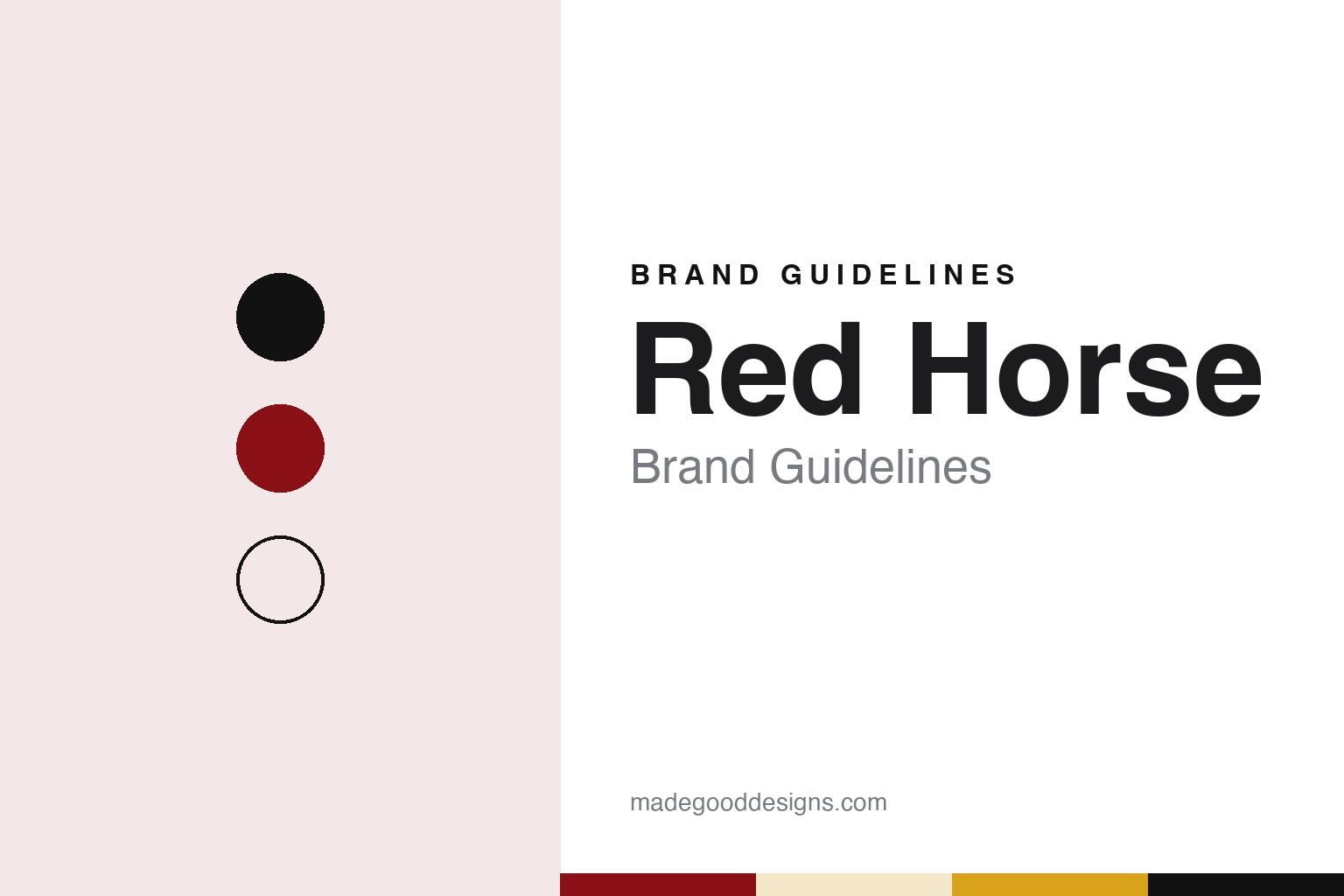
Red Horse Brand Guidelines
San Miguel’s extra-strong lager, born in Cebu in 1982.
Aa
Two constants: a Red Horse red and amber palette and a Stencil sans register. Abstract homage — not a Red Horse product or mark; no bottle, can, label or logo is reproduced.
Project Delta
A new beer from the Mandaue brewery.
Red Horse is a young brand from an old brewer. Its maker, San Miguel Brewery, traces itself to La Fábrica de Cerveza San Miguel, which a historical marker placed by the National Historical Commission of the Philippines says was founded by Enrique María Barretto de Ycaza and inaugurated in Manila on 4 October 1890. The business was incorporated as San Miguel Brewery in 1913, grew into San Miguel Corporation, and ran its beer as a division until 2007, when the domestic beer business was spun off into a new San Miguel Brewery Inc., according to English Wikipedia. The new company was listed on the Philippine Stock Exchange in May 2008 and voluntarily delisted in May 2013, after a rule on minimum public ownership took effect, the same source says.
Red Horse was developed inside that division. English Wikipedia, citing the American Chamber of Commerce of the Philippines’ Business Journal of May 1982, says the beer was formulated by the German brewmaster Eric A. Wimmer at San Miguel’s brewery in Mandaue, Cebu, under the code name “Project Delta,” and first test-marketed in the Ilocos and Davao regions in May 1982. A July 1982 column in the newspaper WE Forum reported its debut in the Ilocos region and wondered when it would reach Metro Manila.
It was positioned from the start as a strong beer. English Wikipedia describes Red Horse as an extra-strong lager with an alcohol content of 6.9 per cent in the Philippines; San Miguel’s international website lists an 8.0 per cent version for export markets.
Colour
Colt, Stallion and Litro.
The brand’s pack names follow its animal. English Wikipedia lists the flagship 500, a 500-millilitre bottle; the Stallion, a smaller 330-millilitre bottle; the Litro, a litre bottle; a discontinued 250-millilitre bottle called the Colt; and cans of 330 and 500 millilitres. San Miguel’s international website adds kegs for draught.
The mark itself has changed. According to English Wikipedia, citing the food site Pepper.ph, bottles from before 2000 carry the original logo, a horse “with a smile,” with separate heels on the horseshoe, the words “Red Horse” in a stencilled lettering and the back information printed in red rather than yellow. Because San Miguel reuses returnable bottles, those older bottles still turn up occasionally in crates, and drinkers nicknamed them the “Laughing Horse” or “Happy Horse.”
The beer is made in the Philippines by San Miguel Brewery, which lists seven breweries there on its international website: Polo in Valenzuela, San Fernando in Pampanga, Santa Rosa in Laguna, Bacolod, Mandaue, Davao and Tagoloan in Misamis Oriental. The company does not say which of them brew Red Horse. It also lists breweries in Hong Kong, southern China, Thailand, Vietnam and Indonesia, and says its beers are sold in more than 70 countries and territories.
Ownership is shared with Japan. In 2009 Kirin Holdings completed its purchase of a 48.3 per cent stake in San Miguel Brewery, Kirin announced; after San Miguel’s 2017 reorganisation, San Miguel Food and Beverage holds the rest, according to English Wikipedia.
Typography
Design and documentation.
The seven brands in this group are all drink names from the Philippines and China: Zest-O, Tanduay, Ginebra San Miguel, Red Horse, Harbin, Snow and Yanjing. Philippine and Chinese drink brands in general sit at many different points in the trade, from family firms that still carry a founder’s name to names that now belong to much larger drinks groups, and a single brand can be sold everywhere from a corner shop to a supermarket shelf.
A drink brand’s identity is usually carried less by a single product than by a bottle, a can, a name and the occasion it promises, because the company behind the name may have changed hands, moved its production or grown far beyond the place where it started. That makes the questions behind each name worth asking plainly: who started it, who owns it now, and where its drinks are actually made and bottled.
Each guide separates what independent sources record from what the company says about itself — its founding story, its owners over time, where its drinks are made and how its packaging has changed — and marks plainly what rests only on the company’s own word.
Aa
A stencil sans — echoing the stencilled lettering of the early bottles. (Specimen set in Saira Stencil One, a sans STAND-IN; NOT the Red Horse logo.)
Red Horse
“Ito ang Tama!”
Red Horse’s marketing has been built around rock music. Since 1999 the brand has sponsored Red Horse Muziklaban, an annual contest for unsigned Filipino rock bands, The Philippine Star reported in 2013; in 2014 the paper called it the country’s premier rock extravaganza, Pambansang Muziklaban — the national Muziklaban — then in its sixteenth edition. Past winners listed by English Wikipedia include the band Mayonnaise in 2004. The contest returned for a new season in 2025, the Philippine Daily Inquirer reported, and English Wikipedia records winners in two categories, Lakas and Aklas.
Its slogan is short. In August 2014 The Philippine Star called “Ito ang Tama!” — Tagalog for “This is the right one!” — the brand’s pitch, in a report on Red Horse winning a gold medal at the Australian International Beer Awards, run in Melbourne by the Royal Agricultural Society of Victoria, where the paper said it was the only gold-medal winner from the Philippines. In 2015 the same awards gave Red Horse their trophy for best international lager, the society’s results show.
San Miguel makes broad commercial claims for the beer. Its international website calls Red Horse the best-selling strong beer in Asia and the world, citing the research firm GlobalData for 2024, and says it is sold across the Americas, Europe, Africa, the Middle East, Asia and Australia; we give those as the company’s claims. The same site reports a stronger variant, Red Horse Super, launched in Africa, and a 2023 promotion of Red Horse cans at a 7-Eleven beer festival in Taiwan. A separate American website for the brand was online by 2020. No official colour or typeface is published.
For a design guide, Red Horse shows how a brewer can build a strong-beer brand on one animal, a slogan and a music stage. Compare Chang, the Thai lager of the two elephants, and Ginebra San Miguel, the gin from the same San Miguel group. For this guide we use a deep red, amber and cream with a stencil sans, an unofficial interpretation; no product or logo is reproduced.
Explore & save
Keep Red Horse’s identity on hand — save it to a board in the Made Good inspiration library.
Red Horse identity set
Pin the Red Horse red and amber palette and the Stencil sans register to your own board.