Yanjing Brand Guidelines
The Shunyi county brewery that became Beijing’s beer.
Aa
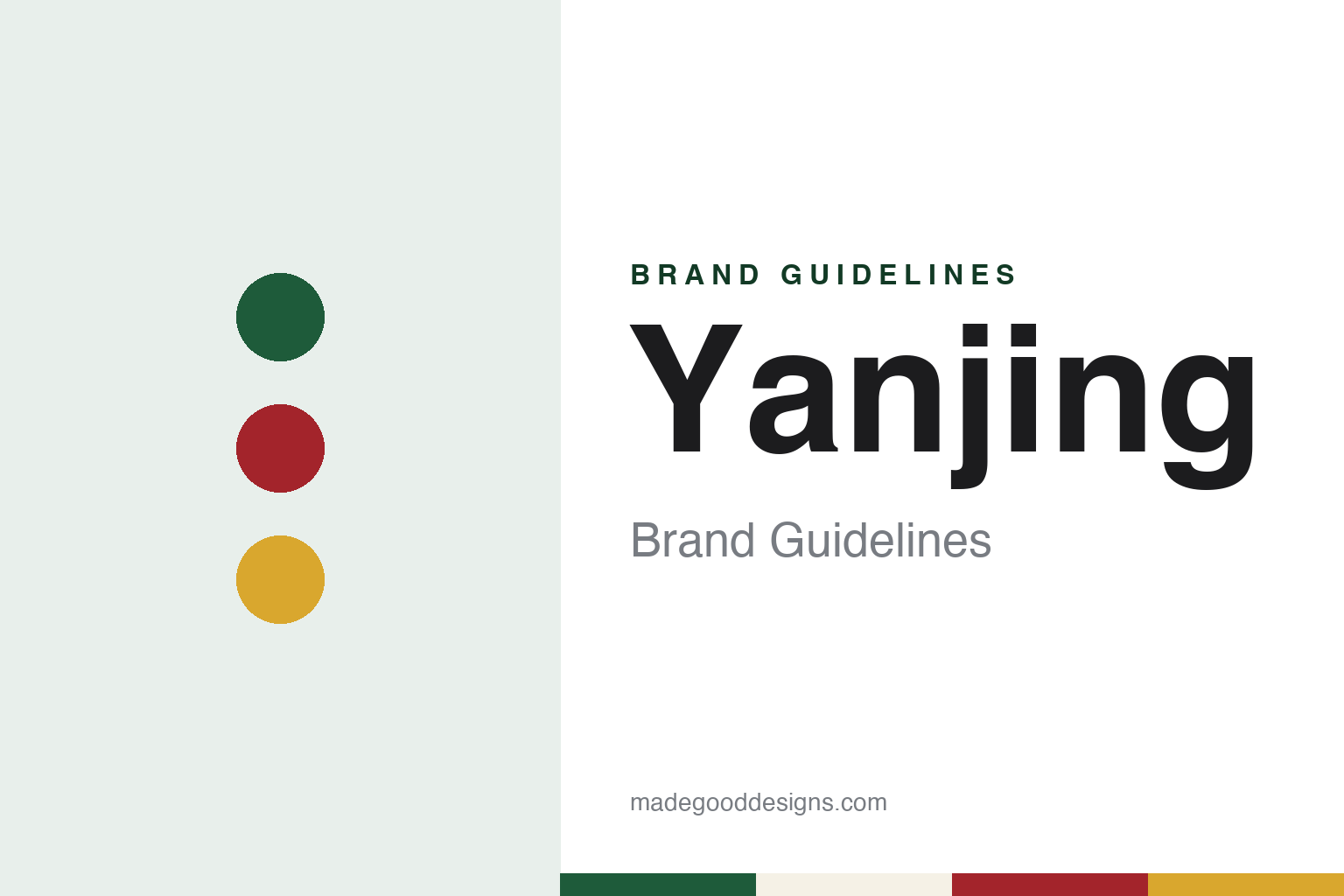
Two constants: a bottle green, banquet red and malt gold palette and a classic Chinese serif register. Abstract homage — not a Yanjing product or mark; no bottle, can, label or logo is reproduced.
A county brewery in Shunyi
From a suburban county plant to Beijing’s everyday beer.
Yanjing began as a small local brewery on the north-eastern edge of Beijing. Chinese Wikipedia says its forerunner was the Shunyi County Brewery, set up in 1980, when Shunyi was still a county. The company’s own history adds that the plant was founded in 1980, began production in 1981 and registered its trademark in 1983. On 13 March 1984, with the approval of the Shunyi county government, the plant was renamed the Beijing Yanjing Brewery, Chinese Wikipedia says. The company is still based in Shunyi today.
The company says it then added around 10,000 tonnes of output every year for nine years, growing from a small brewery into a medium-sized one by the end of the 1980s. The man most closely linked with that growth is Li Fucheng. The Beijing newspaper Jinghua Times reported in 2015 that he joined the brewery in January 1983 after a decade at the Shunyi chemical-fertiliser plant, and Chinese Wikipedia, citing a 2006 profile, says he became director of the brewery in March 1989. The paper called him the “soul” of Yanjing Beer and wrote that under his leadership the company had spent many years among the world’s ten largest brewers.
In its own account of the years from 1989 to 1995, Yanjing says it broke what it describes as a monopoly on sales and built a firm market network through deep distribution, an approach it calls its “hutong strategy”, after the lanes of old Beijing. The company says that by 1993 it was the third-largest beer producer in China, and that in 1995 it drew level with Tsingtao for first place.
Colour
State banquets, a nickname and a smaller bottle.
A milestone in the brand’s standing came in February 1995, when Yanjing was designated as the beer served at state banquets in the Great Hall of the People, according to Peter Peverelli’s 2006 book Chinese Corporate Identity, published by Routledge. Chinese Wikipedia also lists Yanjing as a commemorative drink for the 50th anniversary of the People’s Republic in 1999 and for the return of Macau to China that year.
At home in Beijing the brand is above all an everyday beer. Chinese Wikipedia says Beijingers commonly call the ordinary bottled Yanjing “Pu Jing”, short for “ordinary Yanjing”, a nickname reported by the Beijing newspaper Fazhi Wanbao in 2007 and by Huaxia Shibao in 2010. The 2007 report recorded a change in that standard pack: the ordinary Yanjing bottle was cut from 630 ml to 600 ml, and the shops checked by the paper now sold a 10-degree qingshuang (“fresh and crisp”) version in place of the older 11-degree beer. Because the old bottles were no longer accepted back after May 2007, the paper wrote, many households were left with returnable bottles they could only sell as scrap.
The range has since widened well beyond the ordinary lager. The company’s current lineup is led by U8, a beer it says it designed for young drinkers, with the “8” referring to its original gravity and the “U” standing for “unique”. Alongside it the company lists a U8 Plus, a pilsner called S12, a wheat beer called V10, a pure draught (chunsheng) beer and an unfiltered No. 9 beer, and in March 2026 it announced A10, an all-malt lager aimed at the premium market. Its current slogan, given in Chinese Wikipedia in both languages, is “Fresh and Cool, Inspire the World”. The company also stages the Beijing International Yanjing Beer Culture Festival, which it says reached its 34th edition in July 2025.
Typography
Design and documentation.
The seven brands in this group are all drink names from the Philippines and China: Zest-O, Tanduay, Ginebra San Miguel, Red Horse, Harbin, Snow and Yanjing. Philippine and Chinese drink brands in general sit at many different points in the trade, from family firms that still carry a founder’s name to names that now belong to much larger drinks groups, and a single brand can be sold everywhere from a corner shop to a supermarket shelf.
A drink brand’s identity is usually carried less by a single product than by a bottle, a can, a name and the occasion it promises, because the company behind the name may have changed hands, moved its production or grown far beyond the place where it started. That makes the questions behind each name worth asking plainly: who started it, who owns it now, and where its drinks are actually made and bottled.
Each guide separates what independent sources record from what the company says about itself — its founding story, its owners over time, where its drinks are made and how its packaging has changed — and marks plainly what rests only on the company’s own word.
Aa
A classic Chinese serif for a Beijing beer. (Specimen set in Noto Serif SC, a serif STAND-IN; NOT the Yanjing logo.)
Yanjing
A listed company with a state-owned owner.
Yanjing grew into a national group in the 1990s. The company says it formed a group in 1993 and listed its shares in 1997. Chinese Wikipedia says that in May 1997 the Yanjing group took part in the Hong Kong listing of Beijing Enterprises Holdings, and that on 25 June 1997 its own A-shares were listed on the Shenzhen Stock Exchange; the company gives the Shenzhen listing as July 1997. From 2000, the company says, it began buying and integrating other breweries across China, and Chinese Wikipedia names Huiquan, Liquan and Xuelu among its other beer brands. Yanjing says it now has 61 subsidiaries it controls directly or indirectly, spread across 19 provinces and cities.
Output peaked in 2013. The industry report published by the hop trader BarthHaas for 2013–2014, as cited by English Wikipedia, put Yanjing’s production that year at 57.1 million hectolitres, making it the eighth-largest brewer in the world and the third-largest in China. The company’s own history gives the same peak, at more than 5.7 million kilolitres, and says the Chinese beer market stopped growing after 2014.
Ownership has stayed in state hands. When Li Fucheng stepped down as chairman of the Yanjing group in 2015 on reaching retirement age, the Jinghua Times reported that the group was wholly owned by the Shunyi district government, and that it held a small direct stake in the listed company as well as a fifth of the Beijing Yanjing Beer Investment Co., which in turn held a majority of the listed company. The company’s own shareholder table for 31 March 2025 still shows that investment company, listed as a state-owned legal person, as the largest shareholder with 57.40%, and the Yanjing group holding 1.87% directly and 19.94% of the investment company. Chinese Wikipedia gives the parent as the Shunyi district’s state-capital management company. In 2011, Chinese Wikipedia says, Yanjing formed a joint company with the Taiwanese food maker Agv, its distributor there, to sell its beer in Taiwan.
For a design guide, Yanjing shows how a county brewery’s beer can serve both state banquets and the everyday table under one name. Compare Tsingtao, the Qingdao brewer it once drew level with, and Snow, another Chinese beer brand. For this guide we use a bottle green, a banquet red and a malt gold with a serif, an unofficial interpretation; no product or logo is reproduced.
Explore & save
Keep Yanjing’s identity on hand — save it to a board in the Made Good inspiration library.
Yanjing identity set
Pin the Yanjing bottle green, banquet red and malt gold palette and the classic Chinese serif register to your own board.