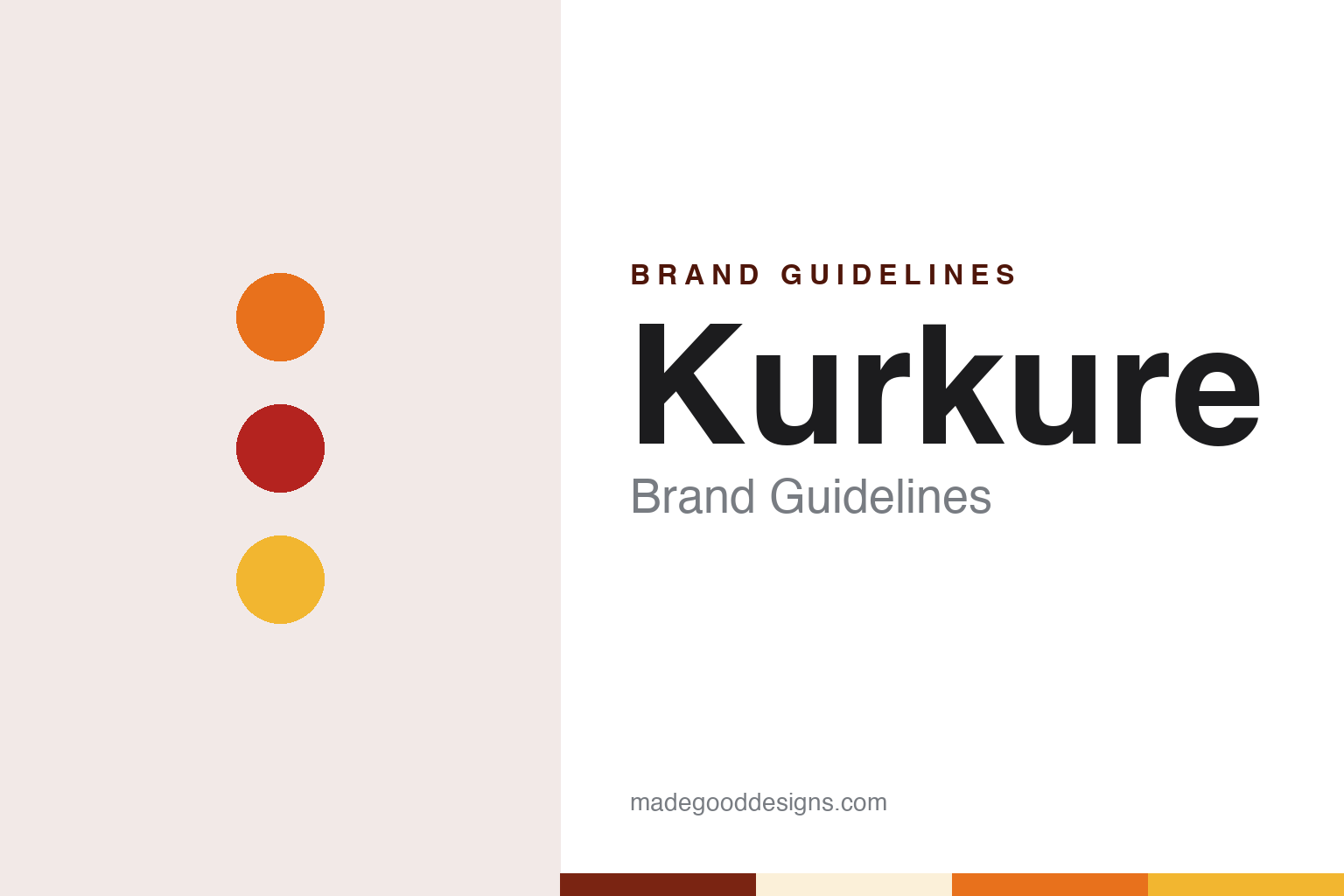
Kurkure Brand Guidelines
PepsiCo India’s crunchy snack built for Indian tastes.
Aa
Two constants: a masala orange, chatpata red and turmeric palette and a chunky, playful sans register. Abstract homage — not a Kurkure product or mark; no pack, logo or snack is reproduced.
A snack made in India, for India
Neither namkeen nor chips, and named for its crunch.
Kurkure is a spiced, crunchy snack made from rice, lentil and corn, owned by PepsiCo through its snack arm Frito-Lay. It was developed in India by PepsiCo India and launched there in 1999, according to the company’s Indian brand page and a 2014 case study in the business magazine Business Today. The name means “crunchy” in Hindi and Urdu, and Business Today said it came out of consumer group discussions in which people kept describing the snack as kurkura.
Business Today credited the launch strategy to a PepsiCo India team that included Geetu Verma, one of its founding members, and named T.S.R. Murali, then head of research and development at PepsiCo India, in the product’s development. The snack was first sold as Lehar Kurkure; the magazine said the Lehar name was added to signal a local taste.
The idea was positioning as much as recipe. Business Today described Kurkure as a “bridge” product between traditional namkeen, the savoury snacks sold loose and in packs across India, and Western-style potato chips such as Lay’s, pitched as an affordable tea-time finger snack. The advertising trade title Ad Age India put it the same way in 2019: PepsiCo believed Indian consumers wanted something new in snacking without giving up traditional tastes, so the product offered a familiar flavour in a new and convenient format.
Colour
From “control nahi hota” to “khayal toh chatpata hai”.
Kurkure’s advertising has been built around taglines and film and television stars. Its first campaigns played on irresistibility, with the line “Kya Karen Control Nahi Hota” — roughly, “what to do, I can’t control myself” — as protagonists kept eating, Ad Age India recalled in 2019. Around 2005, Business Today said, the brand ran “Kahani Mein Kurkure” tie-ins with television serials and a campaign urging people to swap sweets for Kurkure. The actress Juhi Chawla fronted its advertising in the mid-2000s; the trade site indiantelevision.com reported a Chawla commercial in May 2004, while Business Today dated her signing as brand ambassador to 2005.
Its most lasting line answered a competitor. When ITC’s Bingo entered the market in 2007, Business Today said, Kurkure responded with “Tedha Hai Par Mera Hai” — “it’s crooked, but it’s mine” — a line about the snack’s own twisted shape. In 2012 PepsiCo India announced a “Tedha Hai Par Mera Hai” family of actors including Parineeti Chopra, Boman Irani and Farida Jalal. Other faces fronted new lines and regions: in 2008 the actress Kareena Kapoor endorsed a new Kurkure Desi Beats range, the film site Bollywood Hungama reported, and the same year PepsiCo India named the actress Simran its first Kurkure ambassador in South India.
In 2019 the brand changed course with “Khayal toh Chatpata Hai”, a campaign starring Taapsee Pannu as a young homemaker persuading a traditional family to accept her career, Ad Age India reported; Samantha Akkineni fronted the South Indian films, and the brand introduced a digital mascot, Ms Kurkure, alongside story integrations in eight Zee television shows and a rural roadshow of street plays and film screenings in Uttar Pradesh. Later commercials featured Akshay Kumar in 2021 and 2022, ET BrandEquity reported, and Sara Ali Khan in 2024, afaqs! reported.
Typography
Design and documentation.
The seven brands in this group are all Indian snack and Mexican food names: Balaji, Kurkure, Sunfeast, Unibic, Tajín, Marinela and De la Rosa. Indian snack and Mexican food brands in general sit at many different points in the trade, from family firms that still carry a founder’s name to names that now belong to much larger food groups, and a single brand can be sold everywhere from a corner shop to a supermarket shelf.
A food brand’s identity is usually carried less by a single product than by a pack, a name and the snack or meal it promises, because the company behind the name may have changed hands, moved its production or grown far beyond the place where it started. That makes the questions behind each name worth asking plainly: who started it, who owns it now, and where its products are actually made and packed.
Each guide separates what independent sources record from what the company says about itself — its founding story, its owners over time, where its products are made and how its packaging has changed — and marks plainly what rests only on the company’s own word.
Aa
A chunky, playful sans for a snack named after its crunch. (Specimen set in Rubik, a sans STAND-IN; NOT the Kurkure logo.)
Kurkure
Strings of packs, a pack redesign and a snack that travelled.
Much of Kurkure’s presence in India has been built at the shop counter. Business Today said PepsiCo supplied racks to shops from 2001 and hung strings of packs, known as ladis, in small stores, and introduced smaller, cheaper packs in 2004 and again in 2011 to reach more buyers. The brand also met its share of trouble: in 2008, the magazine reported, social-media posts alleged that the snack contained plastic, and the company answered them on each platform where they appeared, later saying the issue had “withered away.”
The packs themselves were reworked in early 2019. Ad Age India reported that Kurkure had revamped its packaging a few months before, telling a “kitchen ingredients story” that set each flavour apart and printing the product format on every pack, so shoppers could tell variants and rival brands apart. It cited PepsiCo research that a shopper takes less than seven seconds to choose a snack, noticing colour first, then shape, brand name and finally the key ingredients.
The snack has also followed South Asian audiences abroad. PepsiCo launched Kurkure in Pakistan in 2008, its Pakistani site says, where local actresses have fronted its commercials. In August 2021 PepsiCo brought it to the United Kingdom in two flavours, Masala Munch and Naughty Tomato, the trade magazine Convenience Store reported; a PepsiCo flavour scientist said the team had spent 18 months recreating the taste for the British market. Among its rivals at home, Business Today listed in 2014 the Rajkot wafer maker Balaji, alongside Bingo, Yellow Diamond and Bikanerwala.
For a design guide, Kurkure shows how a global company can build a brand that reads as local, from its Hindi name to taglines that joke about the snack’s own crooked shape. Compare Lay’s and Cheetos, two other Frito-Lay brands. For this guide we use masala orange, a chatpata red and turmeric yellow with a chunky sans, an unofficial interpretation; no product or logo is reproduced.
Explore & save
Keep Kurkure’s identity on hand — save it to a board in the Made Good inspiration library.
Kurkure identity set
Pin the Kurkure masala orange, chatpata red and turmeric palette and the chunky playful sans register to your own board.