Tsingtao Brand Guidelines
The 1903 Qingdao brewery with a pier pavilion logo.
Aa
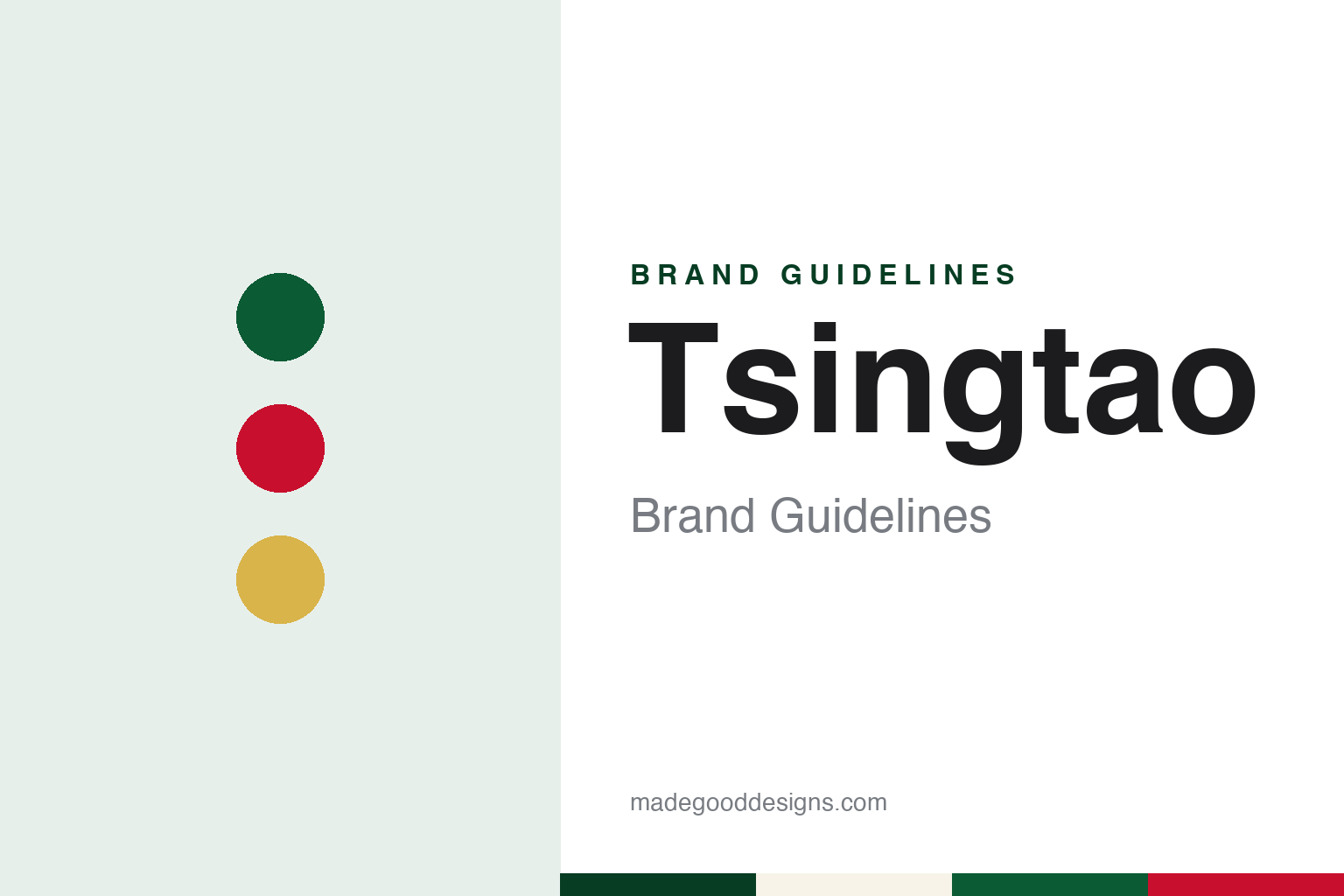
Two constants: a Laoshan green, pavilion red and lager gold palette and a heritage display serif register. Abstract homage — not a Tsingtao product or mark; no bottle, label or logo is reproduced.
The Germania-Brauerei
British and German merchants, a leased port and a first beer in 1904.
Tsingtao takes its name from the old romanised spelling of Qingdao, the port city on China’s Shandong peninsula where the brewery still has its head office. When it was founded the city sat inside the Kiautschou Bay territory, an area China had leased to Imperial Germany, and the brewery was a foreign venture aimed mainly at Europeans living in China, English Wikipedia says.
English Wikipedia dates the founding to 15 August 1903, when the Anglo-German Brewery Co. Ltd, a British and German joint-stock company based in Hong Kong, set up the Germania-Brauerei Tsingtao. Its founding supervisory board was drawn from trading houses in Shanghai, with British and German members side by side, and the brewing was overseen by brewmasters from Germany. The company tells the same story in its own words: Tsingtao, it says, was established in 1903 by German and British merchants as Germania-Brauerei Tsingtao Co., Ltd., as one of the earliest breweries in China. English Wikipedia says the first beer was served on 22 December 1904.
The company says its first award came in 1906, a gold award at an international exhibition in Munich, which it calls the first international award received by the Chinese beer industry. The company’s timeline places it directly after the founding year.
Colour
Japanese, Nationalist and then state ownership.
The brewery changed hands with the city. After the Siege of Tsingtao in the First World War, Qingdao came under Japanese and British military control, and on 16 August 1916 an extraordinary general meeting in Shanghai decided to sell the company to Dai-Nippon Brewery, English Wikipedia says. Dai-Nippon was the Japanese brewer that would be split in 1949 into what became Asahi and Sapporo. Chinese Wikipedia says that under Dai-Nippon the Qingdao plant made beer under both the Tsingtao and Asahi names.
After Japan’s defeat in 1945 the brewery passed into Chinese hands. English Wikipedia says it was owned by the Tsui family under the supervision of the Nationalist government; Chinese Wikipedia says that in June 1947 it was bought by the Qilu Enterprise Corporation and renamed the Qilu Enterprise Qingdao Brewery. Both accounts agree on what came next: in 1949, after the Communist victory, the new People’s Republic took over the shares and the brewery became a state-owned enterprise.
According to English Wikipedia, the Korean War and the Western embargo that followed forced the brewery to replace imported raw materials with domestic ones, and the government encouraged farmers in Shandong to grow hops and barley. For decades the brewery leaned on exports: English Wikipedia says Tsingtao reached the United States in 1972 and became the top-selling Chinese beer there. Its advertising long described the beer as brewed with mineral water from the Laoshan spring, a claim English Wikipedia says now applies only to the beer brewed in Qingdao, not to beer from the company’s other breweries.
Typography
Design and documentation.
The seven brands in this group all make dairy products or drinks, and all of them come from China: Yili, Mengniu, Bright Dairy, Nongfu Spring, Wong Lo Kat, JDB and Tsingtao. Chinese dairy, water, herbal-tea and beer brands in general sit at many different points in the trade, from names with long local histories to companies that now belong to much larger groups or answer to many shareholders, and a single brand can be sold everywhere from a corner shop to a supermarket shelf.
A drinks or dairy brand’s identity is usually carried less by a single product than by a pack, a name and the everyday habit it promises, because the company behind the name may have changed hands, added new plants or grown far beyond the city where it started. That makes the questions behind each name worth asking plainly: who started it, who owns it now, and where its products are actually made and packed.
Each guide separates what independent sources record from what the company says about itself — its founding story, its owners over time, where its products are made and how its packaging has changed — and marks plainly what rests only on the company’s own word.
Aa
A heritage display serif for a brewery that dates its story to 1903. (Specimen set in Playfair Display, a serif STAND-IN; NOT the Tsingtao logo.)
Tsingtao
A pavilion on the pier, two listings and a run of shareholders.
The Tsingtao logo is a piece of Qingdao itself. It shows the Huilan Pavilion, the octagonal pavilion at the end of Zhanqiao Pier on the city’s southern shore, English Wikipedia says. The pier was built in 1891 as Qingdao’s first wharf, and the pavilion was added at its end in 1930.
The modern company took shape in the early 1990s. English Wikipedia says the brewery was merged with three other Qingdao breweries in 1993 and renamed Tsingtao Brewery Company Limited, and that in June that year it became the first Chinese firm listed on the Hong Kong Stock Exchange; the company says it was the first Chinese company listed in both Hong Kong and Shanghai. Chinese Wikipedia says Anheuser-Busch became a strategic investor in 2002; English Wikipedia says its stake reached about 27%. AB InBev announced on 23 January 2009 that it would sell 19.9% to Asahi Breweries, and in May 2009 it sold its remaining 7% to the Chinese businessman Chen Fashu, English Wikipedia says. Asahi sold its own stake in 2017; Chinese Wikipedia says Fosun International bought the 17.99% holding, and it names the Tsingtao Brewery Group as the controlling shareholder.
The company says it was an official sponsor of the Beijing 2008 Olympic and Paralympic Games and of the Beijing 2022 Winter Games, and it lists awards for its beers from the European Beer Star and the World Beer Championships, along with Brand Finance naming Tsingtao the world’s strongest beer brand in 2024 and 2025. In Qingdao, the brewery applied for an international beer festival that first opened on 23 June 1991 and has been held every year since, English Wikipedia says; Chinese Wikipedia dates the opening of the Tsingtao Beer Museum to 15 August 2003, the centenary of the founding. The company says its beer is now sold in more than 100 countries and regions, and its English website lists a Classic Lager, a Pure Draft and an alcohol-free Tsingtao 0.0.
For a design guide, Tsingtao shows how a city landmark can serve as a brewery’s mark for generations, carrying the name of a port across a century of changing owners. Compare Wahaha, the Hangzhou drinks maker, and Master Kong, the Tianjin noodle and drinks brand. For this guide we use a Laoshan green, a pavilion red and a lager gold with a heritage serif, an unofficial interpretation; no product or logo is reproduced.
Explore & save
Keep Tsingtao’s identity on hand — save it to a board in the Made Good inspiration library.
Tsingtao identity set
Pin the Tsingtao Laoshan green, pavilion red and lager gold palette and the heritage display serif register to your own board.