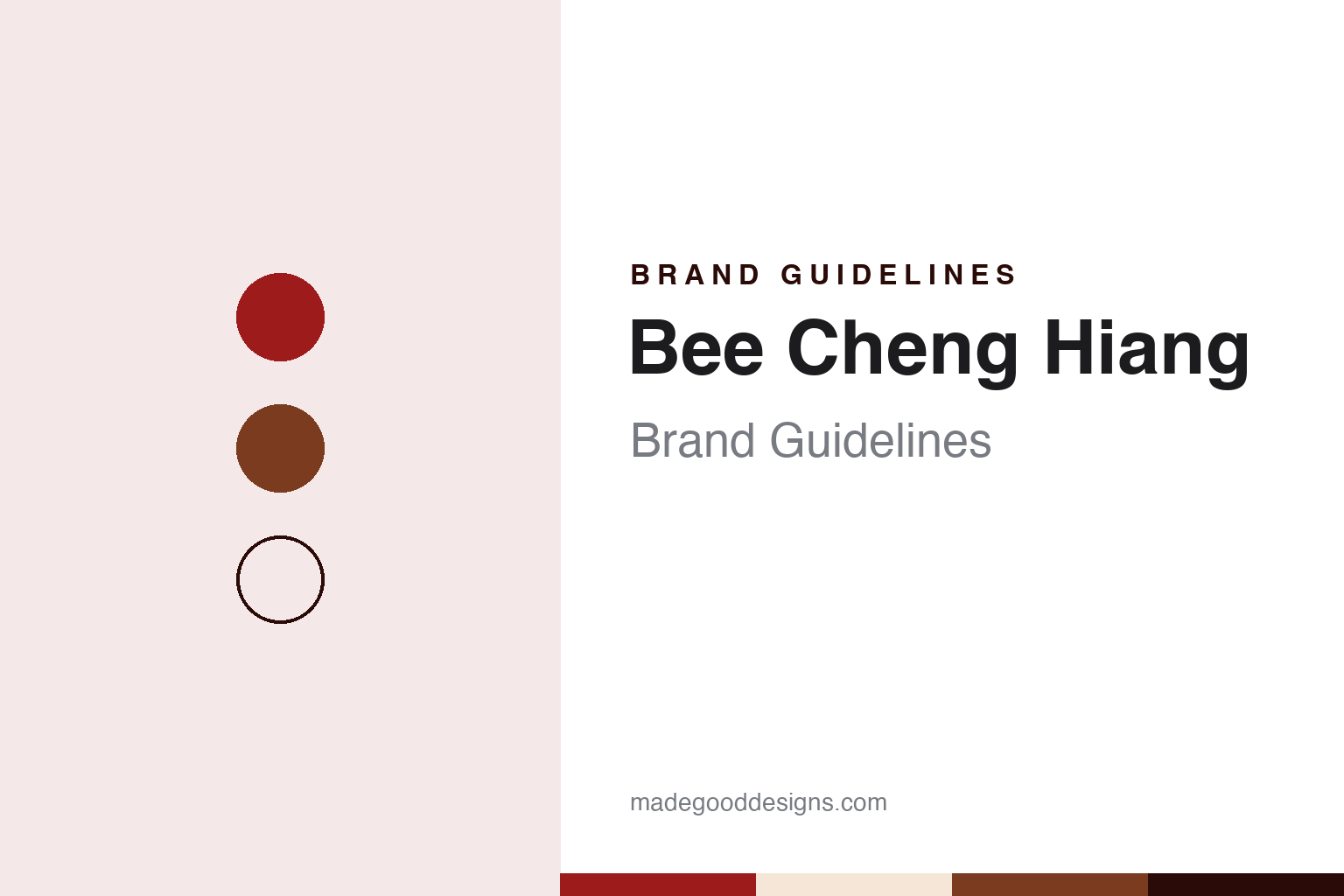
Bee Cheng Hiang Brand Guidelines
The 1933 Chinatown bakkwa pushcart with a nine-stroke name.
Aa
Two constants: a Bee Cheng Hiang red, brown and cream palette and a brush serif register. Abstract homage — not a Bee Cheng Hiang product or mark; no bag, logo or shopfront is reproduced.
A Pushcart in Chinatown
Homemade barbecued pork, sold from a cart.
Bee Cheng Hiang traces itself to 1933, when Teo Swee Ee began selling his homemade barbecued pork slices from a pushcart in Singapore’s Chinatown, according to Singapore’s National Library Board, whose Infopedia entry draws on the company’s own history and on Straits Times reports. The company describes him as “an enterprising migrant” with a mobile cart, and calls the product by its Hokkien name, bakkwa — dried, barbecued sweet meat, also known as rougan in Mandarin.
Bakkwa was a festive food. The library’s account says demand soared at Chinese New Year, when it was bought as a treat and a gift, and that Teo built the business by promoting it as a seasonal delicacy; the company says he and his family would gather each festive season to grill it in bulk.
After the Japanese Occupation ended, Teo opened his first shop, on Rochor Road, in 1945, the company and the library both say, and the company says its production line began at the back of that store. The company’s first factory came much later: its milestones list one on Depot Road, Singapore, in 1979.
The shop gave the brand one of its founding stories. Large lorries parked outside kept blocking the view of the shopfront, so Teo paid the vehicles’ owners to carry the Bee Cheng Hiang name — making him, in the library’s words, citing a 2007 business history by M.T.G. Lee, “one of the pioneers of mobile advertising in Singapore.” The company tells the same story and adds that trucks carrying its brand became a familiar sight on the road.
Colour
Nine strokes, three meanings.
The brand’s name is also its mark. The National Library Board says the logo was designed by Teo himself, who was an amateur Chinese astrologer: he chose the three characters 美, 珍 and 香 — Mei Zhen Xiang in Mandarin — because each is written with nine strokes, and nine sounds like the word for longevity in Mandarin. The characters were also picked for their meanings, which the company gives as appearance, flavour and aroma; English Wikipedia renders the name as “Beauty-Flavor-Aroma.” The company adds that Teo drew on a passion for calligraphy and divination, and that a newer logo was later introduced to give the brand a more contemporary presence, though it does not date the change.
Packaging is part of the same story. The company says that before its red carrier bag became the Bee Cheng Hiang identity, bakkwa was wrapped in wax paper, put into a plastic bag and packed in a paper bag or a box with a handle that customers could carry easily. It presents that packaging as one reason for its lead in the trade; we give that as its claim.
The identity was reworked after a hard period. The library, citing Lee’s business history, says the 1997 Asian financial crisis hit the company hard, and that it then modernised the brand’s image and overhauled its outlets to make them brighter and more welcoming. In 2001, the Straits Times reported, George Yeo, then Singapore’s Minister for Trade and Industry, said that “the key to Bee Cheng Hiang’s success lies in its strong branding and comprehensive franchise system.”
The brand’s value also drew imitators. In 2001, the library records, stalls in Chinatown sold bakkwa at Chinese New Year in boxes bearing the Bee Cheng Hiang name but not its logo; the company chose not to take legal action, saying the problem arose only in the festive season.
The product range grew around the original bakkwa. The library records a crispy version called Chiziban, launched in 1998, and a Satay Bakkwa reported by the Straits Times in 2005; Wikipedia dates Gourmet Bakkwa, bakkwa in thin bacon-like slices, to 2003 and a chilli version to 2005. Wikipedia, citing the company’s website, says the range now takes in prawn rolls, crispy pork floss, cuttlefish and sausages.
Typography
Design and documentation.
The seven brands in this group all make food, and all of them come from Hong Kong or Singapore: Garden, Kee Wah, Maxim’s, Bee Cheng Hiang, Koon Chun, Kowloon Dairy and Wing Wah. Food brands from the two cities in general sit at many different points in the trade, from family firms that still carry a founder’s name to names that now belong to much larger groups, and a single brand can be sold everywhere from a neighbourhood shop to an airport counter.
A food brand’s identity is usually carried less by a single product than by a pack, a name and the meal, gift or festival it promises, because the company behind the name may have changed hands, moved its kitchens or grown far beyond the street where it started. That makes the questions behind each name worth asking plainly: who started it, who owns it now, and where its food is actually made and packed.
Each guide separates what independent sources record from what the company says about itself — its founding story, its owners over time, where its food is made and how its packaging has changed — and marks plainly what rests only on the company’s own word.
美
A brush serif — the register of three nine-stroke characters. (Specimen set in Noto Serif SC, a serif STAND-IN; NOT the Bee Cheng Hiang logo.)
Bee Cheng Hiang
From one shop to franchises across Asia.
Bee Cheng Hiang grew abroad through franchising. The company dates its first outlet in Malaysia to 1985 and in Hong Kong to 1992; the National Library Board, citing Straits Times reports from 1995, says a franchise expansion programme began in 1994 and that within a year there were more than ten outlets across Malaysia, Hong Kong and China. The company’s milestones go on to list first outlets in Indonesia in 1996, the Philippines in 1998, Taiwan in 2000, mainland China in 2002, South Korea in 2010, Macau in 2012, and Japan and Vietnam in 2016. In 2010 the Straits Times reported that the company had opened two outlets in Seoul, and Inside Retail Asia reported its arrival in Japan in October 2016. The company says it opened its 100th outlet in 2007.
Where the bakkwa is made is documented by the company itself. Its milestones list a first factory in Xiamen, China, in 1994; a factory at Senoko, in northern Singapore, from 1995, with research and development facilities; and a new, larger factory in Xiamen from 2009. The company says its bakkwa is woven by hand on a bamboo sieve, smoked over live coal and barbecued; we give that as its description of the method. The library adds that the company planned in 2010 to set up a factory in Korea to make products there.
The company has stayed in the founder’s extended family. The library, citing a 2010 Straits Times report, names the group general manager as Daniel Wong, the founder’s grand-nephew, who joined in 1993. In the company’s 2016 website footer the operating company is named as Bee Cheng Hiang Hup Chong Foodstuff Pte Ltd.
Recognition has come mostly from Singapore’s business and food-safety schemes. The company lists the Promising Franchisor of the Year award in 1997, ISO 9002 certification in 1997 and HACCP certification in 1999, Singapore Promising Brand awards from 2002, a Heritage award in 2005 and a Singapore Prestigious Brand award in 2009, along with food-safety awards from the former Agri-Food & Veterinary Authority. It celebrated its 80th anniversary in 2013.
For a design guide, Bee Cheng Hiang shows how a founder’s choice of three characters, a red carrier bag and a name on a lorry can carry a single product across a region. Compare Prima Taste, another Singapore food brand sold abroad, and Khong Guan, a Singapore-founded biscuit maker known for its tins. For this guide we use red, brown and cream with a serif, an unofficial interpretation; no product or logo is reproduced.
Explore & save
Keep Bee Cheng Hiang’s identity on hand — save it to a board in the Made Good inspiration library.
Bee Cheng Hiang identity set
Pin the Bee Cheng Hiang red, brown and cream palette and the brush serif register to your own board.