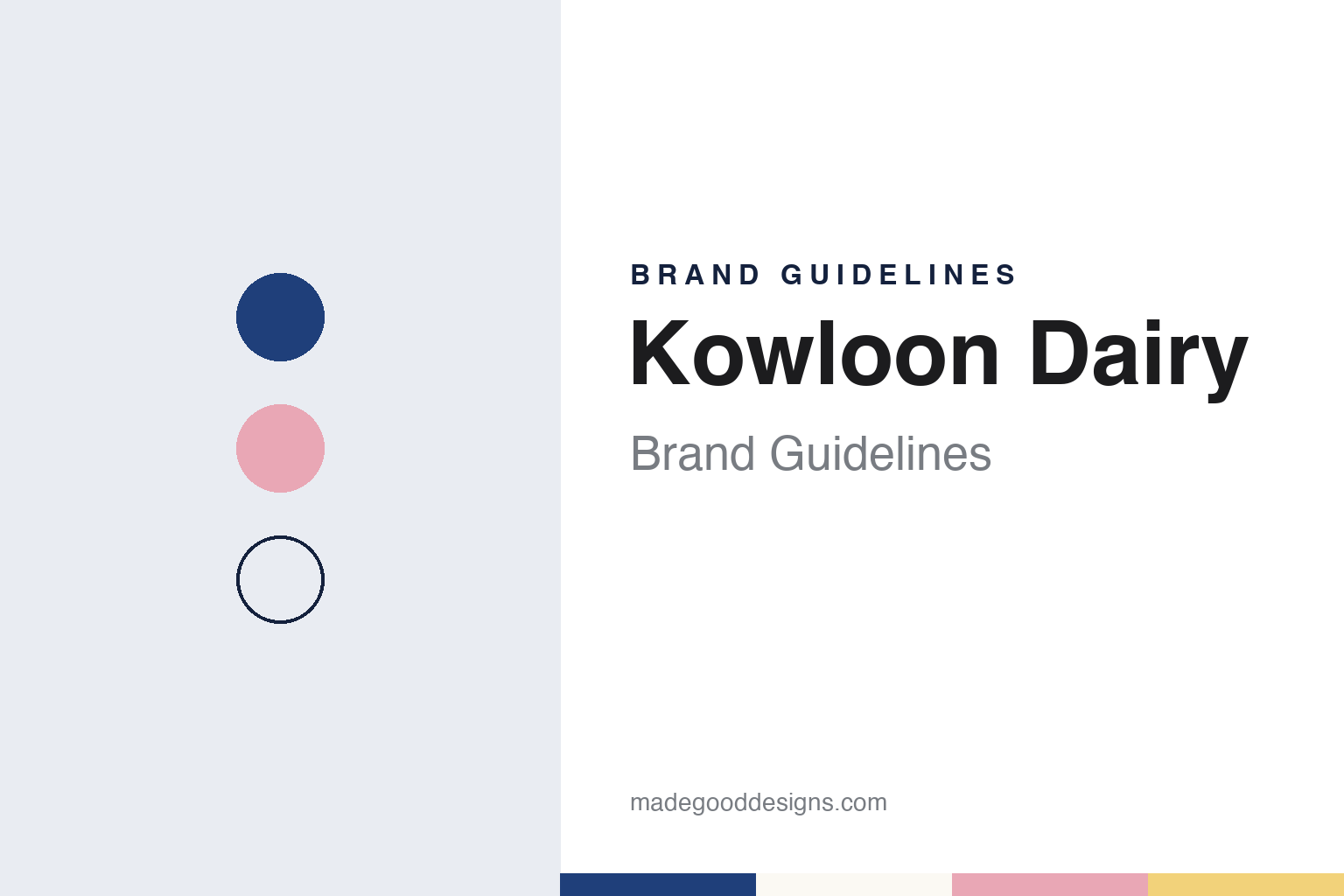
Kowloon Dairy Brand Guidelines
The 1940 Hong Kong dairy that turned milk bottles into Mochi Ice.
Aa
Two constants: a Kowloon Dairy blue, milk white and mochi pink palette and a rounded friendly sans register. Abstract homage — not a Kowloon Dairy product or mark; no bottle, carton, label or logo is reproduced.
North Kowloon, 1940
A dairyman, a jockey and a racehorse owner.
Kowloon Dairy (九龍維記牛奶, known in Chinese as 維記, Wai Kee) is a Hong Kong maker of milk and ice cream founded in 1940. English Wikipedia gives its incorporation date as 21 March 1940 and names George Ahwee and Rudy Choy as its founders. The company’s own website told the same story in 2012: Ahwee, a devotee of dairy husbandry, and Choy, an amateur jockey, co-founded the business, which started with 30 employees selling fresh milk in the northern part of the Kowloon peninsula. Then Li Lan Sang, a racehorse owner, put in more money to expand it and set up The Kowloon Dairy Ltd.
The company’s current “Our story” page puts Li at the centre from the start, saying that in 1940 he “joined his friends in a business partnership,” and that, together with Ahwee and Choy, he invested more capital to grow the business, at which point “Limited” was added to the name. English Wikipedia describes Li as a member of Hong Kong’s Li banking family. The 2012 site explained the name simply: the dairy was set up in Kowloon, and the name set it apart from another well-known dairy across the harbour on Hong Kong Island.
The first farm lay on land that is now Choi Wan Estate, where, the company says, hundreds of cows once grazed; English Wikipedia says the company imported 100 cows from Australia during the Second World War. In 1972 the government resumed the land for public housing, and Kowloon Dairy split its operations, moving the farm to Yuen Long and the factory to a purpose-built plant in Tuen Mun, a move the company calls the beginning of its automation. Since about 1975, English Wikipedia says, the business has been run by Li’s family. The 2012 website credited its chairman, Eric Li, who took charge of the company at his father’s request, with modernising it, including what it described as pioneering computer-printed sales invoices in the 1970s.
Colour
Milk from Guangdong, pasteurised in Tuen Mun.
The cows left Hong Kong in the 1980s. In 1984, the company says, it gave up the Yuen Long farm and moved its dairy farming north to Guangzhou. Its fresh milk, the company says, is collected daily from farms in Guangdong, then homogenised and pasteurised at its own plant in Tuen Mun and delivered to shops by its own refrigerated trucks; its product pages call the result “100% produced daily in Hong Kong.” Alongside fresh milk it makes recombined milk drinks from imported milk powder, a range the company says it developed after fresh milk, including a chocolate milk.
Kowloon Dairy also expanded into China. It formed a joint venture, The Kowloon Dairy (GZ) Ltd., which the company’s 2012 website dated to 1992 and its current timeline to 1993; English Wikipedia gives 1992, names the partner as Fengxing Milk, and says production in China began in 1994. A later company page lists further subsidiaries: Foshan Ausoon Dairy, with a farm at Nandanshan in Foshan, and two companies at Rugao, in Jiangsu province. The company says its milk reached every part of Hong Kong and Macau by 1975.
Its product history is one of firsts, by the company’s account. Until about 1979 it acted only as an agent for overseas ice-cream brands; it then built its own ice cream with technology transferred from an Australian dairy company. It says it launched a 2% low-fat milk in 1986 and Hi-Calcium Slimilk in 1993, followed by a papaya milk. Its best-known product came in 1989: Mochi Ice, ice cream wrapped in a chewy glutinous-rice skin. The company has said it borrowed the concept from Japan and Taiwan; Chinese Wikipedia says it was modelled on Lotte’s Yukimi Daifuku.
The company also cites food-safety certifications, saying it was the first local dairy to gain HACCP certification from BSI, in January 2007, followed by ISO 22000 from BSI in 2009 and from SGS in September 2011, and that it added tamper-proof seals to its milk bottles in 2010.
Typography
Design and documentation.
The seven brands in this group all make food, and all of them come from Hong Kong or Singapore: Garden, Kee Wah, Maxim’s, Bee Cheng Hiang, Koon Chun, Kowloon Dairy and Wing Wah. Food brands from the two cities in general sit at many different points in the trade, from family firms that still carry a founder’s name to names that now belong to much larger groups, and a single brand can be sold everywhere from a neighbourhood shop to an airport counter.
A food brand’s identity is usually carried less by a single product than by a pack, a name and the meal, gift or festival it promises, because the company behind the name may have changed hands, moved its kitchens or grown far beyond the street where it started. That makes the questions behind each name worth asking plainly: who started it, who owns it now, and where its food is actually made and packed.
Each guide separates what independent sources record from what the company says about itself — its founding story, its owners over time, where its food is made and how its packaging has changed — and marks plainly what rests only on the company’s own word.
Aa
A rounded friendly sans for a milk brand that sells on family and freshness. (Specimen set in Nunito, a sans STAND-IN; NOT the Kowloon Dairy logo.)
Kowloon Dairy
A 2015 rebrand, a new logo and an 80th birthday.
Kowloon Dairy has said plainly that marketing matters. Its 2012 website argued that the old idea that “a good product sells itself” was out of date, and that the company had to explain its products through integrated marketing. The same site recalled that in the old days local people rarely drank milk except when they were sick, and that milk had since become a daily habit.
The modern identity dates from the last decade. The company’s timeline lists a 2015 rebranding, under the line “It’s still all about our milk,” along with the launch of Kowloon Dairy ice-cream cones the same year; from 2015 it has also been the “Official Dairy Partner” of the Hong Kong Tennis Open, appointed by the Hong Kong Tennis Association. A half-fat fresh milk followed in 2017, a first pop-up store and ice-cream cups in 2018, and the 80th anniversary in 2020. The “Our story” page says the “expression of satisfaction” on the brand’s new logo underlines its dedication to “generations of happy Hong Kong families.” The company also promotes returnable glass bottles, which it says can be sterilised and reused nine or ten times.
For a design guide, Kowloon Dairy shows how a brand named after a place can keep that local promise even after its cows have moved across the border, by keeping the bottling, and the story, in Hong Kong. Compare Vitasoy, the Hong Kong soy milk brand also founded in 1940, and Garden, the Hong Kong bakery. For this guide we use a dairy blue, a milk white and a mochi pink with a rounded sans, an unofficial interpretation; no product or logo is reproduced.
Explore & save
Keep Kowloon Dairy’s identity on hand — save it to a board in the Made Good inspiration library.
Kowloon Dairy identity set
Pin the Kowloon Dairy blue, milk white and mochi pink palette and the rounded friendly sans register to your own board.