Wing Wah Brand Guidelines
The Yuen Long restaurant that became a mooncake name.
Aa
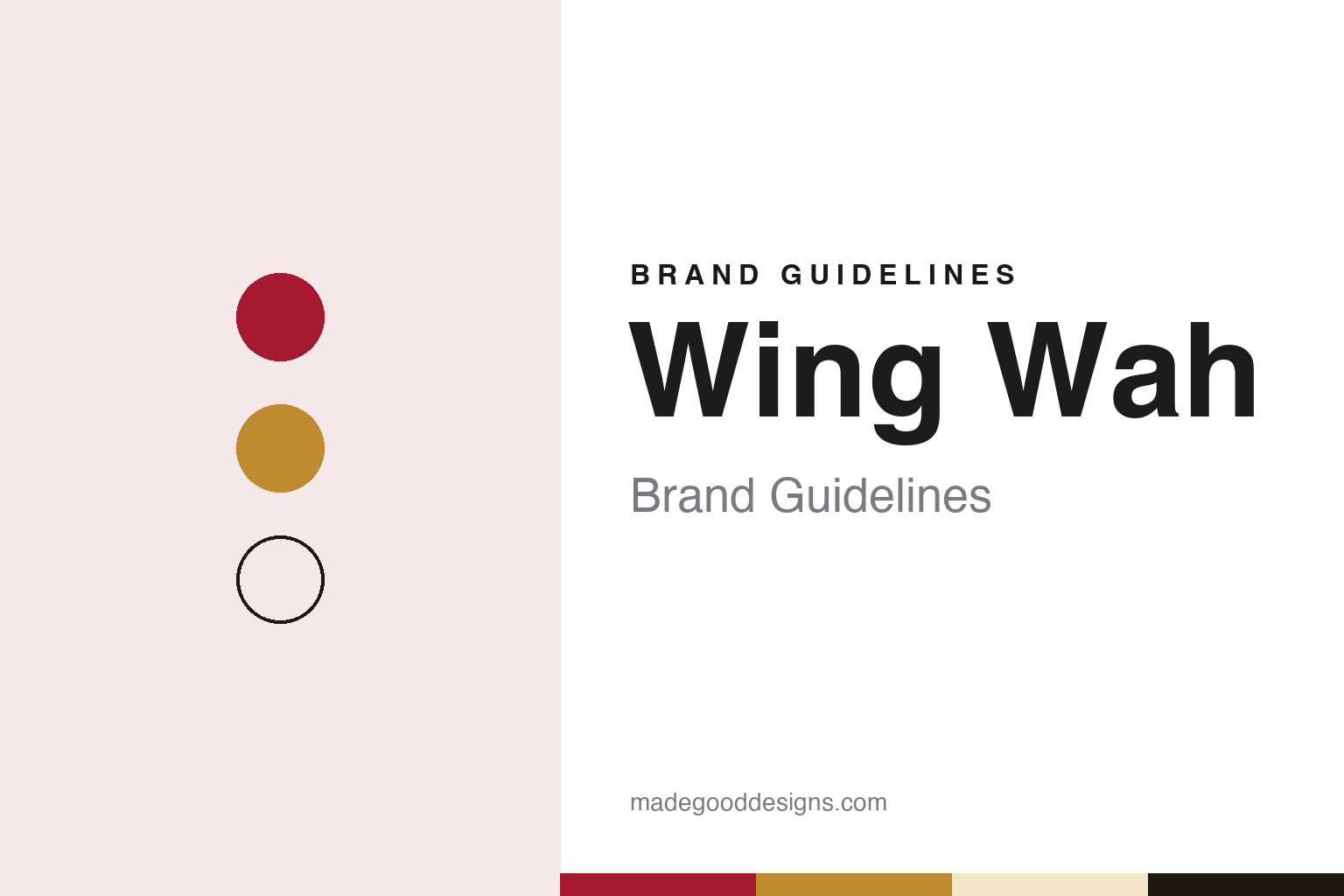
Two constants: a Wing Wah red, gold and lotus cream palette and a calligraphy and serif register. Abstract homage — not a Wing Wah product or mark; no box, tin, logo or label is reproduced.
A restaurant in Yuen Long
Four floors, a cake counter and a market town.
Wing Wah — 榮華 in Chinese — began in 1950 in Yuen Long, then a market town in the rural New Territories of Hong Kong. Chinese and English Wikipedia name its founders as 劉培齡 (Lau Pui Ling) and 趙聿修, and say the business started as a restaurant, 榮華酒樓, in a four-storey building, with a counter selling cakes to take away. The company tells the same story: “In 1950, we started our first restaurant in Yuen Long as our prime business,” its English website said in 2002, and in 2013 it described a “humble beginning at a corner of Yuen Long.”
The cake business grew out of the restaurant. Chinese Wikipedia says the firm became a limited company in 1962, and that in 1963 it first made a mooncake filled with white lotus seed paste, the product it is still best known for; the company’s own slogan calls it a “pioneer in white lotus seed paste.” A second restaurant opened on Lockhart Road in Wan Chai in 1967, and in 1975 a larger restaurant, Tai Wing Wah (大榮華), opened in Yuen Long, according to Chinese Wikipedia.
In the 1960s, the company said in 2013, it concentrated on cake manufacturing and set up a plant in Hong Kong with automated equipment. A 2004 version of its website says it bought its own bakery factory and opened a shop on Castle Peak Road, then added shops in Mong Kok, Kwun Tong, Aberdeen and Tsuen Wan in the 1980s. In the 1970s, the company says, it began selling mooncakes abroad, to cities in mainland China, the United Kingdom, the United States, Canada, Australia and New Zealand.
Colour
Mooncakes first, then everything around them.
The mooncake is the centre of the brand. Chinese Wikipedia records two advertising lines used for decades: 「清香嫩滑,零舍不同」, roughly “fragrant and smooth, quite unlike the rest,” and 「行船爭解纜,月餅我賣先」, which the company has rendered as “one step ahead in setting sail, leader in moon cake production.” The second line, Chinese Wikipedia says, refers to Wing Wah putting its mooncakes on sale soon after the Dragon Boat Festival, earlier than other makers. Snow-skin, or “icy,” mooncakes followed in 2007, according to the same source.
Around the mooncake sit the other products of a Cantonese cake shop. The company’s 2013 website listed “Wing Wah preserved meat sausages” and “fresh from oven wife cakes” among the foods it associates with Yuen Long, and its current ranges include Chinese sausage, wedding cakes (嫁囍禮餅), Chinese cakes, cookies, snacks and tea. In 2007, Chinese Wikipedia says, it opened two themed shops at Hong Kong International Airport, one named Wing Wah 50 and one given over to wife cakes.
The identity was reworked by two of Hong Kong’s best-known graphic designers. Chinese Wikipedia says that in 1997 the company hired Kan Tai-keung (靳埭強) and Freeman Lau (劉小康) as design consultants to redesign the company logo and develop new products, and that in 2010 the pair designed new packaging for the preserved-meat range; the wedding-cake series was redesigned in 2008. Chinese Wikipedia’s article on Kan Tai-keung lists 榮華餅家 among the brands he has worked for. As early as 2002 the company said it invested heavily in market research and packaging design.
Wing Wah says it was the first Chinese cake shop with retail branches at Hong Kong International Airport, opened in the late 1990s; Chinese Wikipedia dates the first airport shop and an online shop to 1998, and the first MTR station shop, at Mei Foo, to 2000. In 2006 it opened a multimedia tea house at Ngong Ping on Lantau.
Typography
Design and documentation.
The seven brands in this group all make food, and all of them come from Hong Kong or Singapore: Garden, Kee Wah, Maxim’s, Bee Cheng Hiang, Koon Chun, Kowloon Dairy and Wing Wah. Food brands from the two cities in general sit at many different points in the trade, from family firms that still carry a founder’s name to names that now belong to much larger groups, and a single brand can be sold everywhere from a neighbourhood shop to an airport counter.
A food brand’s identity is usually carried less by a single product than by a pack, a name and the meal, gift or festival it promises, because the company behind the name may have changed hands, moved its kitchens or grown far beyond the street where it started. That makes the questions behind each name worth asking plainly: who started it, who owns it now, and where its food is actually made and packed.
Each guide separates what independent sources record from what the company says about itself — its founding story, its owners over time, where its food is made and how its packaging has changed — and marks plainly what rests only on the company’s own word.
榮華
A Wei-stele calligraphic mark beside a serif. (Specimen set in Noto Serif TC, a serif STAND-IN; NOT the Wing Wah logo.)
Wing Wah
A Yuen Long base and a mark contested across the border.
The business is owned by Wing Wah Food Manufactory Limited (榮華食品製造業有限公司), the parent company named on its website and by Chinese and English Wikipedia; Wing Wah Cake Shop and the group’s restaurants trade under it.
Production has stayed close to Yuen Long. The company said in 2004 that its 23-storey Wing Wah Centre in Yuen Long, completed in the 1990s, was used for production and administration; Chinese Wikipedia says it became the group’s headquarters in 1992 and that a factory was set up in Dongguan, in Guangdong, in 1994 to serve the mainland market. Its website lists delivery to Hong Kong, Macau, the mainland, Taiwan, the United States, Australia and New Zealand.
Across the border the name has been contested. Chinese Wikipedia says Wing Wah’s mooncakes entered the mainland in 1979 without a registered trademark there, and that a long series of cases followed against 蘇氏榮華, a separate food company in Shunde, Guangdong; it says that in December 2023 China’s Supreme People’s Court, on retrial, upheld a 2012 judgment, leaving the Hong Kong company to use 「榮華月餅」 written left to right in Wei-stele (魏碑) calligraphic script. Wing Wah also sells mooncakes under the marks 元朗榮華 (“Yuen Long Wing Wah”) and WING WAH, Chinese Wikipedia says.
The company lists its recognition: the Hong Kong Brand Development Council’s Top Brand Ten Year Achievement Award in 2008, the Hong Kong Productivity Council’s Best Brand Enterprise Award in 2006 and the Hong Kong Q-Mark, among others. Chinese Wikipedia adds that in 1999 it was among the first winners of the Top Ten Hong Kong Brands award from the Chinese Manufacturers’ Association of Hong Kong. Since 1989, according to English Wikipedia, it has made community mooncakes each Mid-Autumn Festival to raise money for The Community Chest of Hong Kong.
For a design guide, Wing Wah shows how a seasonal product can carry a whole company’s name, and how a calligraphic mark can matter enough to be fought over in court. Compare Kee Wah, another Hong Kong cake shop known for mooncakes, Garden, a Hong Kong bakery that Chinese Wikipedia also lists among Kan Tai-keung’s clients, and Lee Kum Kee. For this guide we use a lantern red, a mooncake gold and a lotus-paste cream with a serif, an unofficial interpretation; no product or logo is reproduced.
Explore & save
Keep Wing Wah’s identity on hand — save it to a board in the Made Good inspiration library.
Wing Wah identity set
Pin the Wing Wah red, gold and lotus cream palette and the calligraphy and serif register to your own board.