Mazoon Brand Guidelines
Oman’s integrated dairy at As’Sunainah.
Aa
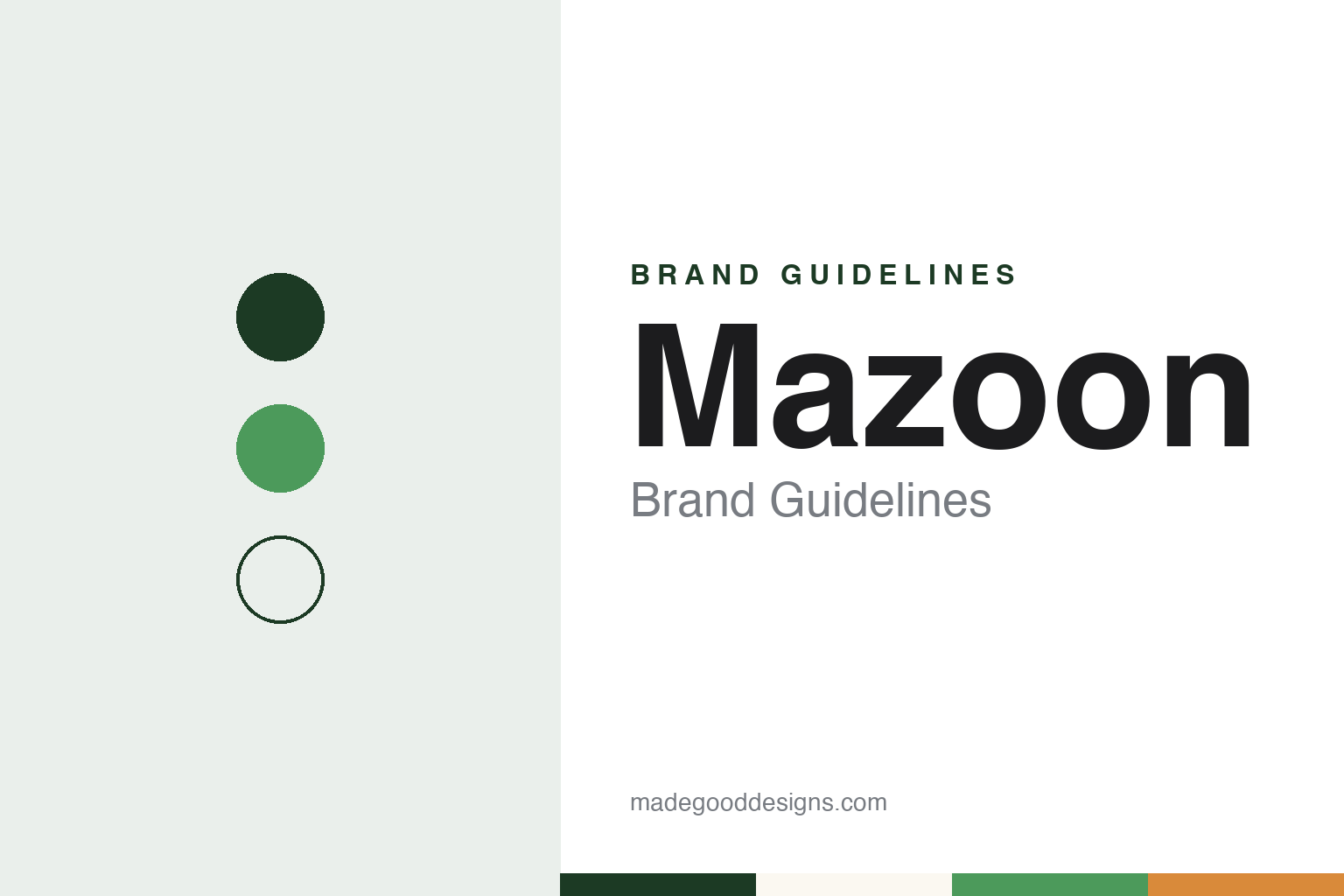
Two constants: a grove green, leaf green and fresh cream palette and a fluid humanist sans register. Abstract homage — not a Mazoon product or mark; no pack, carton or logo is reproduced.
A dairy built from scratch
A closed joint stock company and a site in Al Buraimi.
Mazoon is a young brand with an unusually precise start date. Mazoon Dairy Company SAOC, the Omani firm behind it, says it was incorporated on 1 January 2015 as a closed joint stock company, set up to build a fully integrated dairy and juice business inside the Sultanate under Oman’s national food-security initiative. Its stated aims, as listed on its company profile, were to raise self-sufficiency in dairy production, build skills in food manufacturing and create local jobs and opportunities for small Omani suppliers.
The shareholders were institutional. In 2020 the company’s investors page named Oman Food Investment Holding Company alongside National Industries & Resources Company, Oman Dairy Products and Derivatives, the Civil Service Pension Fund, the Royal Office Pension Fund and Al Hosn Investment Company. A company release from October 2020 described Mazoon as launched within the initiatives of Oman Food Investment Holding Company, which it said was owned by the Oman Investment Authority, the state investment body.
The site was the project. The company says it chose As’Sunainah (also spelt Al Sunainah) in the Al Buraimi Governorate, near Oman’s border with the UAE, and that the facility spreads over about 15 square kilometres. The foundation stone was laid on 18 October 2017, the company says. The plan combined a dairy farm with capacity for more than 25,000 cows, a central processing plant rated at more than a million litres of liquid milk a day, staff housing, a wastewater-treatment plant and a biogas plant. The company said the farm began with a herd of 3,500 milking cows, and that the target was to reach 25,000 by 2026.
Colour
From fresh milk and laban to juices and cheese.
Mazoon reached shops in October 2019. A company release marking its first anniversary says distribution began on 20 October 2019 with fresh milk and fresh laban in the governorates of Muscat and North Al Batinah, and that the brand covered every governorate of Oman within its first hundred days; a second-anniversary release a year later gives the launch date as 19 October. The integrated facility at As’Sunainah was formally inaugurated under the sponsorship of Oman’s Minister of Agriculture, Fisheries and Water Resources, according to a ministry statement the company republished, which also called Mazoon the first wholly Omani company in the sector.
The range widened quickly. By its own counts the company had about 160 products by October 2021 and about 190 by early 2022, spanning fresh and long-life milk, flavoured milk, laban and laban drinks, a line called Mazoon up, yoghurt, labneh, cream, cheese, ice cream and juices. In December 2021 it announced its first long-life juice, an orange juice in a one-litre pack, with smaller sizes and other flavours to follow.
Exports followed. At the Gulfood trade fair in Dubai in February 2022, Mazoon announced an exclusive distribution agreement with Ghassan Aboud Trading Group for its full range in the UAE, signed by Mazoon’s chairman, Mohammed bin Sulaiman Al Harthy, and Ghassan Aboud. In the same release the company said its products were exported to 20 countries.
Typography
Design and documentation.
The seven brands in this group all make food and drink, and they come from the United Arab Emirates, Saudi Arabia and Oman: Al Kabeer, Sunbulah, Al Rawabi, Mazoon, Lacnor, Al Ain and Rani. Gulf food and drink brands in general sit at many different points in the trade, from family firms that still carry a founder’s name to names that now belong to much larger food groups, and a single brand can be sold everywhere from a corner grocery to a hypermarket aisle.
A food or drink brand’s identity is usually carried less by a single product than by a pack, a name and the meal or refreshment it promises, because the company behind the name may have changed hands, moved its factory or grown far beyond the town where it started. That makes the questions behind each name worth asking plainly: who started it, who owns it now, and where its products are actually made and packed.
Each guide separates what independent sources record from what the company says about itself — its founding story, its owners over time, where its products are made and how its packaging has changed — and marks plainly what rests only on the company’s own word.
Aa
A fluid humanist sans for a logo the company calls lively and fluid. (Specimen set in Lexend, a sans STAND-IN; NOT the Mazoon logo.)
Mazoon
A logo from a tree and two Omani brand awards.
Mazoon has explained its logo in public. On its brand-story page in 2020 the company said its visual identity was meant to show “a vibrant, progressive and dynamic society,” and described the logo as “lively, energetic and fluid.” It gave the mark an origin story: the logo, it said, stems from the first tree planted on the As’Sunainah site, which it presents as a symbol of the cycle of life and of a story spanning “the old and the new.” The company does not name a designer, and it does not publish colour codes or typefaces.
The brand leans on national identity. The company described itself in 2020 as “proudly Omani” and as the flagship food company of the Sultanate, and its releases stress its Omani identity and its role as a supplier and employer for Omani businesses and graduates. It has also run community programmes in Al Buraimi, including school events and awards for outstanding students, and in March 2022 it held the first Mazoon Business Forum for entrepreneurs in the governorate.
Recognition has come from Omani brand awards. The company reported in April 2023 that Mazoon had been named the most trusted brand in the dairy category for 2022, for the second year running, at awards organised by Al Qimma Media; in March 2023 it reported that Mazoon was among Oman’s 100 strongest brands in the food category, in a survey run by the economic magazine Alam Al Iqtisad of United Media Services with the Arab Research House.
For a design guide, Mazoon shows how a brand with no history can write one into its mark, tying a logo to a single tree on a new site. Compare Al Rawabi, the Dubai dairy that says it reached Oman in 1992, and Almarai, the Saudi dairy built around Al Kharj. For this guide we use grove green, leaf green and fresh cream with a fluid humanist sans, an unofficial interpretation; no product or logo is reproduced.
Explore & save
Keep Mazoon’s identity on hand — save it to a board in the Made Good inspiration library.
Mazoon identity set
Pin the Mazoon grove green, leaf green and fresh cream palette and the fluid humanist sans register to your own board.