Marilan Brand Guidelines
The Marília biscuit maker still run by the Garla family.
Aa
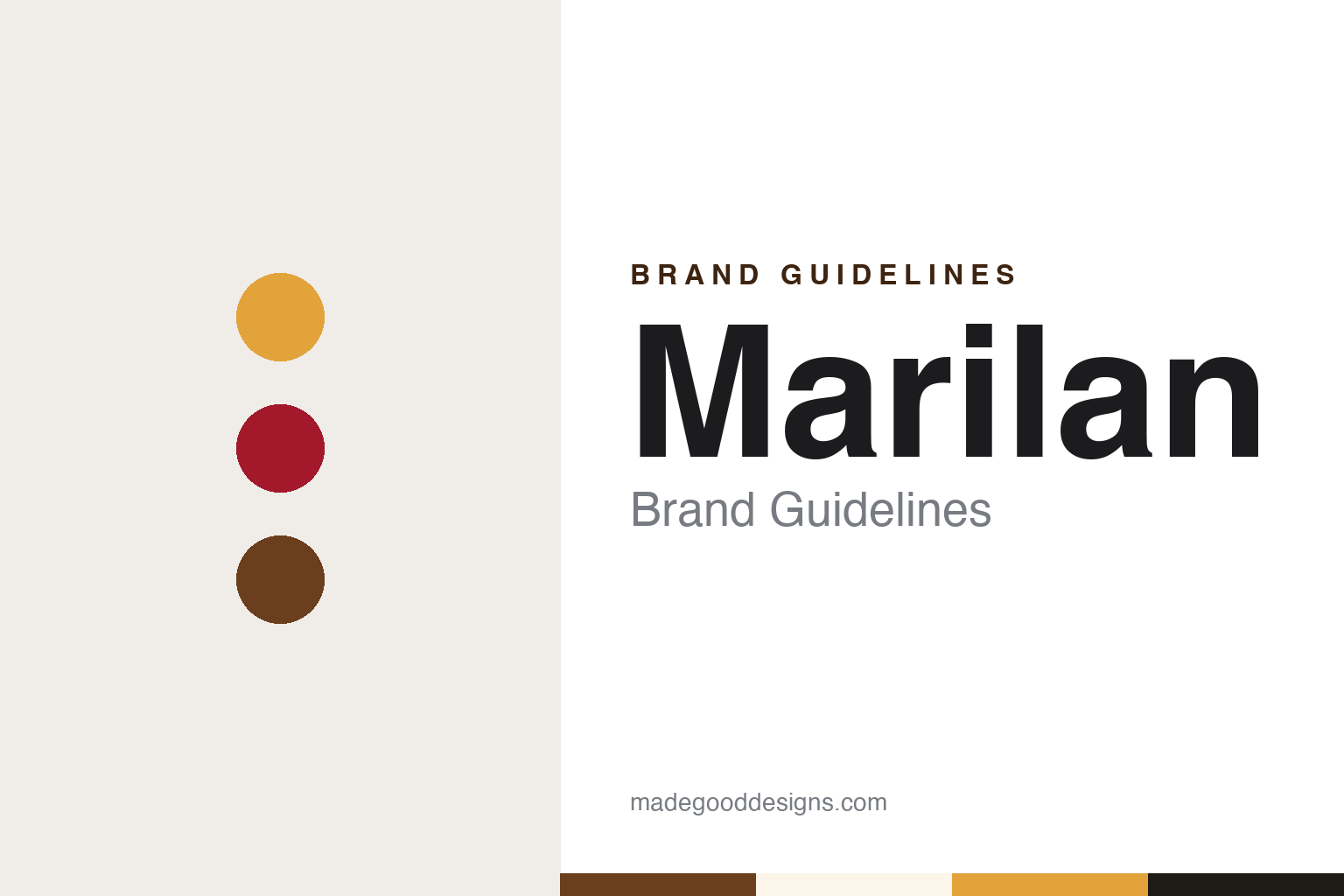
Two constants: a biscuit gold, oven brown and flour cream palette and a rounded friendly sans register. Abstract homage — not a Marilan product or mark; no pack, logo or biscuit is reproduced.
A wood-fired oven in Marília
A couple, a modest building and four first biscuits.
Marilan is a biscuit maker from Marília, a city in the interior of São Paulo state, and it is still run by the family that founded it. The company says its story began in 1956, when Maximiliano Garla and Iracema Fontana Garla decided to make a product of quality for people to enjoy. The business itself opened the following year: Portuguese Wikipedia, citing the company, says the Indústria de Biscoitos Marilan Ltda. was inaugurated on 31 March 1957 in a modest building in Marília. The business magazine Exame likewise dates the company, founded by the Garla family, to 1957 in Marília.
The start was small. The company says it began with a production of 300 kilograms an hour, and Portuguese Wikipedia says the first biscuits — Maria, Água e Sal (a water cracker), coconut and Maizena — came out of a bakery-style oven heated with firewood. Those are the everyday biscuit types still at the centre of the range: Exame wrote in 2025 that the company is known for cream crackers, Maizena biscuits, sandwich biscuits and rosquinhas, the small ring biscuits sold across Brazil.
Growth came in steps. In the 1970s the Garla family decided to invest in a new industrial site, and in 1976 a new industrial park of 67,000 square metres opened, with 250 employees at the time, the company and Portuguese Wikipedia say; processes that had been manual gave way to automated equipment. By 1990, the company says, its annual output of biscuits had reached 84,000 tonnes, made with more than 1,300 direct employees. In 2011 Exame reported that from its Marília plant the company distributed its products across Brazil and exported them to more than 50 countries.
Colour
Teens, Lev, Pit Stop and a new identity.
Marilan’s portfolio widened at the turn of the century. The company says it launched the Teens and Lev brands in 2001 — Lev being the home of its Magic Toast crispbreads — and the Pit Stop brand in 2002. Magic Toast has had a second life online. Exame reported in May 2025 that the product had become a digital phenomenon, spread largely on TikTok spontaneously by accounts sharing recipes and eating tips, and that its sales in March 2025 were 50% higher than in the same month of 2024, according to the company.
The factory grew with the brands. In 2016, the company says, an expansion raised production capacity by around 40%, to about 220,000 tonnes of biscuits a year; Exame gave the same figure in 2025, across 21 production lines and 53,000 square metres of built area. The family’s names are written into the buildings. The company says it opened its corporate headquarters, named the Sede Corporativa Maximiliano Garla, in 2017, and in 2020 opened an industrial unit in Igarassu, in the north-eastern state of Pernambuco, named after Iracema Fontana Garla.
The brand’s current look dates from 2019. The company lists that year as the moment of a repositioning and new visual identity for the Marilan brand. The company also says that its products are present in more than 70% of Brazilian homes and that its portfolio runs to more than 200 items, spanning biscuits, toasts, cakes, small cakes, panettones and chocolates; Exame put the portfolio at more than 300 products in 2025.
Typography
Design and documentation.
The seven brands in this group all make food, and all of them come from Brazil: Sadia, Perdigão, Seara, Aurora, Bauducco, Marilan and Itambé. Brazilian food brands in general sit at many different points in the trade, from family firms that still carry a founder’s surname to cooperatives and names that now belong to much larger food groups, and a single brand can be sold everywhere from a neighbourhood market to a national supermarket chain.
A food brand’s identity is usually carried less by a single product than by a pack, a name and the meal or snack it promises, because the company behind the name may have changed hands, moved its factories or grown far beyond the town where it started. That makes the questions behind each name worth asking plainly: who started it, who owns it now, and where its food is actually made and packed.
Each guide separates what independent sources record from what the company says about itself — its founding story, its owners over time, where its products are made and how its packaging and advertising have changed — and marks plainly what rests only on the company’s own word.
Aa
A rounded friendly sans for an everyday biscuit brand. (Specimen set in Nunito, a sans STAND-IN; NOT the Marilan logo.)
Marilan
A third generation, three acquisitions and five factories.
Marilan remains a family company. Exame reported in May 2025 that it is led by the third generation of the Garla family, with Rodrigo Garla as chief executive since 2019, and that the business became a sociedade anônima, a corporation with a board and more structured governance, in 2013. Portuguese Wikipedia describes it as a privately held company.
Since 2021 the group has grown by buying other Brazilian brands. The company says it acquired Casa Suíça, which Exame describes as one of the main makers of cakes and panettones, in 2021. In March 2024 it announced the purchase of Top Cau, a chocolate maker founded in 1994 in the Pari district of São Paulo; the general superintendency of CADE, Brazil’s competition authority, approved the deal without restrictions on 2 May 2024, the trade site Mercado&Consumo reported. In 2025 it added Festtone, a panettone brand that Exame says came with the purchase of Siena Alimentos and leads the market in southern Brazil. “The market is changing. You can’t be just biscuits today,” Rodrigo Garla told Exame, in our translation. The group now trades as Grupo Marilan, with the brands Marilan, Casa Suíça, Pit Stop, Lev, Teens, Top Cau and Festtone.
Where it makes things is set out on its own site. The company says it has five factories: in Marília, Jandira and São Paulo, in São Paulo state; in Igarassu, Pernambuco; and in São José dos Pinhais, Paraná. It says it has more than 4,500 employees and more than 20 factory shops in São Paulo state; Exame put the workforce at about 5,000 in 2025, rising towards 6,000 in the Easter and Christmas seasons, and counted 160,000 points of sale and 30 of the group’s own shops. On exports the figures differ: the company says it is present in more than 30 countries, while Exame reported in 2025 that its products are exported to more than 50 countries but still make up only 3% of revenue.
For a design guide, Marilan shows how a regional biscuit maker can keep a family name and an everyday range while adding cakes, panettone and chocolate. Compare Piraquê, the Rio de Janeiro biscuit maker, and Bauducco, the São Paulo panettone and biscuit brand. For this guide we use a biscuit gold, an oven brown and a flour cream with a rounded sans, an unofficial interpretation; no product or logo is reproduced.
Explore & save
Keep Marilan’s identity on hand — save it to a board in the Made Good inspiration library.
Marilan identity set
Pin the Marilan biscuit gold, oven brown and flour cream palette and the rounded friendly sans register to your own board.