Bauducco Brand Guidelines
The Brás panettone shop that became a Guarulhos bakery group.
Aa
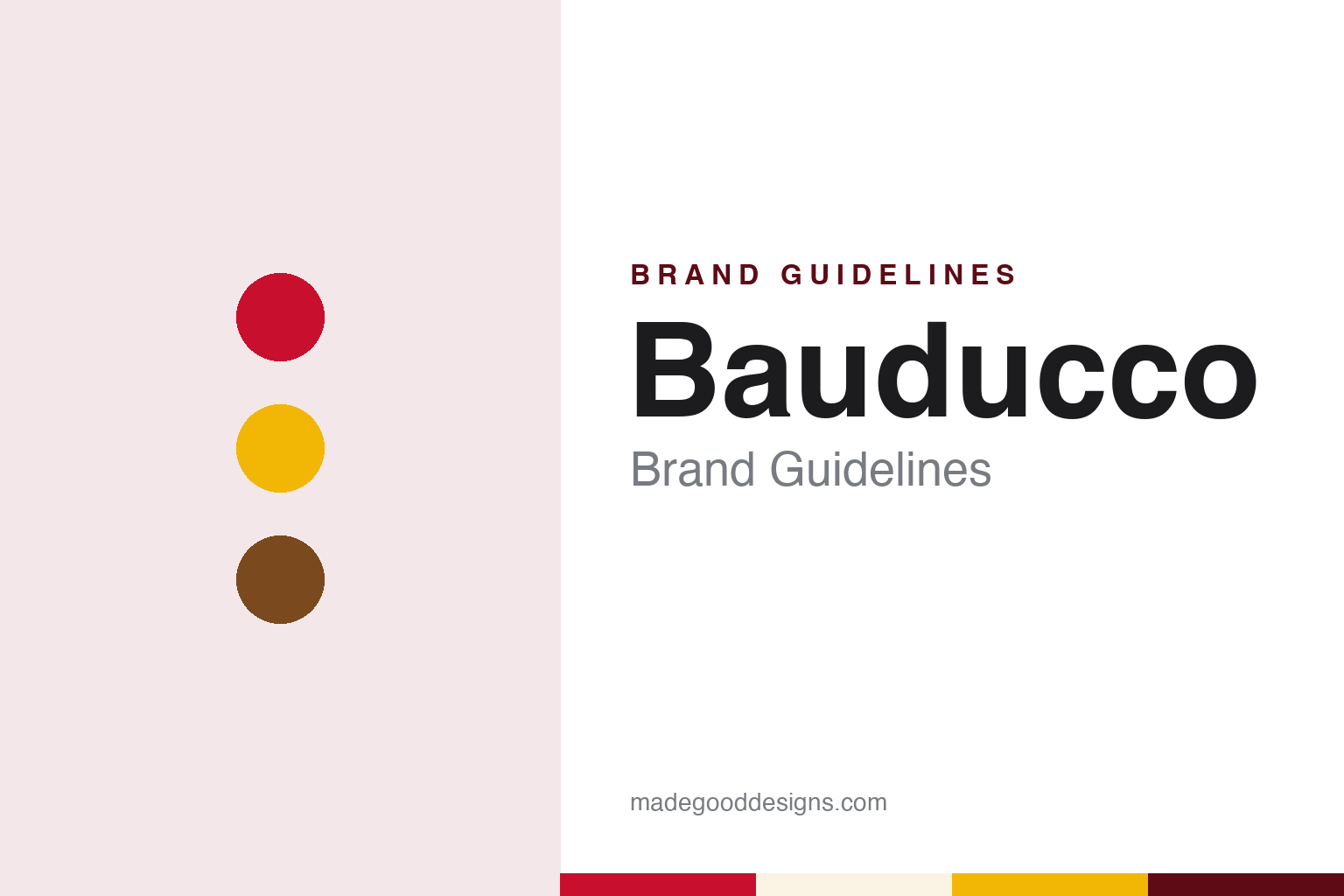
Two constants: a panettone red, crust gold and cream palette and an Italianate display serif register. Abstract homage — not a Bauducco product or mark; no pack, logo or panettone is reproduced.
A sweet shop in Brás
A Turin baker, a piece of live dough and a law that changed.
Bauducco is the panettone brand of Pandurata Alimentos, a family-owned food company based in Guarulhos, in greater São Paulo. Its founder, Carlo Bauducco, came from Turin. The company’s own history says he first arrived in Brazil in 1948, bringing a family recipe and a piece of live sourdough, the massa madre, with the idea of opening his own business in São Paulo. Portuguese Wikipedia, citing the company and the São Paulo history site SP In Foco, says the trip began with a consignment of bread-making machines he had shipped to Brazil, and that he went back to Turin resolved to sell up and move his wife and son to the city, which had a large Italian community.
He returned in 1950, Portuguese Wikipedia says, with a confectioner friend, Armando Poppa. At the time Brazilian law required a foreigner to have a Brazilian partner to open a firm. When that rule ended, in 1952, the family opened its own Doceria Bauducco, a small sweet shop in the São Paulo district of Brás. The company says it was there that Carlo, his wife Margherita and their son Luigi made the first Panettone Bauducco. Portuguese Wikipedia adds that the shop also sold champagne biscuits, sweets, savouries and petit fours, and that Carlo once had leaflets for his products dropped over central São Paulo from an aeroplane. It credits him with introducing panettone to Brazil, citing a 2013 report by the Italian news agency ANSA carried by the Brazilian portal UOL.
The decisive step came ten years later. In 1962, with orders arriving from across the country, Bauducco opened its first factory in Guarulhos and began industrial production of its panettone, according to both the company and Portuguese Wikipedia. By then, the company says, its panettone had won a place on Brazilian family tables, as had its champagne biscuit.
Colour
A box, a family on television and a chocolate panettone.
Bauducco’s own history gives unusually specific dates for its design. Until 1965, the company says, its panettones were wrapped by hand in tissue paper, which looked attractive but was not practical. That year Carlo Bauducco worked with a designer named Giorgio Bricarello on an industrial pack: a box printed with a São Paulo landscape, an Italian landscape and the panettone between them, according to a recollection by Giorgio Picca, whom the company describes as its first employee. The first printer to make those boxes, Picca says, was Brasil Gráfica, which the company still lists as a supplier. The company says the box let its panettones reach every part of Brazil fresh and intact.
Television followed. In 1972, the company says, its first advertising campaigns ran on TV, showing Carlo with his son preparing recipes for the whole family, under the idea that everything Bauducco makes comes “from the heart,” from the Bauducco family to yours. In 1978 a grandson, Massimo Bauducco, created the Chocottone, a chocolate panettone, as a college marketing project; in the company’s telling, his father and Picca saw the work, agreed to make it, and it became one of the firm’s major products.
The brand’s present look is newer. The company says that at the end of the 1990s it adopted the red and yellow visual identity now associated with the brand. It has continued to use the founding story as a selling point: the company says the same massa madre Carlo brought from Italy is still used in its naturally leavened products, kept fed with a flour whose composition it keeps secret. Portuguese Wikipedia says the mother dough is kept in a kind of bunker at the company’s factory in Extrema, Minas Gerais. In 2014, the company says, it launched Bauducco Cereale, a line made with wholegrain cereals.
Typography
Design and documentation.
The seven brands in this group all make food, and all of them come from Brazil: Sadia, Perdigão, Seara, Aurora, Bauducco, Marilan and Itambé. Brazilian food brands in general sit at many different points in the trade, from family firms that still carry a founder’s surname to cooperatives and names that now belong to much larger food groups, and a single brand can be sold everywhere from a neighbourhood market to a national supermarket chain.
A food brand’s identity is usually carried less by a single product than by a pack, a name and the meal or snack it promises, because the company behind the name may have changed hands, moved its factories or grown far beyond the town where it started. That makes the questions behind each name worth asking plainly: who started it, who owns it now, and where its food is actually made and packed.
Each guide separates what independent sources record from what the company says about itself — its founding story, its owners over time, where its products are made and how its packaging and advertising have changed — and marks plainly what rests only on the company’s own word.
Aa
An Italianate display serif for a panettone brand with roots in Turin. (Specimen set in Playfair Display, a serif STAND-IN; NOT the Bauducco logo.)
Bauducco
Pandurata, its factories, Visconti and a chain of shops.
The company behind the brand was once called Bauducco & Cia and is now Pandurata Alimentos, owned by the Bauducco family, Portuguese Wikipedia says. In the early 1990s, the company says, demand for panettone and new products led it to open a second factory, also in Guarulhos. Portuguese Wikipedia lists production in Guarulhos and in Extrema, in Minas Gerais, and cites the newspaper Diário de Guarulhos, which reported in December 2009 that the company employed about 1,300 people in Guarulhos and about 2,700 more elsewhere in Brazil. Its range now runs from panettone to wafers, toasts, cakes and biscuits.
Bauducco began exporting in 1979, when its first panettone reached the United States by ship, according to the company and Portuguese Wikipedia. The company now says its panettones go to more than 50 countries.
Pandurata also owns other panettone names. Portuguese Wikipedia lists Visconti and Tommy among its brands. Visconti began in São Paulo in 1962 making panettone; in 1982 it merged with Agis, a São Roque maker of crystallised fruit founded by Italians in 1960, to form Visagis, which kept the Visconti name on its products, Portuguese Wikipedia says. In January 2008 Hershey and Pandurata announced a joint venture in Brazil, giving the Bauducco family 49% of Hershey’s Brazilian subsidiary and putting Hershey chocolate into Bauducco’s sales network of more than 130,000 points of sale, according to the business site Investimentos e Notícias and Brazil’s competition authority CADE, as cited by Portuguese Wikipedia.
The brand also has its own shops. The company says Casa Bauducco opened in 2012, selling special panettones, focaccias, brownies and biscuits, and had reached 49 outlets in the states of São Paulo, Rio de Janeiro and Paraná by 2017. In 2025 Exame noted that Casa Bauducco sells slices of panettone all year round. In January 2024 Folha de S.Paulo and the site Tenis News reported that the Brazilian tennis player Beatriz Haddad Maia had signed a sponsorship deal with Bauducco.
For a design guide, Bauducco shows how a boxed panettone and a family story can carry a São Paulo bakery brand from one shop to a national name. Compare Piraquê, the Rio de Janeiro biscuit maker, and Bauli, the Verona pandoro and panettone maker. For this guide we use a panettone red, a crust gold and a cream with a display serif, an unofficial interpretation; no product or logo is reproduced.
Explore & save
Keep Bauducco’s identity on hand — save it to a board in the Made Good inspiration library.
Bauducco identity set
Pin the Bauducco panettone red, crust gold and cream palette and the Italianate display serif register to your own board.