Mount Gay Brand Guidelines
The Barbados rum with a 1703 deed.
Aa
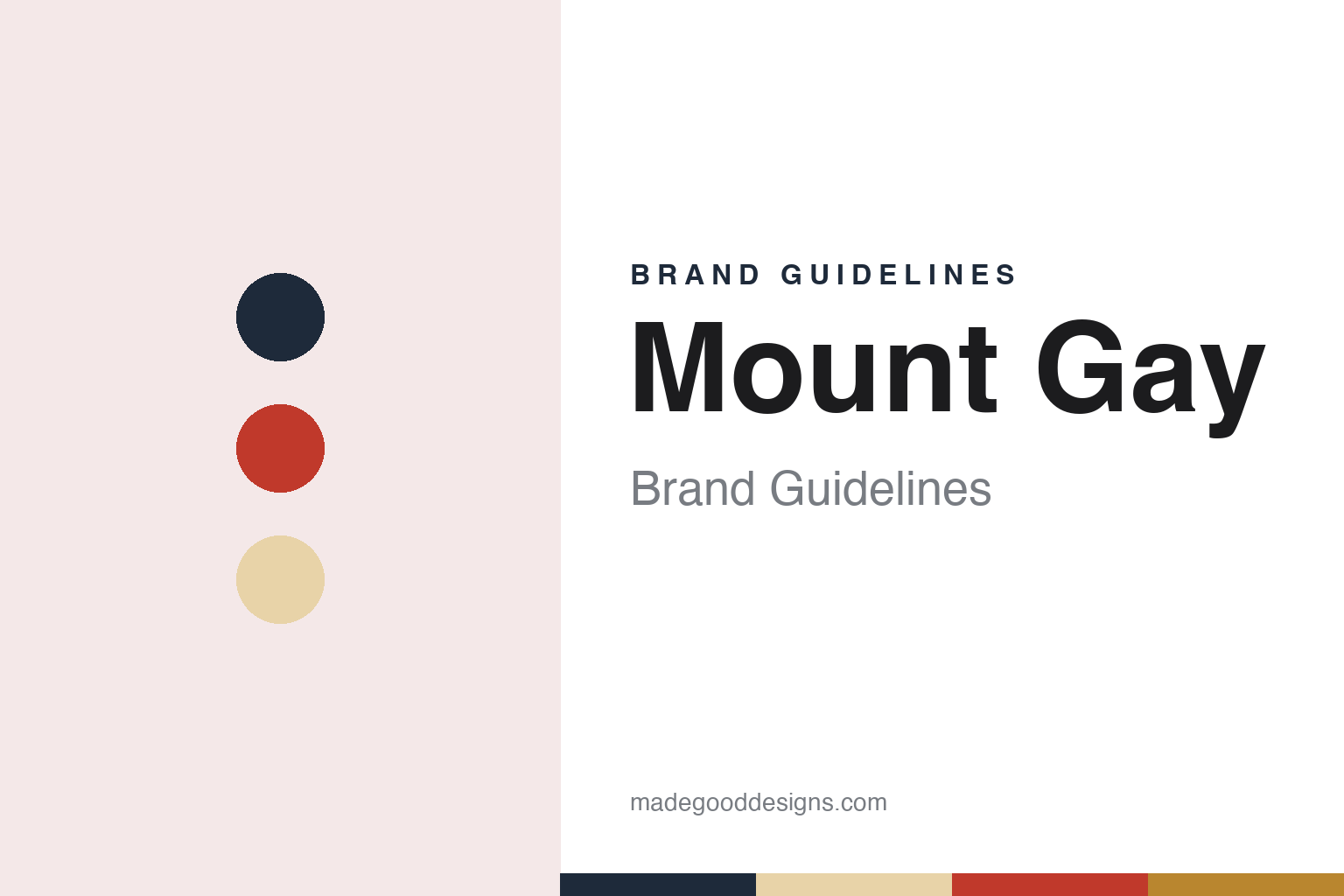
Two constants: a regatta red, Atlantic navy and Eclipse gold palette and a bookish serif register. Abstract homage — not a Mount Gay product or mark; no bottle, label or cap is reproduced.
Mount Gilboa
A deed, a plantation and a manager’s middle name.
Mount Gay is made in the parish of St Lucy, at the northern tip of Barbados. Its claim to age rests on paper: English Wikipedia says the oldest surviving deed for the company dates from 1703, and its owner, Rémy Cointreau, says the oldest property deed dates from February 1703 and calls Mount Gay the oldest brand of rum in the world. The company describes the operation as the world’s oldest running rum distillery, a claim Forbes repeated in 2018, and calls Barbados “the birthplace of rum.” Rémy Cointreau also says the distillery draws water from an artesian well that it says was first dug in 1703.
The name came later. Forbes, in a 2018 profile by Joe Micallef, says the business was originally the Mount Gilboa plantation and distillery, which John Sober bought from William Sandiford in 1747. Sober asked a trusted friend, John Gay Alleyne, to manage it, and under Alleyne the distillery became known for the quality of its rum. Alleyne also sat in the Barbados Parliament for some forty years, twice serving as Speaker of the House of Assembly.
When Alleyne died in 1801, the distillery was renamed in his honour. Because Barbados already had a Mount Alleyne, it took his middle name instead, and became Mount Gay, Forbes and English Wikipedia both say. Through the twentieth century the business was run by the Ward family, English Wikipedia says; the last family member to manage the distillery was Frank Ward.
Colour
Eclipse, XO and a red cap at the finish line.
The best-known Mount Gay rum is Eclipse. Rémy Cointreau dates it to 1910; English Wikipedia says it was developed in 1911 and named after the total solar eclipse and the passage of Halley’s Comet in 1910. Rémy Cointreau dates XO, the brand’s first extra-old rum, to 1994. Today the company groups its rums into a core range — Silver, Eclipse, Black Barrel and XO among them — plus cask-strength bottlings, exceptionally aged rums, a Single Estate Series and a Master Blender Collection, which Rémy Cointreau says began in 2018.
The brand’s visual life has long been tied to sailing. English Wikipedia says Mount Gay sponsors more than a hundred regattas worldwide and gives its distinctive red caps to top competitors; in 2022 it became official sponsor of Cowes Week, the regatta held off the Isle of Wight, The Spirits Business reported. The rum also marks national occasions: for the 50th anniversary of Barbados’s independence in November 2016 it released a limited XO Cask Strength in a wooden box with a booklet on the history of rum in Barbados, with part of the sales going to the Barbados Museum and Historical Society, The Spirits Business reported. In 2023 it marked its 320th year with Black Barrel Cask Strength, its first rum sold only at the distillery and its visitor centre.
Bottles and labels were last reset in 2020. In March that year The Spirits Business reported a brand reset from April 2020 that included a new bottle design for the core range and updated labels intended to give drinkers more transparency about what is in the bottle, alongside a new blend for Black Barrel and a broader selection of rums for XO. The rum is a blend of pot and column still spirit, Forbes wrote in 2018, with a retort on the still and ageing mostly in former American bourbon casks.
Typography
Design and documentation.
The seven brands in this group all make beer or rum, and all of them come from the Caribbean: Presidente, Brugal, Barceló, Red Stripe, Appleton Estate, Mount Gay and Carib. Caribbean drink brands in general sit at many different points in the trade, from family firms that still carry a founder’s surname to names that now belong to much larger drinks groups, and a single brand can be sold everywhere from a rum shop to an airport duty-free shelf.
A drink brand’s identity is usually carried less by a single product than by a bottle, a label and the place it promises, because the company behind the name may have changed hands, moved its brewing or bottling or grown far beyond the island where it started. That makes the questions behind each name worth asking plainly: who started it, who owns it now, and where its beer or rum is actually made and bottled.
Each guide separates what independent sources record from what the company says about itself — its founding story, its owners over time, where its drinks are made and how its labels have changed — and marks plainly what rests only on the company’s own word.
Aa
A bookish serif for a rum that dates itself by a deed. (Specimen set in Libre Baskerville, a serif STAND-IN; NOT the Mount Gay logo.)
Mount Gay
A Cognac house, an estate and a new master blender.
Mount Gay belongs to Rémy Cointreau, the family-controlled spirits group based in Cognac, France. English and French Wikipedia both say the group acquired Mount Gay Rum in 1989, and English Wikipedia describes Rémy Cointreau as the majority shareholder of Mount Gay Distilleries since then; Rémy Cointreau’s own brand page dates Mount Gay’s entry into the group to 2014. The distillery sits in St Lucy, and the brand runs a visitor centre near Bridgetown, English Wikipedia says.
Under Rémy Cointreau the brand has moved closer to the land. Rémy Cointreau says that in 2015 Mount Gay acquired 324 acres of the historic Mount Gay and Oxford estates, giving it control from sugar cane to bottling. Forbes reported in 2018 that Barbados rum makers had for decades relied mostly on molasses imported from Guyana, and that Mount Gay had begun to grow its own cane to make its own molasses. In 2021 the brand appointed Maggie Campbell as estate rum manager, and in 2023 it launched a Single Estate Series, The Spirits Business reported.
The blending desk has changed hands too. In April 2019 The Spirits Business reported that Trudiann Branker, who joined the company in 2014 as a quality assurance manager, had become Mount Gay’s first female master blender after a five-year apprenticeship with Allen Smith. The magazine said Smith had been master blender since 2005 and had brought XO and the 1703 blend to market; Rémy Cointreau gives his tenure as 2010 to 2019. Branker has described herself as the first female master blender in Barbados.
For a design guide, Mount Gay shows how a dated deed, a manager’s middle name and a red sailing cap can give a rum brand its story. Compare Appleton Estate, the Jamaican rum that dates itself to 1749, and Brugal, the Dominican rum house. For this guide we use regatta red, Atlantic navy and an Eclipse gold with a serif, an unofficial interpretation; no product or logo is reproduced.
Explore & save
Keep Mount Gay’s identity on hand — save it to a board in the Made Good inspiration library.
Mount Gay identity set
Pin the Mount Gay regatta red, Atlantic navy and Eclipse gold palette and the bookish serif register to your own board.